By Marvin Gandis
Many online marketers believe that the secret to more sales is stronger pressure.
- More urgency.
- More hype.
- More “buy now” messages.
- More aggressive calls to action.
But in today’s online world, pressure does not always create trust. In many cases, it creates resistance.
People are tired of being pushed. They see offers every day. They receive emails, ads, posts, videos, messages, promotions, and promises from every direction.
Because of that, the real winning strategy is not always louder marketing.
- It is clearer marketing.
Clarity beats pressure because a confused prospect rarely takes action.
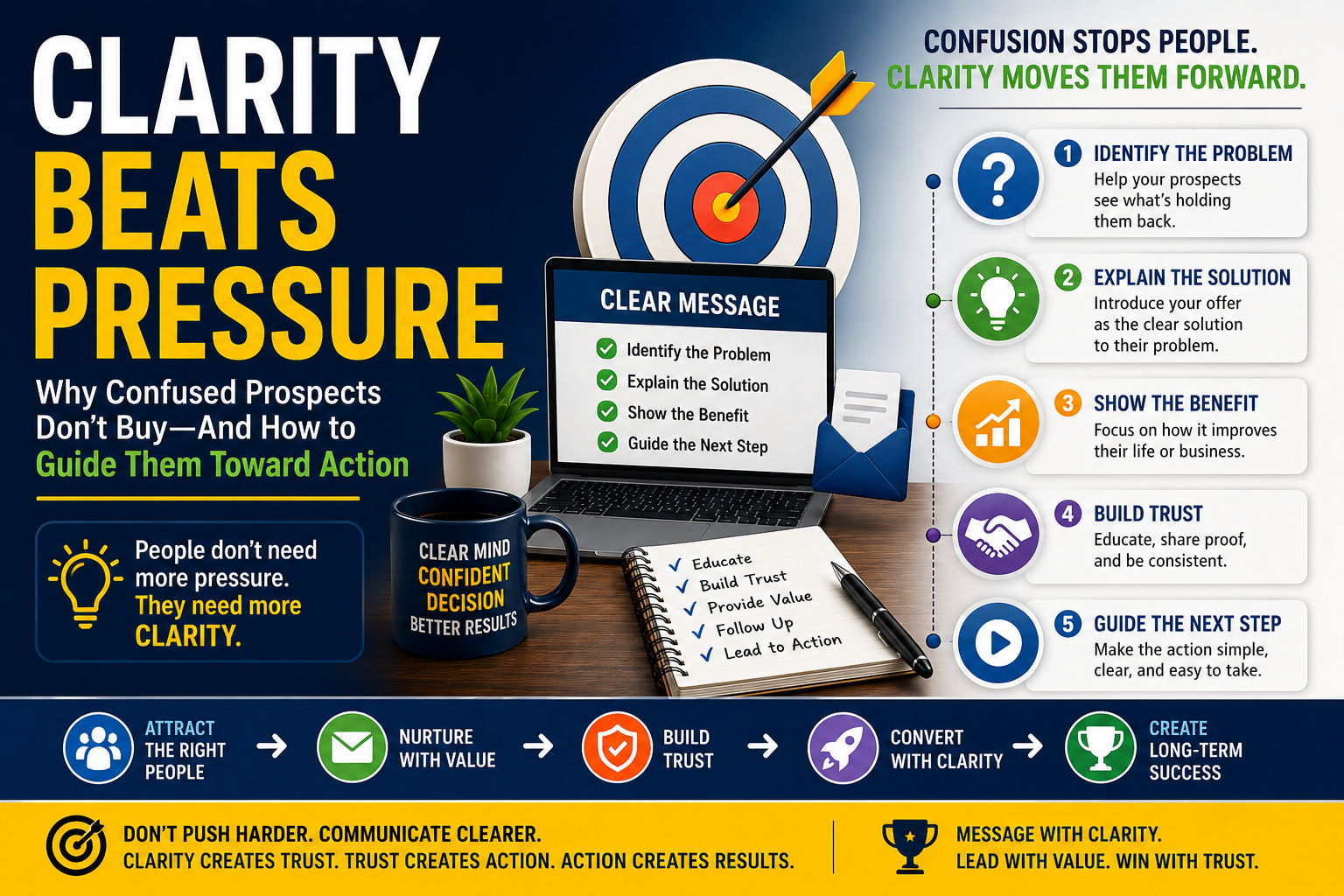
When people understand the problem, the solution, the benefit, and the next step, they are more likely to move forward with confidence.
But when they feel confused, rushed, overwhelmed, or suspicious, they usually leave.
That is why your goal as a marketer should not be to force people into a decision.
Your goal should be to guide them into understanding.
Confusion Is One of the Biggest Conversion Killers
A person may be interested in your offer and still not take action.
- Why?
Because interest alone is not enough.
They may wonder:
- What exactly is this?
- How does it work?
- Is this for beginners?
- What do I receive?
- What happens after I sign up?
- Is this a product, a service, a system, or an opportunity?
- How much time will it take?
- Can I trust this?
- What should I do first?
If your message does not answer those questions clearly, the prospect may not say “no.”
- They may do nothing.
And in online marketing, doing nothing is often the result of confusion.
A confused mind delays. A clear mind decides.
Pressure Can Push People Away
Urgency can be useful when it is honest and relevant.
But pressure becomes dangerous when it replaces education.
If every message sounds like, “Act now before it is too late,” people may begin to feel manipulated instead of helped.
Pressure may get attention, but it does not always build trust.
Trust grows when the reader feels respected.
Trust grows when the message is simple.
Trust grows when the benefits are explained.
Trust grows when the next step feels easy.
Trust grows when the person feels free to make an informed decision.
The best marketers do not pressure people into action.
They help people see why action makes sense.
Clear Marketing Answers Four Important Questions
Every good marketing message should answer four simple questions.
1. What is the problem?
People need to understand the problem before they care about the solution.
For example, the problem may be poor follow-up, wasted traffic, lack of leads, weak conversions, lost data, lack of automation, or not knowing where to begin online.
2. Why does it matter?
The reader must see why the problem is important.
If traffic is wasted, money is wasted.
If leads are not followed up with, opportunities are lost.
If data is not backed up, memories, documents, and business files may be at risk.
If there is no system, beginners may feel lost and quit too early.
3. What is the solution?
Your offer should be positioned as a helpful solution, not just another link.
Explain what it helps people do.
Does it help them capture leads?
Build a list?
Follow up automatically?
Protect important files?
Get more visibility?
Create content faster?
Start smarter online?
4. What is the next step?
Never assume people know what to do next.
Tell them clearly.
Watch the presentation.
Start the free trial.
Subscribe for updates.
Download the guide.
Join the training.
Visit the page.
Learn more today.
The simpler the next step, the easier it is for the prospect to act.
Simple Messaging Builds Confidence
Many beginners make the mistake of saying too much too soon.
They overload the prospect with features, links, bonuses, screenshots, compensation details, technical explanations, and multiple calls to action.
Instead of making the offer stronger, this can make it harder to understand.
A clear message does not explain everything at once.
It explains the right thing at the right time.
For example:
- First, identify the problem.
- Then, explain why it matters.
- Then, introduce the solution.
- Then, show the benefit.
- Then, invite the next step.
That simple flow helps the reader move forward without feeling overwhelmed.
In marketing, simplicity is not weakness.
Simplicity is power.
Education Creates Better Buyers
When you educate your audience, you do more than promote.
- You help people make better decisions.
Educational marketing works because it respects the reader’s intelligence.
Instead of shouting, “This is the best thing ever,” it says:
- Here is the problem.
- Here is why many people struggle.
- Here is what usually goes wrong.
- Here is a smarter way to approach it.
- Here is a tool or system that may help.
- Here is how to learn more.
This type of content positions you as a guide, not just a promoter.
And people are more likely to trust a guide than a salesperson.
Clarity Helps You Attract the Right People
Clear marketing not only helps you convert more leads.
- It also helps you attract better leads.
When your message is specific, the right people recognize themselves.
A beginner who wants to build an email list will pay attention to a message about simple list-building.
A person worried about losing files will pay attention to a message about secure backup.
An affiliate marketer struggling with traffic will pay attention to a message about turning clicks into leads.
A business owner who needs automation will pay attention to a message about follow-up systems.
When your message is clear, you do not need to convince everyone.
You only need to connect with the people who already have the problem your offer helps solve.
The Best CTA Is Clear, Not Complicated
A call to action should never confuse the reader.
Avoid giving too many instructions at once.
For example, instead of saying:
“Click here, watch this, join this, read this, message me, subscribe, and check out all my other links.”
Say something simple:
- “Watch the short presentation.”
- “Start your free trial.”
- “Subscribe to get the guide.”
- “See how the system works.”
- “Learn the next step here.”
One clear action is stronger than five confusing actions.
When people know exactly what to do, they are more likely to do it.
Use Follow-Up to Create More Clarity Over Time
Not every prospect will understand everything from the first message.
- That is why follow-up matters.
Your first message may create curiosity.
Your second message may explain the problem.
Your third message may answer a question.
Your fourth message may share a story.
Your fifth message may introduce the solution.
Your sixth message may invite action.
- This is how clarity grows.
Instead of trying to force the entire message into one post or one email, use follow-up to guide people step by step.
A good follow-up sequence gives prospects time to understand, trust, and decide.
The Clear Marketing Formula
Here is a simple formula any beginner can use:
Problem → Explanation → Solution → Benefit → Proof → Next Step
Let’s break it down.
- Problem: What is the reader struggling with?
- Explanation: Why does this problem matter?
- Solution: What tool, system, offer, or method can help?
- Benefit: How does it improve the reader’s situation?
- Proof: Why should they believe it is worth exploring?
- Next Step: What should they do now?
This formula works for emails, blog posts, landing pages, short ads, social posts, and follow-up messages.
When in doubt, return to clarity.
Final Thoughts: Clear Wins More Than Loud
The internet is already noisy.
Your audience does not need more confusion.
They need direction.
They need simple explanations.
They need honest education.
They need a clear path from problem to solution.
Pressure may create temporary attention, but clarity creates confidence.
And confidence is what helps people take action.
So before you write your next email, article, landing page, or social media post, ask yourself:
- Is this message clear?
- Does it explain the problem?
- Does it show the benefit?
- Does it guide the reader?
- Does it make the next step easy?
When the answer is yes, your marketing becomes more powerful.
Because the goal is not to push harder.
The goal is to communicate better.
Ready to improve your online marketing results?
Start by making your message clearer. Build a simple path for your prospects, capture their interest, follow up with value, and guide them toward the next step with confidence.
Remember: people do not usually act when they feel confused.
They Act When They Understand.
Affiliate Disclosure
Some links or recommendations connected to this article may be affiliate links. This means the publisher may earn a commission if a reader chooses to purchase, subscribe, or register through those links, at no additional cost to the reader.
Disclaimer
This article is for educational and informational purposes only. It does not guarantee income, sales, conversions, traffic, or business results. Online marketing, affiliate marketing, and business growth require effort, testing, learning, consistency, and personal responsibility. Results vary based on strategy, audience, offer quality, market conditions, traffic source, follow-up process, and individual action.
Debe estar conectado para enviar un comentario.