Publicado en Education, Entrepreneurship, Leadership, Mindset, Personal Development, Technology

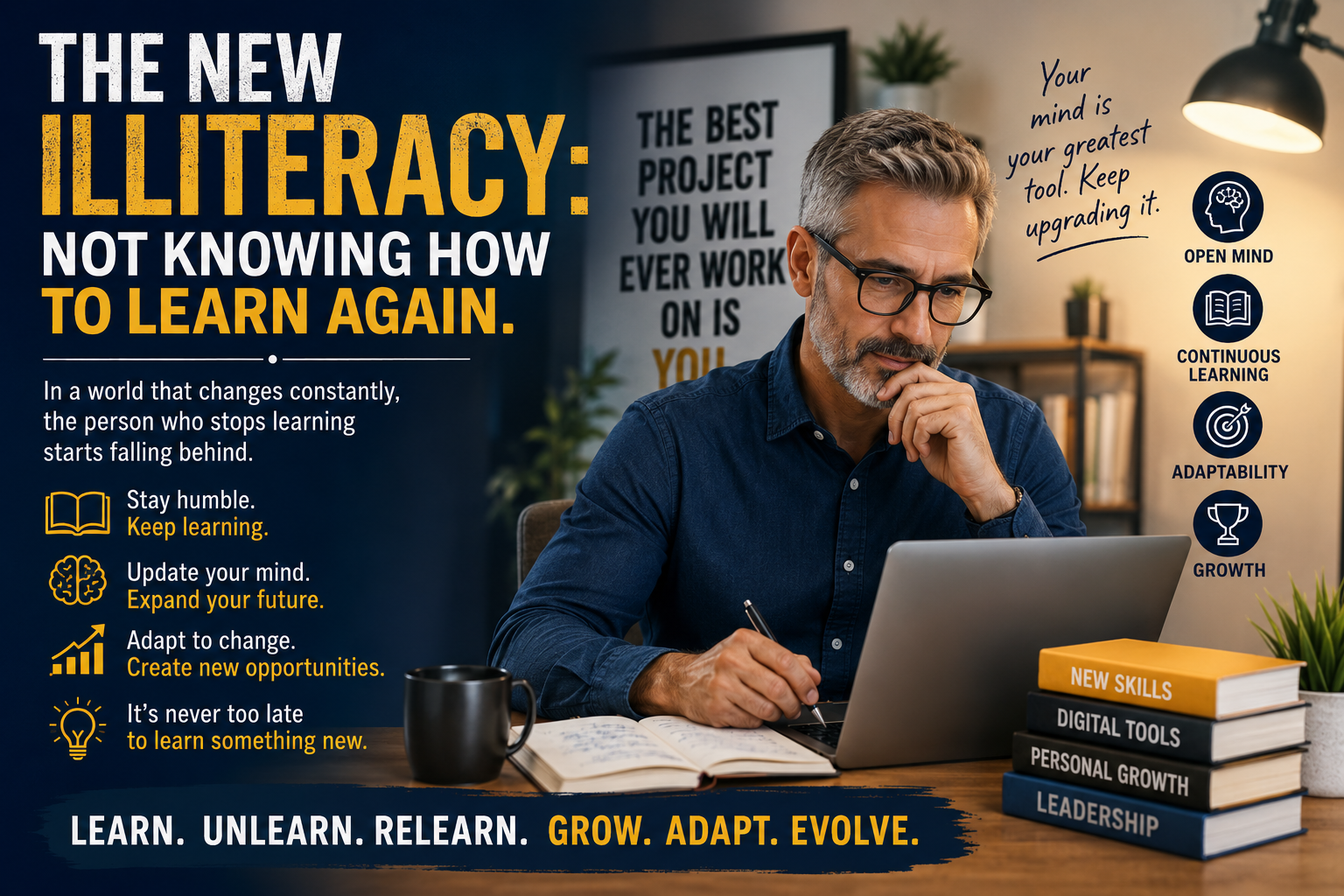
The New Illiteracy: Not Knowing How to Learn Again

By Marvin Gandis

The Problem Is No Longer Just Not Knowing

For a long time, when people talked about illiteracy, they thought about someone who could not read or write. But in today’s world, there is a new and dangerous form of illiteracy:

  • Not knowing how to learn again.

Today, a person may know how to read, write, use a phone, send messages, and browse the internet, yet still fall behind because they refuse to keep up.

The problem is not always a lack of intelligence. Many times, it is resistance to change.

We live in a time when tools, jobs, businesses, technology, the economy, and the way we communicate change.

That is why one of the most dangerous phrases a person can say is:

  • “I already know enough.”

Because in a constantly changing world, believing that you no longer need to learn can become a silent trap.


Knowing Yesterday Does Not Guarantee Understanding Today

Experience is valuable. No one should despise the years lived, the lessons learned, or the knowledge earned through effort.

But experience can become a limitation when we stop updating it.

  • What worked before may not work the same way today.
  • The way people sell has changed.
  • The way people communicate has changed.
  • The way people learn has changed.
  • The way people build trust has changed.
  • The way people work has changed.

This does not mean everything old is useless. It means we must learn how to combine wisdom with updating.

A wise person does not reject experience, but they also do not use it as an excuse to reject what is new.


Pride Is the Enemy of Learning

One of the biggest obstacles to learning again is pride.

Pride says:

  • “That is not for me.”
  • “I do not need to learn that.”
  • “That is for young people.”
  • “I have always done it this way.”
  • “That will not work.”
  • “I am too old to start.”

But humility says:

  • “I can learn.”
  • “I can improve.”
  • “I can ask for help.”
  • “I can start slowly.”
  • “I can update myself without losing my identity.”

Learning requires humility because it forces us to recognize that we do not know everything.

And that is not shame. That is wisdom.

The person who can learn again, even with experience, stays mentally alive.


Technology Does Not Wait Until We Feel Ready

Many people wait until they feel ready before learning something new.

But technology does not wait.

  • Platforms change.
  • Digital tools evolve.
  • Artificial intelligence advances.
  • Businesses become automated.
  • Consumers change their habits.
  • Audiences move into new spaces.

The person who waits too long may end up depending on others for everything.

This is not about becoming an expert overnight. It is about maintaining an attitude of constant learning.

  • Learn a new tool.
  • Understand a new concept.
  • Try a new strategy.
  • Read a guide.
  • Watch a tutorial.
  • Practice a little every day.

Technological ignorance does not always arrive suddenly. Sometimes it builds slowly through years of resistance.


Learning Again Does Not Mean Starting From Zero

Many people are afraid to learn something new because they feel it invalidates everything they already know.

But learning again does not erase your past.

It improves it.

  • Your experience is still valuable.
  • Your story still matters.
  • Your mistakes still teach.
  • Your character still counts.
  • Your wisdom still has weight.

The difference is that now you need to use all of it in a new context.

  • A teacher can learn digital tools.
  • A salesperson can learn online marketing.
  • A leader can learn modern communication.
  • An entrepreneur can learn automation.
  • An older person can learn technology step by step.

You are not starting from zero. You are building on what you already are.


The Person Who Learns Becomes Harder to Defeat

When a person decides to keep learning, they develop a quiet advantage.

  • They can adapt better.
  • They can recover faster.
  • They can understand new opportunities.
  • They can avoid repeated mistakes.
  • They can communicate with new generations.
  • They can find solutions where they once saw obstacles.

Learning does not guarantee an easy life, but it increases your ability to respond to life with intelligence.

The person who learns does not remain trapped in one version of themselves.

They can evolve.

And in times of change, evolving is a form of survival.


Learning Is Also a Personal Responsibility

It is easy to blame the world.

  • “The economy is difficult.”
  • “Technology is moving too fast.”
  • “People do not listen anymore.”
  • “Social media has changed.”
  • “Business is not like it used to be.”

There may be truth in those phrases. But we also need to ask ourselves:

  • What am I learning?
  • What am I avoiding learning?
  • What skill have I delayed for too long?
  • What tool intimidates me?
  • What part of my mindset needs to be updated?

Personal responsibility does not mean blaming yourself for everything. It means recognizing that you still have power to grow.

You cannot control every change in the world, but you can decide how you will respond to those changes.


Learning Requires Patience

One of the biggest mistakes is wanting to learn something new without going through the discomfort of the beginning.

Every learning process has an awkward stage.

  • At first, you may feel slow.
  • You may make mistakes.
  • You may get confused.
  • You may need help.
  • You may feel frustrated.

That is normal.

No one masters something important without going through a learning stage.

Patience helps you avoid quitting too soon.

  • Do not say, “I am not good at this.”
  • Say, “I am still learning.”

That small difference changes your mindset.


Education No Longer Ends With a Diploma

In the past, many people thought education was one stage of life.

You studied, you worked, and then you repeated what you learned for years.

But today, learning must be continuous.

  • It does not matter your age.
  • It does not matter what your profession is.
  • It does not matter your experience.
  • It does not matter what your current level is.

There is always something to learn.

  • Communication.
  • Technology.
  • Finances.
  • Marketing.
  • Leadership.
  • Emotional intelligence.
  • Digital security.
  • Content creation.
  • Human relationships.
  • Critical thinking.

Modern education does not end. It renews itself.


How to Overcome the New Illiteracy

First, accept that not knowing something is not shameful.

The shame is not in not knowing. The real loss is refusing to learn.

Second, choose one skill at a time.

Do not try to learn everything at once. Choose one important thing and begin.

Third, practice in small steps.

Dedicate 15 or 20 minutes a day to learning or practicing something new.

Fourth, ask without fear.

Asking for help does not make you less capable. It makes you wiser.

Fifth, apply what you learn.

Knowledge that is not used is forgotten. Learn, practice, adjust, and repeat.

Sixth, keep a flexible mind.

Not every change is a threat. Some changes are opportunities in disguise.


The Future Favors Learners

The future will not be kind to those who refuse to grow.

But it will offer opportunities to those willing to learn, unlearn, and learn again.

  • You do not need to know everything.
  • You do not need to master everything today.
  • You do not need to compete with experts immediately.

You only need to maintain a humble and active attitude:

  • “I can learn something new.”
  • “I can improve step by step.”
  • “I can update my mind.”
  • “I can adapt without losing my essence.”

That attitude can change your life.


It Is Never Too Late to Learn Again

My dear reader and friend, the new illiteracy is not the inability to read. It is the refusal to keep learning in a world that keeps changing.

Do not allow pride, fear, age, comfort, or frustration to steal your opportunity to grow.

  • Learning again does not make you weak.
  • It makes you flexible.
  • It makes you wise.
  • It makes you useful.
  • It keeps you relevant.
  • It makes you better prepared.

The world will keep changing.

The question is:

  • Will you also change with wisdom?

You do not have to do everything perfectly. Just begin.

  • Learn something new.
  • Ask a question.
  • Read a guide.
  • Practice a tool.
  • Improve a skill.
  • Update your mind.

Because in the modern world, the person who stops learning begins to fall behind.

But the person who learns again opens new doors.


Disclaimer:


This article is provided for educational, motivational, inspirational, and informational purposes only. It is intended to encourage reflection, continuous learning, personal growth, digital awareness, adaptability, and responsible decision-making.

The content should not be interpreted as financial, legal, medical, psychological, technological, educational, or professional advice. Any examples related to personal development, technology, digital tools, business, entrepreneurship, leadership, online learning, or success are not guarantees of specific results.

Individual outcomes may vary depending on effort, consistency, experience, access to resources, personal discipline, market conditions, technological changes, learning ability, and other factors beyond our control.

Readers are encouraged to use their own judgment, conduct their own research, and seek qualified professional guidance when necessary. The purpose of this content is to inspire and educate, not to promise instant results or replace professional advice.
Publicado en Business Growth, Education, Leadership, Mindset, Personal Development, Success

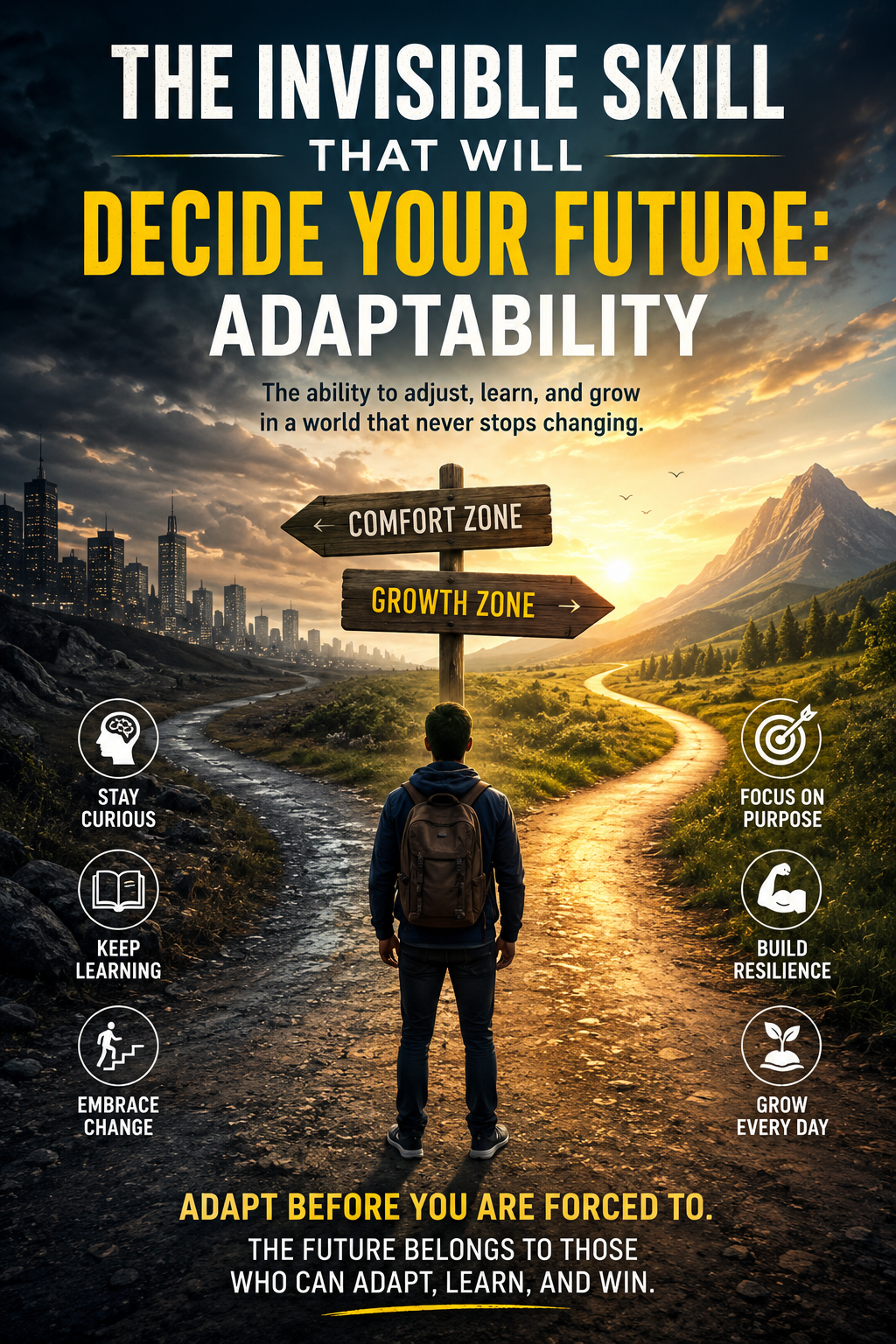
The Invisible Skill That Will Decide Your Future: Learning How to Adapt Before Life Forces You To

By Marvin Gandis

The World Is Not Waiting for Anyone

There is a quiet truth many people ignore until life becomes uncomfortable:

The future does not belong only to the strongest, the smartest, or even the most talented. The future belongs to those who know how to adapt.

We live in a time where everything changes quickly. Technology changes. Jobs change. Businesses change. Relationships change. The economy changes. Even the way people communicate, buy, learn, work, and trust others is changing.

Yet many people are still trying to succeed with the same mindset they had five, ten, or twenty years ago.

They are waiting for things to return to normal.

But what if “normal” is not coming back?

What if the new advantage in life is not simply having more money, more education, or more contacts—but having the ability to adjust, learn, improve, and move forward when the world changes around you?

That skill has a name:

Adaptability.

And in the coming years, it may become one of the most valuable skills a person can develop.


Adaptability Is Not Weakness — It Is Intelligence in Motion

Many people confuse adaptation with surrender.

They think adapting means giving up your values, changing your identity, or accepting defeat. But true adaptation is not about becoming someone else. It is about becoming strong enough to respond wisely to new circumstances.

A tree that refuses to bend in a storm may break. But a tree that bends without losing its roots survives.

That is adaptability.

It means you keep your principles, but you change your methods.

You keep your purpose, but you adjust your strategy.

You keep your dream, but you improve your plan.

The person who adapts is not unstable. The person who adapts is awake.


The Most Dangerous Phrase Is: “I Have Always Done It This Way”

There is nothing wrong with experience. Experience is valuable. But experience becomes dangerous when it turns into resistance.

Many people fail not because they lack ability, but because they become emotionally attached to old methods.

They say:

  • “I have always done it this way.”
  • “That will never work.”
  • “I don’t need to learn that.”
  • “This new generation doesn’t understand.”
  • “Things were better before.”

Maybe some things were better before. But life does not move backward to comfort us. Life moves forward and asks us to grow.

In business, this can destroy progress.

A person may have a good product, a good message, or a good opportunity, but if they refuse to learn new tools, new platforms, new ways to communicate, and new ways to build trust, they slowly become invisible.

Not because they are bad.

Not because they have nothing to offer.

But because they stopped adapting.


The Marketplace Rewards Those Who Pay Attention

The marketplace is always speaking.

People’s habits tell us what they care about. Their questions reveal their fears. Their silence reveals confusion. Their clicks reveal curiosity. Their complaints reveal problems waiting for solutions.

The wise person pays attention.

Instead of saying, “Why is nobody listening to me?” they ask:

  • “What are people actually struggling with?”
  • “How can I explain this more clearly?”
  • “Is my message helping, teaching, or only selling?”
  • “Am I building trust before asking for action?”
  • “Am I using the tools people actually use today?”

Adaptability begins when we stop blaming the audience and start studying the audience.

This does not mean blindly chasing trends. It means understanding people deeply.

Trends change, but human needs remain: security, hope, clarity, belonging, progress, peace, confidence, and opportunity.

The adaptable person learns how to connect timeless human needs with modern communication.

That is powerful.


Adaptability Requires Humility

One of the hardest parts of adapting is admitting that we still need to learn.

This is difficult because the ego wants to appear finished, polished, and certain. But growth requires honesty.

A beginner who knows they are learning is often more dangerous than an expert who thinks they already know everything.

Humility says:

  • “I can improve.”
  • “I can ask better questions.”
  • “I can study what is working.”
  • “I can correct my mistakes.”
  • “I can learn from younger people.”
  • “I can learn from failure without becoming failure.”

This kind of humility is not weakness. It is maturity.

A humble person can be corrected without being destroyed. They can receive feedback without feeling attacked. They can change direction without feeling ashamed.

That is why humility and adaptability go hand in hand.

You cannot adapt while pretending you already know everything.


The Future Will Punish Passive People

This may sound strong, but it is necessary:

The future will not be kind to passive people.

Passive people wait too long.

They wait for perfect timing.

They wait until they feel ready.

They wait until someone explains everything.

They wait until success is guaranteed.

They wait until fear disappears.

But fear does not disappear before action. Fear usually gets smaller after action.

The adaptable person does not need perfect confidence to begin. They begin, observe, learn, adjust, and continue.

That is how progress is built.

Not in one dramatic moment.

Not in one lucky opportunity.

Not in one viral post.

Progress is built through repeated adjustment.

You try. You learn. You improve. You try again.

That cycle is one of the greatest secrets of successful people.


Adaptability Does Not Mean Following Every Trend

There is a difference between being adaptable and being distracted.

Some people jump from idea to idea, tool to tool, business to business, and strategy to strategy. They call it adaptation, but it is really confusion.

True adaptability is not panic.

It is an intelligent adjustment.

You do not need to follow every trend. You do not need to use every platform. You do not need to copy everyone who seems successful.

You need to know your mission, understand your audience, and improve your method.

The question is not:

  • “What is everyone doing?”

The better question is:

“What change would make my message clearer, my service better, and my results stronger?”

That is focused adaptation.


The Person Who Learns Faster Has the Advantage

In the past, people often competed based on resources: money, location, connections, or formal education.

Those things still matter, but today there is another advantage:

  • learning speed.

The person who learns faster can recover faster.

They can test ideas faster.

They can understand tools faster.

They can recognize mistakes faster.

They can improve communication faster.

They can respond to change faster.

This is why continuous learning is not optional anymore. It is survival.

But learning does not only mean taking courses or reading books. It also means paying attention to your own life.

  • Every failure is data.
  • Every rejection is information.
  • Every delay is a lesson.
  • Every mistake is a mirror.

The question is: are you learning from what happens to you, or are you only suffering through it?

The adaptable person turns experience into education.


Emotional Adaptability May Be Even More Important

Adapting is not only about technology, business, or strategy. It is also emotional.

  • Can you stay calm when things change?
  • Can you think clearly when plans fail?
  • Can you keep moving when results are slow?
  • Can you receive criticism without losing your identity?
  • Can you adjust without becoming bitter?

Many people are mentally capable but emotionally fragile. They know what to do, but frustration controls them. They have ideas, but disappointment paralyzes them.

This is why emotional adaptability matters.

It teaches you to say:

  • “This did not work, but I am not finished.”
  • “This season is difficult, but I can still grow.”
  • “This result disappointed me, but it can teach me.”
  • “I may need a new strategy, but I do not need to quit my purpose.”

That kind of emotional strength is rare.

And rare things have value.


How to Build Adaptability in Your Daily Life

Adaptability is not built in theory. It is built in practice.

Here are simple ways to develop it:

Ask better questions

Instead of asking, “Why is this happening to me?” ask, “What can this teach me?”

Instead of asking, “Why don’t people support me?” ask, “How can I communicate with more clarity and value?”

Update your skills regularly

Do not wait until you are forced to learn. Learn before pressure arrives.

Study communication, digital tools, financial habits, leadership, emotional discipline, and problem-solving.

Detach from one method

Your goal may remain the same, but your path may need to change.

Do not worship the method. Respect the mission.

Review your results honestly

If something is not working, do not pretend it is. Look at the facts. Adjust with wisdom.

Honesty saves time.

Stay rooted in values

Adaptability without values becomes compromise. Values without adaptability can become rigidity.

You need both: strong roots and flexible branches.


The Real Winners Will Be the Ones Who Can Reinvent Without Losing Themselves

Life will ask every person to reinvent something.

Maybe your career.

Maybe your business.

Maybe your habits.

Maybe your mindset.

Maybe your communication.

Maybe your relationship with money.

Maybe your relationship with yourself.

Reinvention does not mean your past was wasted. It means your past prepared you for a new level.

The lessons you learned still matter. The pain you survived still matters. The skills you developed still matter. The wisdom you gained still matters.

But now you may need to use them in a new way.

That is not failure.

That is evolution.

The person who can reinvent without losing their soul becomes very difficult to defeat.


Adapt Before You Are Forced To

The greatest mistake is waiting until life gives you no choice.

Do not wait until your job disappears to learn new skills.

Do not wait until your business fails to improve your message.

Do not wait until your audience ignores you to study communication.

Do not wait until your confidence is broken to develop emotional strength.

Do not wait until the storm arrives to strengthen your roots.

  • Adapt now.
  • Learn now.
  • Adjust now.
  • Grow now.

The future is not asking you to be perfect.

It is asking you to be awake.

And those who are awake, humble, flexible, and willing to grow will always have a chance to rise again.

Because the world may change, but the adaptable person does not disappear. The adaptable person transforms.


Disclaimer:


The articles and content ideas provided are for educational, inspirational, and informational purposes only. They are designed to encourage reflection, personal growth, digital awareness, and responsible decision-making. They should not be considered financial, legal, medical, psychological, or professional advice.

Any business, marketing, personal development, or income-related examples mentioned are not guarantees of results. Individual outcomes may vary depending on effort, consistency, experience, market conditions, personal discipline, and other factors beyond our control.

Readers are encouraged to do their own research, seek qualified professional guidance when necessary, and make decisions based on their own situation, values, and responsibilities.