Publicado en Biblical Teaching, Christian Faith, Christian Living, Christian Reflection, Church, Jesus Christ, Spiritual Growth

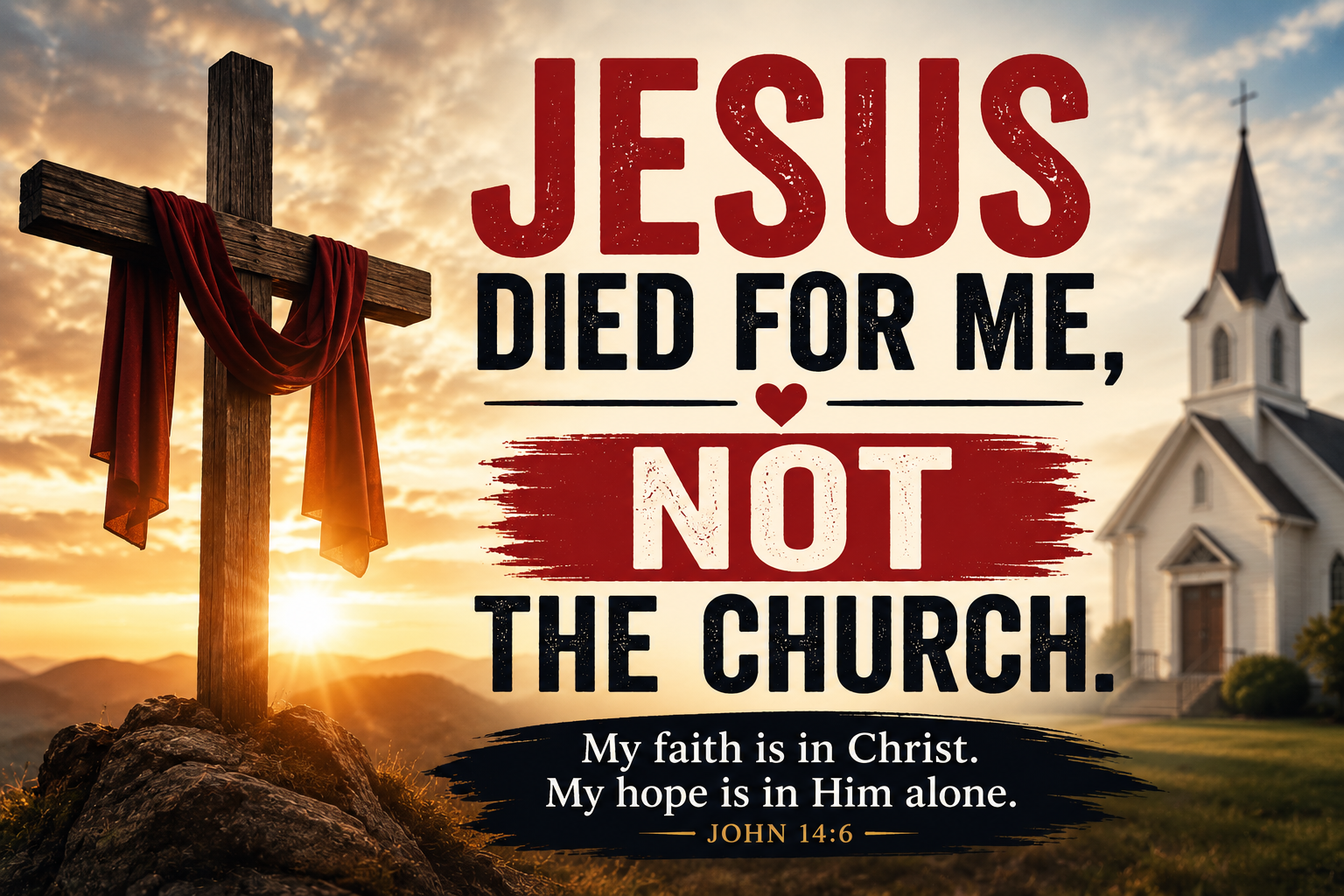
Jesus Died for Me, Not the Church

When Our Faith Is Placed in Christ, Not in People

By Marvin Gandis

There is a truth every believer needs to remember, especially after being disappointed, criticized, rejected, or hurt by people within a congregation:

Jesus died for me. The church did not.

This statement is not meant to belittle the Church or promote an isolated Christian life. The Church has an important place in God’s purpose. We are called to gather, serve one another, grow together, and function as the body of Christ.

But there is a fundamental distinction we must never forget:

The Church is not our Savior. Jesus is.

No pastor died on the cross for our sins. No religious leader paid the price for our redemption. No denomination can grant salvation. No congregation can replace a personal relationship with Jesus Christ.

Jesus carried our sins.

Jesus shed His blood.

Jesus conquered death.

Jesus opened the way to the Father.

That is why our faith must be rooted first and foremost in Christ, not in people.


When We Confuse Jesus with the Church

One of the problems many people face is that they connect their entire experience with God to their experience with a congregation.

If the pastor fails, they feel that God failed them.

If a brother or sister disappoints them, they feel that Christianity disappointed them.

If someone judges them, they assume Jesus is rejecting them too.

If a church makes serious mistakes, they begin questioning their entire faith.

But we must learn to distinguish between a perfect Christ and imperfect human beings.

The Church is made up of people who are still growing, learning, and being transformed.

That means we will find sincere and spiritually mature believers within congregations, but we may also encounter immature, wounded, mistaken, or even hypocritical people whose behavior does not accurately reflect the Gospel.

Jesus never instructed us to place absolute trust in human beings.

Scripture points us to Him.

“Looking unto Jesus, the author and finisher of our faith.”
— Hebrews 12:2

Our primary focus must remain on Christ.


Jesus Is the One Who Died for Us

The center of the Gospel is not an institution.

The center of the Gospel is Jesus Christ.

Romans 5:8 says:

“But God commendeth his love toward us, in that, while we were yet sinners, Christ died for us.”

Notice what it says:

Christ died for us.

When we were lost, Jesus came.

When we needed reconciliation with God, Jesus paid the price.

When sin separated us from God, Christ took our guilt upon Himself.

The cross represents God’s love revealed personally through Jesus Christ.

Paul also wrote:

“For there is one God, and one mediator between God and men, the man Christ Jesus.”
— 1 Timothy 2:5

There are not many mediators.

There is one.

Jesus Christ.


No Pastor Can Replace Christ

We should love, respect, and honor those who faithfully serve in ministry.

Pastors can teach.

Leaders can guide.

Brothers and sisters can walk beside us.

Teachers can help us understand Scripture.

But none of them can occupy the place that belongs exclusively to Jesus.

The problem begins when we become more spiritually dependent on a person than on Christ.

Some believers know exactly what their pastor says but rarely study what Jesus Himself taught.

Others build their faith around a personality, ministry, denomination, or organization.

That can become spiritually dangerous.

Paul had to correct something similar in the church at Corinth.

Some said:

“I follow Paul.”

Others said:

“I follow Apollos.”

Others said:

“I follow Cephas.”

Then Paul asked a powerful question:

“Is Christ divided? was Paul crucified for you?”
— 1 Corinthians 1:13

The answer is obvious.

Paul did not die for them. Christ did.

The same principle still applies today.

Your pastor may be a blessing.

Your congregation may be wonderful.

Your denomination may have a long and meaningful history.

But none of them were crucified for you.

Jesus was.


When the Church Disappoints You

Many people walk away from faith entirely because of a painful experience inside a church.

Maybe they were ignored.

Perhaps they were judged unfairly.

Someone may have spoken badly about them.

They may have witnessed hypocrisy.

A leader may have abused authority.

Or perhaps they expected to find perfect people and discovered that the Church is also made up of flawed human beings.

The pain can be real.

It should not be minimized.

But we must not allow the failures of other people to separate us from Christ.

Do not give another person the power to destroy your relationship with Jesus.

The person who hurt you did not die for you.

The person who criticized you did not die for you.

The person who disappointed you did not die for you.

Jesus died for you.

And He has not changed.

“Jesus Christ the same yesterday, and to day, and for ever.”
— Hebrews 13:8

People change.

Congregations change.

Leaders change.

Denominations change.

Christ remains.


But This Does Not Mean We Should Despise the Church

Balance is important.

Saying “Jesus died for me, not the Church” does not mean:

“I do not need to gather with other believers.”

“I do not need Christian brothers and sisters.”

“I do not need correction.”

“I do not need community.”

“I do not need to listen to anyone.”

That would not be biblical either.

Jesus loves His Church.

Ephesians 5:25 says:

“Christ also loved the church, and gave himself for it.”

Believers are also called to walk together.

Hebrews 10:25 encourages us not to forsake assembling together.

The biblical Church serves important purposes:

  • Teaching the Word of God.
  • Building fellowship among believers.
  • Serving those in need.
  • Discipling new believers.
  • Praying for one another.
  • Sharing the Gospel.
  • Encouraging one another in difficult times.
  • Correcting one another in love.
  • Worshiping God together.

So we do not have to choose between Jesus or the Church.

The proper order is:

Jesus first.
And because we follow Jesus, we also learn to love His Church properly.


Christ Is the Head of the Church

The Bible never presents a pastor as the supreme head of the Church.

Christ is the Head.

Colossians 1:18 says:

“And he is the head of the body, the church.”

That changes our perspective.

The Church belongs to Christ.

It does not belong to the pastor.

It does not belong to the founder.

It does not belong to a family.

It does not belong to an organization.

It does not belong to a denomination.

It belongs to Jesus.

Leaders are stewards and servants within God’s work.

Christ remains Lord.


Do Not Turn a Denomination into Your Identity

Denominations can help organize doctrine and administration, but our spiritual identity must be found in Christ.

Before saying:

“I am Baptist.”

“I am Pentecostal.”

“I am Methodist.”

“I am Presbyterian.”

“I am Catholic.”

“I am Evangelical.”

“I belong to this ministry.”

The more important question should be:

Am I truly a disciple of Jesus Christ?

Because one day, no religious label will have the power to save us.

Salvation is in Christ.

Acts 4:12 says:

“Neither is there salvation in any other.”

Our denomination does not save.

Our membership does not save.

Our ministry title does not save.

Our church attendance record does not save.

Christ saves.


When Someone Leaves a Congregation

We must also avoid another mistake.

Leaving one particular congregation does not necessarily mean abandoning God.

There are circumstances where a person may need to find another healthy Christian community.

For example, when there is:

  • spiritual abuse,
  • manipulation,
  • serious doctrinal distortion,
  • ongoing corruption,
  • unhealthy control,
  • lack of accountability,
  • financial exploitation,
  • or an environment where healthy spiritual growth is no longer possible.

Such decisions should be made with prayer, wisdom, and maturity.

We should not jump from church to church simply because someone corrected us or because everything did not go our way.

But neither should we believe that remaining under any leadership, no matter what happens, is an absolute spiritual obligation.

Our highest loyalty belongs to Christ.


Do Not Follow a Person More Than You Follow Jesus

John the Baptist understood this principle clearly.

When some people became concerned that crowds were beginning to follow Jesus, John responded:

“He must increase, but I must decrease.”
— John 3:30

That should also be the spirit of every true Christian leader.

A healthy pastor does not try to create personal followers.

He or she seeks to form disciples of Jesus.

A healthy teacher does not say:

“Depend on me.”

The message is:

“Know Christ.”

A genuine ministry does not turn the leader into the star.

It continually points people toward Jesus.


Learn to Know Christ Personally

One of the greatest protections against spiritual deception is developing a deep relationship with God and knowing His Word.

Do not live only on sermons.

Read the Bible.

Do not live only on Christian videos.

Pray personally.

Do not depend entirely on other people’s interpretations.

Study Scripture.

Do not allow another person to become a permanent spiritual intermediary between you and God.

Jesus opened the way for us to approach the Father.

Develop these habits:

Prayer.

Speak honestly with God.

Bible reading.

Learn what Scripture actually teaches.

Obedience.

Knowing the Word is not enough; we are called to live it.

Discernment.

Compare every teaching with Scripture.

Christian fellowship.

Surround yourself with believers who encourage you to draw closer to Christ.

Service.

Mature faith also seeks to bless others.


If a Leader Fails Someday

Remember something important:

Your faith was never supposed to depend completely on that leader.

Leaders can fall.

Ministries can disappear.

Organizations can divide.

People we admire can disappoint us.

But our hope is not built on them.

Paul wrote:

“For other foundation can no man lay than that is laid, which is Jesus Christ.”
— 1 Corinthians 3:11

That is the foundation.

Jesus Christ.

When our spiritual house is built on Christ, human failures can hurt us, but they do not have to destroy our faith.


The Church Needs to Remember This Too

This message is not only for members of congregations.

It is also for leaders.

Pastors, evangelists, teachers, bishops, ministers, and Christian leaders must remember:

People do not belong to us.

They belong to Christ.

Our responsibility is not to make people permanently dependent on us.

Our responsibility is to help them grow until they walk more closely with Jesus.

John 10:27 says:

“My sheep hear my voice, and I know them, and they follow me.”

Notice:

They follow Him.


When You Understand Who Died for You, Your Perspective Changes

When we truly understand the cross, we stop turning people into spiritual idols.

We can love our church without idolizing it.

We can respect our pastor without treating that person as infallible.

We can belong to a denomination without believing we are spiritually superior to everyone else.

We can receive teaching without surrendering our responsibility to discern.

We can serve faithfully without forgetting who our true Lord is.

Our faith begins to mature.

We stop saying:

“I believe because my pastor believes.”

Instead, we say:

“I believe because I have come to know Christ.”

We stop saying:

“I serve only because the church needs me.”

Instead:

“I serve because I love the Lord.”

We stop saying:

“If someone disappoints me, I will walk away from Jesus.”

Instead:

“Even when people fail, Christ remains faithful.”


Jesus Died for Me

When no one else could pay the price, Jesus paid it.

When no one else could carry away our sin, Jesus carried it.

When no one could reconcile us to God, Jesus opened the way.

When death appeared to have the final word, Jesus rose again.

That is why our hope is not placed primarily in buildings, organizations, titles, denominations, or religious personalities.

Our hope is in a Person:

Jesus Christ.

Love the Church.

Gather with other believers.

Serve.

Honor those who faithfully teach the Word.

Help your brothers and sisters.

Allow others to help you.

But never forget the proper order:

Jesus first.

When everyone else fails, He remains.

When others walk away, He remains.

When institutions change, He remains.

When people disappoint you, He remains.

When you walk through the valley, He remains.

And when we reach the end of our earthly journey, it will not be a denomination that receives us into eternity.

It will be Christ.

That is why we can say with gratitude, conviction, and humility:

Jesus died for me. The Church did not.

And precisely because Jesus died for me, I want to learn to love His Church without ever placing it in the position that belongs to Him alone.


Final Reflection

Ask yourself:

Is my faith truly founded on Jesus Christ, or does it depend too heavily on people, leaders, organizations, or denominations?

If a negative church experience has damaged your relationship with God, it may be time to separate the two.

People may have failed you.

Jesus was not the one who committed that wrong.

People may have hurt you.

Christ still extends His arms toward you.

People may have abandoned you.

Jesus still says:

“I will never leave thee, nor forsake thee.”
— Hebrews 13:5

Return to the foundation.

Return to the Word.

Return to prayer.

Return to Christ.

The Church can walk beside you, but only Jesus is Savior, the Way, the Truth, and the Life.

“I am the way, the truth, and the life: no man cometh unto the Father, but by me.”
— John 14:6

Christ first. Christ at the center. Christ to the end.


Disclaimer: This content is provided for educational, devotional, and Christian reflection purposes. It is not intended to attack, discredit, or make broad judgments about churches, denominations, pastors, ministers, or religious leaders. Situations involving spiritual abuse, manipulation, misconduct, or serious conflict within a congregation should be considered individually, and appropriate pastoral guidance, professional support, or legal advice should be sought when necessary. Biblical references are included to encourage personal study of Scripture and a deeper relationship with Jesus Christ.

Publicado en Entrepreneurship, Faith and Spirituality, Financial Education, Leadership, Motivation, Personal Development, Personal Growth

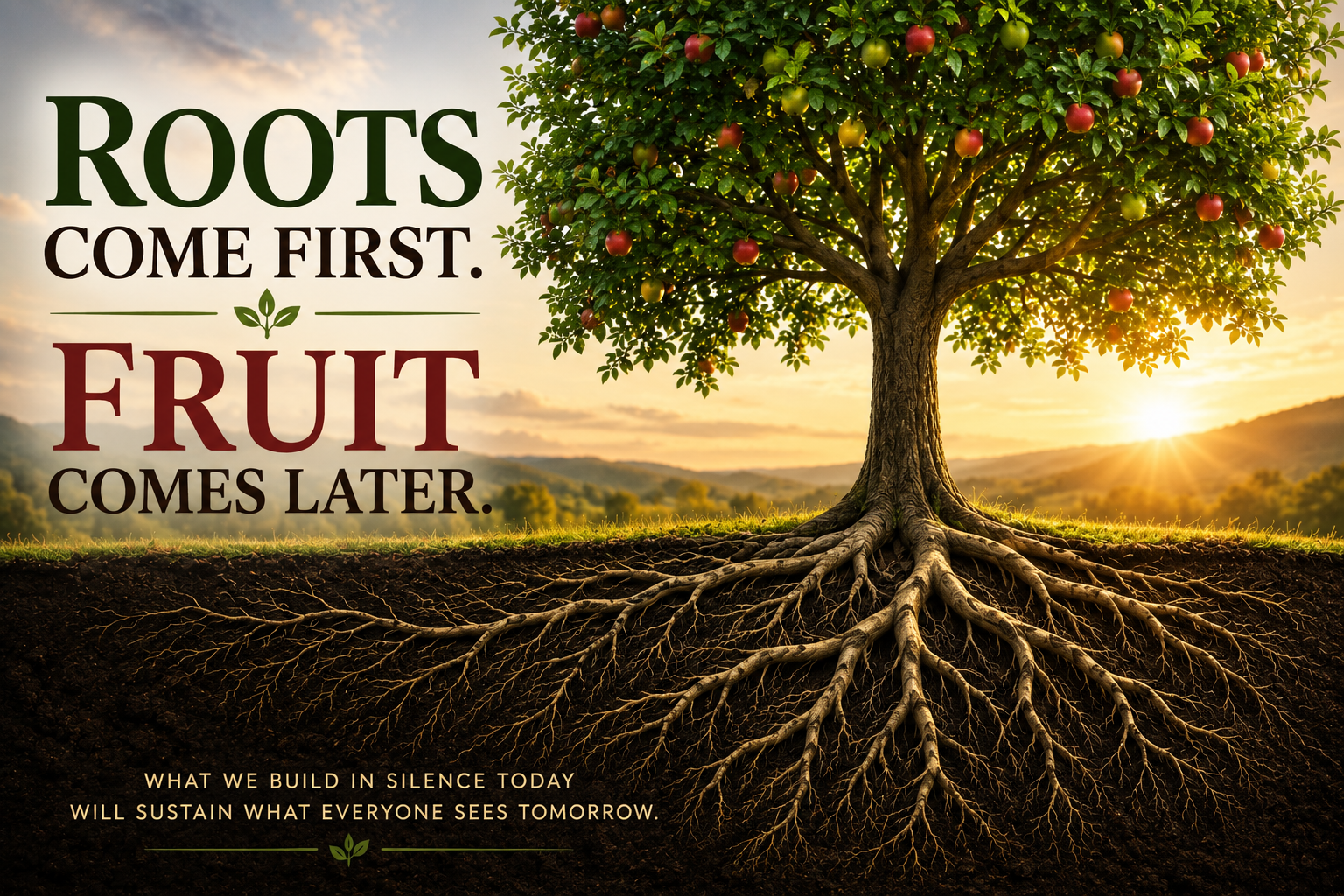
Roots Come First. Fruit Comes Later.

What No One Sees Determines What Everyone May Eventually See

By Marvin Gandis

We live in a world obsessed with results.

We want fast growth, fast income, recognition, successful businesses, healthy relationships, financial stability, emotional peace, and immediate answers.

We want the fruit.

But we rarely talk about the roots.

A tree does not begin by producing fruit. It develops roots first. It anchors itself in the soil. It searches for water. It absorbs nutrients. It survives difficult seasons. It grows quietly where no one can see it.

Only later does everyone admire what appears above the ground.

Life works much the same way.

Roots come first. Fruit comes later.

This simple truth can transform the way we understand success, faith, money, relationships, work, and personal growth.


The world celebrates fruit but rarely notices roots

When we see a successful person, we usually see the outcome.

We see the business.

The house.

The knowledge.

The confidence.

The audience.

The ministry.

The stability.

The accomplishments.

What we do not easily see are the years of preparation, mistakes, difficult nights, uncomfortable decisions, opportunities they turned down, skills they developed, quiet prayers, and all the times they had to begin again.

We are looking at fruit without having witnessed the roots.

That is one of the dangers of comparison.

We compare our invisible process with someone else’s visible results.

Then we assume we are behind.

Perhaps we are not.

Perhaps we are simply in a season of growing roots.


The most important growth often happens where nobody can see it

When a seed is placed underground, it seems to disappear.

For a while there is no tree.

No flowers.

No fruit.

From above the ground, nothing appears to be happening.

Yet underneath the soil, an extraordinary transformation has begun.

The seed is changing.

Roots are developing.

Life is preparing itself.

The same thing can happen to us.

There are seasons when we study, and nobody notices.

We work, and nobody applauds.

We save money, and nobody celebrates.

We pray and still do not see an answer.

We publish content, and almost nobody responds.

We build something while the results seem insignificant.

We learn new skills while others appear to move much faster.

Do not confuse lack of visibility with lack of progress.

Some of life’s most important stages happen beneath the surface.


Roots represent what sustains our lives

Our roots may be invisible, but they determine our ability to stand.

Those roots include:

character, discipline, knowledge, faith, principles, habits, patience, integrity, education, experience, healthy relationships, stewardship, and perseverance.

Fruit represents the results that can eventually grow from those roots:

opportunity, influence, stability, prosperity, leadership, confidence, strong relationships, and lasting achievement.

Problems arise when we try to obtain the fruit without developing what must support it.


Fruit without roots can become a blessing too heavy to carry

Not all rapid growth is healthy growth.

Imagine receiving ten times more money today without having learned how to manage it.

Or gaining thousands of customers without systems capable of serving them.

Or receiving a leadership position without developing character.

Or suddenly gaining a massive audience without knowing what you stand for.

What looked like a blessing can quickly become a burden.

Sometimes preparation must come before opportunity because capacity must grow alongside opportunity.

Before asking for greater fruit, perhaps we should ask:

Can my roots support it?


Financial roots before financial prosperity

This principle is especially important with money.

Many people want more income.

That is understandable.

But increasing income without improving financial habits does not necessarily create stability.

Financial roots include budgeting, saving, responsibly reducing debt, financial education, prudent investing, developing valuable skills, reasonable income diversification, and learning to distinguish wants from needs.

Money tends to amplify behavior.

Someone who poorly manages $1,000 does not automatically become an excellent money manager after earning $10,000.

Real prosperity therefore begins before the money arrives.

It begins with knowledge and behavior.

Stewardship first. Expansion later.


Roots before results in business

The internet can make building a business look incredibly fast.

We see advertisements promising extraordinary results.

But behind sustainable businesses are usually less glamorous foundations:

understanding customers, communicating value, developing useful offers, earning trust, building an audience, learning marketing, creating systems, measuring results, and continually improving.

These activities may appear small.

But they are roots.

An advertising campaign may generate sales.

An audience that trusts you can generate opportunities for years.

There is an enormous difference.


Roots before influence

Today anyone can publish content.

But publishing does not automatically create influence.

Real influence grows from trust.

And trust usually requires time.

Every useful article is a root.

Every email that genuinely helps a reader is a root.

Every respectful response is a root.

Every promise kept is a root.

Every time we choose to educate rather than pressure people is a root.

Eventually, those small actions can become a reputation.

And reputation can become influence.


Spiritual roots before the storm

Jesus repeatedly used seeds, trees, vines, roots, and fruit to communicate spiritual truths.

In the parable of the sower, He described seed that initially grew but could not endure because “it had no root” (Matthew 13:5–6, 20–21).

Initial growth was not enough.

Depth mattered.

The principle remains relevant.

Faith should not be developed only after the storm arrives.

Prayer, Scripture, fellowship with God, obedience, gratitude, and service are spiritual roots developed through everyday life.

When difficult seasons arrive, we discover how deeply those roots have grown.

Jeremiah 17:7–8 describes the person who trusts in the Lord as a tree planted by water, extending its roots toward the stream and continuing to bear fruit even through difficult conditions.

Visible strength begins with invisible roots.


God often works beneath the surface first

Joseph received dreams before receiving authority.

David was anointed before sitting on the throne.

Moses spent years in the wilderness before leading Israel.

The disciples walked with Jesus and learned before carrying the Gospel to other nations.

Between calling and fulfillment came preparation.

Between seed and fruit came roots.

A season of waiting does not necessarily mean abandonment.

It may be a season of formation.

Perhaps things we cannot yet see are developing exactly the capacity we will need tomorrow.


Stop digging up the seed to see whether it is growing

Imagine planting a seed today.

Tomorrow we dig it up to see whether anything happened.

Then we plant it again.

Two days later, we repeat the process.

The seed never receives enough uninterrupted time to establish itself.

We often do something similar with our lives.

We begin a project.

Two weeks later, we switch.

We try another strategy.

We abandon it.

We buy another course.

We start another business.

Then we change again.

We are constantly planting but never staying long enough to develop roots.

Patience does not mean remaining forever with something that clearly does not work.

We should measure, learn, and adjust.

But there is an important difference between intelligent adaptation and constant abandonment.


Storms reveal the depth of our roots

A strong tree does not demonstrate its full strength on a calm afternoon.

The storm reveals it.

The same is true of us.

Difficulty exposes our roots.

When an opportunity disappears.

When a project fails.

When someone rejects us.

When income falls.

When our plans change.

When we have to begin again.

Those moments reveal what we have built inside ourselves.

Success may display our fruit.

Adversity reveals our roots.


Not every root produces good fruit

We must also examine what we are cultivating.

A root of resentment can produce bitterness.

A root of fear can produce paralysis.

A root of pride can prevent learning.

A root of comparison can steal contentment.

A root of irresponsibility can produce financial problems.

Having roots is not enough.

We need healthy roots.

We should regularly ask ourselves:

What thoughts am I feeding?

What habits am I strengthening?

Who is influencing me?

What am I learning?

What am I repeatedly practicing?

Where am I placing my trust?

Because what we feed beneath the surface will eventually appear above it.


Harvest requires time

There is a truth our instant-gratification culture does not enjoy hearing:

Some important things simply take time.

We cannot artificially accelerate every process.

Reputation takes time.

Relationships take time.

Experience takes time.

Trust takes time.

Wisdom takes time.

A sustainable business usually takes time.

Spiritual maturity takes time.

We can work intelligently.

We can learn faster.

We can use better tools.

We can avoid unnecessary mistakes.

But a fundamental principle remains:

plant, cultivate, wait, harvest.


What should you do when the fruit has not appeared yet?

When results take longer than expected, we should not simply wait passively.

We can work on the roots.

Learn another skill.

Read.

Study.

Improve our message.

Organize our finances.

Strengthen our health and relationships.

Correct destructive habits.

Build systems.

Serve people better.

Listen more carefully.

Pray.

Study our results.

Remove what does not work.

Continue planting what demonstrates genuine value.

A season without visible fruit can become an extraordinary season of preparation.


The question that changes everything

Instead of only asking:

“Why am I not seeing results yet?”

begin asking:

“What roots must I develop to sustain the results I want?”

That question changes everything.

If we want stronger finances, we need stronger financial roots.

If we want better relationships, we need roots of communication, respect, and patience.

If we want a larger business, we need stronger systems.

If we want influence, we need credibility.

If we want leadership, we need character.

If we want to remain strong through adversity, we need spiritual depth.

Fruit tells us what we hope to achieve.

Roots tell us who we need to become.


Roots Come First

My Dear Reader or Friend:

Perhaps you are working, and nobody recognizes it yet.

Perhaps you are learning but cannot show impressive results yet.

Perhaps you are planting while everyone around you seems to be harvesting.

Do not measure your entire life only by what you can display today.

Pay attention to what you are building within yourself.

Because one day the roots nobody saw may support the fruit everyone can see.

Do not chase fruit alone.

Build roots capable of carrying it.

Go deeper before expanding.

Learn before teaching.

Manage before multiplying.

Serve before seeking recognition.

Develop character before pursuing influence.

Strengthen your faith before the storm arrives.

And remember:

The seed is not ashamed because it does not look like a tree yet.

It is doing exactly what it needs to do.

It is growing roots.

And when those roots become deep, healthy, and strong, the fruit has somewhere to remain.

Roots come first.
Fruit comes later.


Final Reflection

Do not ask only:

Where is my fruit?

Also ask:

How are my roots?

Because often the future we desire does not begin with what we receive.

It begins with who we are becoming.


Disclaimer

This article is provided for educational, informational, motivational, and reflective purposes. References to personal growth, business, finances, success, or prosperity do not constitute financial, professional, legal, or investment advice and do not guarantee specific results. Individual outcomes may vary according to circumstances, decisions, preparation, effort, and other factors. Biblical and spiritual references are presented for Christian reflection and educational purposes. Readers should carefully evaluate financial, business, and personal decisions and consult qualified professionals when appropriate.

Publicado en Biblical History, Christian Reflection, Christmas, Culture and Traditions, Faith and Religion, Spiritual Education

🎄 The True Story of Christmas

An Educational Article Separating Truth from Fable

Introduction

Every year, as Christmas Eve and Christmas Day arrive, the world fills with lights, music, celebrations, and gifts. For many, it is a season of joy and togetherness; for others, a time of nostalgia, loneliness, or deep reflection.


Yet behind the modern sparkle lies an ancient, powerful, and revealing story, very different from the one most often told.

Christmas did not begin as a commercial celebration. It began as a spiritual event that challenged power, awakened consciences, and changed the course of humanity.

The purpose of this educational article is to reveal the true story of Christmas, separate cultural tradition from historical and spiritual truth, and answer questions that few dare to ask.


Who Was the Child Born in a Manger?

The heart of Christmas is not a tree, gifts, or a festive character.


The heart of Christmas is Jesus, known as Jesus Christ.

Jesus was not born in a palace or under privileged circumstances. His birth took place in a manger, a place meant for animals, symbolizing humility and simplicity. This detail is not accidental: from the very beginning, his life delivered a clear message—true power does not lie in wealth or political authority, but in love and service.


The Angels’ Announcement: A Message That Changed History

According to biblical accounts, angels announced his birth to shepherds—ordinary people, often marginalized by society. The message was unmistakable:

“Peace on earth, goodwill toward men.”

This was not a promise of peace imposed by force, but a spiritual and inner peace, a reconciliation between God and humanity. From its origin, Christmas was a message directed to the humble, not to the elite.


The Star and the Magi from the East

A group of wise men from the East, known as the Magi, followed an extraordinary star announcing the birth of a new King. This was no ordinary ruler—he would not conquer lands nor raise armies.

The star symbolized light in the midst of darkness, knowledge in times of confusion, and hope for a world weary of oppression.


The King Who Feared a Child

News of this birth reached Herod the Great, a powerful yet deeply insecure ruler. Herod did not fear an army—he feared the possibility of losing his throne.

Driven by fear, he ordered the death of innocent children. This episode reveals an uncomfortable truth: when light appears, those who thrive on power and deception feel threatened. From the very beginning, Christmas was not a sweet fairy tale—it was a dangerous event for unjust systems.


What Message and Revelation Did Jesus Bring?

Jesus came to reveal truths that shattered established norms:

  • That God draws near to humanity
  • That love is greater than law without compassion
  • That forgiveness liberates more than revenge
  • That the one who serves is greater than the one who dominates

His life taught that real transformation begins within, not through external imposition.

This is why his message transcended cultures, eras, and borders.


Was Santa Claus Part of This Story?

Here we must clearly separate tradition from truth.

Santa Claus is a modern cultural figure, loosely inspired by Saint Nicholas, a historical figure known for generosity. However, Santa Claus does not appear in the biblical account of Jesus’ birth.

He was not present in Bethlehem, was not announced by angels, and did not follow the star. His association with Christmas is cultural and commercial—not spiritual.


The Great Lie of the Modern Christmas

The greatest distortion of Christmas is not a fictional character, but the belief that:

  • Christmas depends on money
  • Happiness can be bought
  • A person’s value is measured by what they give

This mindset has transformed a spiritual celebration into a social and economic obligation, leaving many people anxious, frustrated, or heartbroken.


The Great Truth of Christmas

The truth is simple yet profound:

  • Hope was born in humility
  • Light appeared in the darkness
  • Peace began in a forgotten place
  • God drew near to humanity

Christmas reminds us that even in the darkest moments, something new can be born.


A Christmas Also for Those Who Are Hurting

Christmas was not created only for those who celebrate without struggle.


It was first announced to the poor, the weary, and the overlooked.

That is why its message remains alive today: no one is excluded from hope.


Conclusion

The true meaning of Christmas is neither a childish fairy tale nor a commercial strategy. It is an eternal reminder that love, humility, and truth can transform the world.

Separating fable from truth does not remove the magic of Christmas—it restores its deepest meaning.

May this Christmas illuminate not only streets and storefronts, but also conscience and heart.

🎄 Merry Christmas—with truth and purpose.