Publicado en Education, Entrepreneurship, Leadership, Mindset, Personal Development, Technology

The New Illiteracy: Not Knowing How to Learn Again

By Marvin Gandis

The Problem Is No Longer Just Not Knowing

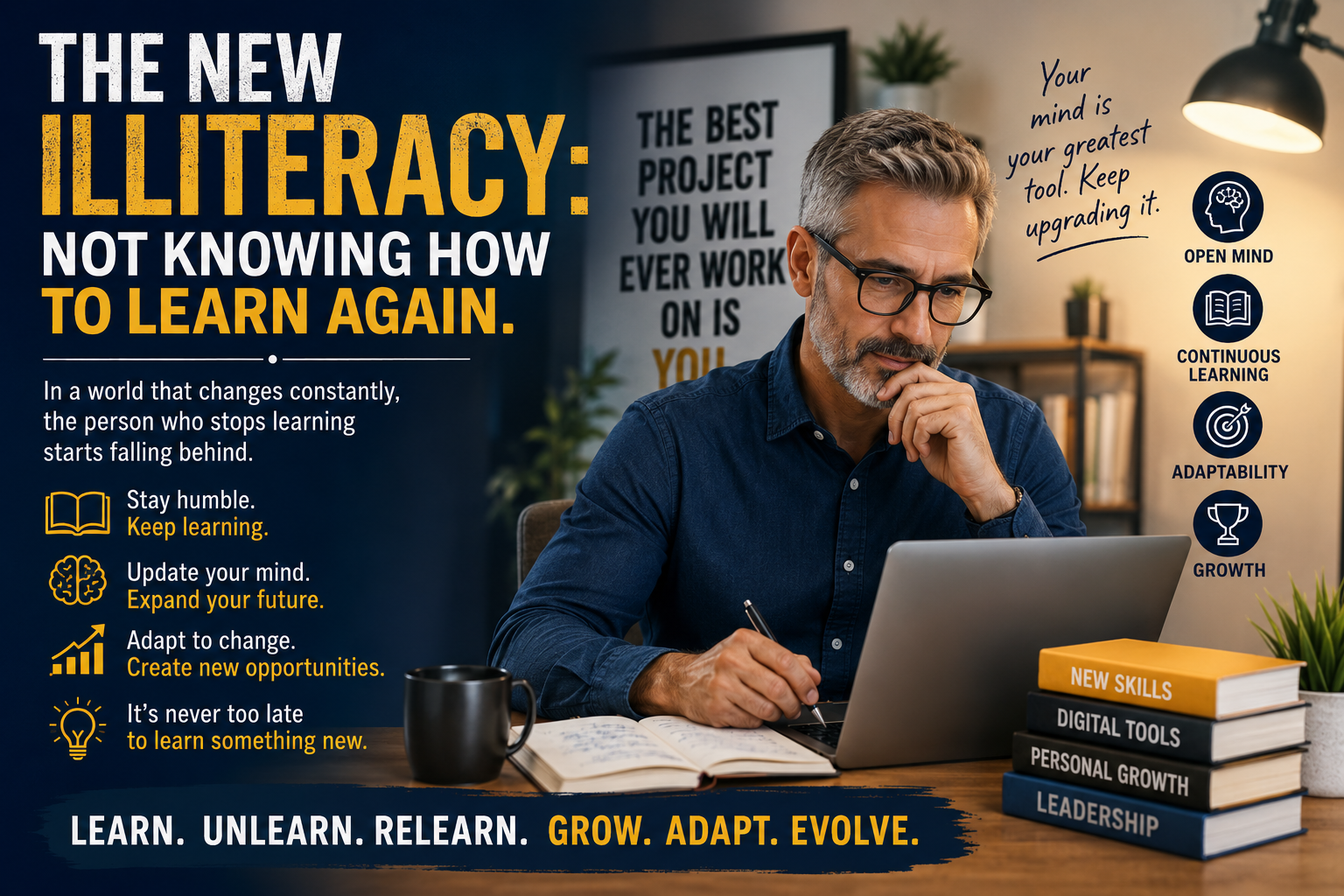
For a long time, when people talked about illiteracy, they thought about someone who could not read or write. But in today’s world, there is a new and dangerous form of illiteracy:

  • Not knowing how to learn again.

Today, a person may know how to read, write, use a phone, send messages, and browse the internet, yet still fall behind because they refuse to keep up.

The problem is not always a lack of intelligence. Many times, it is resistance to change.

We live in a time when tools, jobs, businesses, technology, the economy, and the way we communicate change.

That is why one of the most dangerous phrases a person can say is:

  • “I already know enough.”

Because in a constantly changing world, believing that you no longer need to learn can become a silent trap.


Knowing Yesterday Does Not Guarantee Understanding Today

Experience is valuable. No one should despise the years lived, the lessons learned, or the knowledge earned through effort.

But experience can become a limitation when we stop updating it.

  • What worked before may not work the same way today.
  • The way people sell has changed.
  • The way people communicate has changed.
  • The way people learn has changed.
  • The way people build trust has changed.
  • The way people work has changed.

This does not mean everything old is useless. It means we must learn how to combine wisdom with updating.

A wise person does not reject experience, but they also do not use it as an excuse to reject what is new.


Pride Is the Enemy of Learning

One of the biggest obstacles to learning again is pride.

Pride says:

  • “That is not for me.”
  • “I do not need to learn that.”
  • “That is for young people.”
  • “I have always done it this way.”
  • “That will not work.”
  • “I am too old to start.”

But humility says:

  • “I can learn.”
  • “I can improve.”
  • “I can ask for help.”
  • “I can start slowly.”
  • “I can update myself without losing my identity.”

Learning requires humility because it forces us to recognize that we do not know everything.

And that is not shame. That is wisdom.

The person who can learn again, even with experience, stays mentally alive.


Technology Does Not Wait Until We Feel Ready

Many people wait until they feel ready before learning something new.

But technology does not wait.

  • Platforms change.
  • Digital tools evolve.
  • Artificial intelligence advances.
  • Businesses become automated.
  • Consumers change their habits.
  • Audiences move into new spaces.

The person who waits too long may end up depending on others for everything.

This is not about becoming an expert overnight. It is about maintaining an attitude of constant learning.

  • Learn a new tool.
  • Understand a new concept.
  • Try a new strategy.
  • Read a guide.
  • Watch a tutorial.
  • Practice a little every day.

Technological ignorance does not always arrive suddenly. Sometimes it builds slowly through years of resistance.


Learning Again Does Not Mean Starting From Zero

Many people are afraid to learn something new because they feel it invalidates everything they already know.

But learning again does not erase your past.

It improves it.

  • Your experience is still valuable.
  • Your story still matters.
  • Your mistakes still teach.
  • Your character still counts.
  • Your wisdom still has weight.

The difference is that now you need to use all of it in a new context.

  • A teacher can learn digital tools.
  • A salesperson can learn online marketing.
  • A leader can learn modern communication.
  • An entrepreneur can learn automation.
  • An older person can learn technology step by step.

You are not starting from zero. You are building on what you already are.


The Person Who Learns Becomes Harder to Defeat

When a person decides to keep learning, they develop a quiet advantage.

  • They can adapt better.
  • They can recover faster.
  • They can understand new opportunities.
  • They can avoid repeated mistakes.
  • They can communicate with new generations.
  • They can find solutions where they once saw obstacles.

Learning does not guarantee an easy life, but it increases your ability to respond to life with intelligence.

The person who learns does not remain trapped in one version of themselves.

They can evolve.

And in times of change, evolving is a form of survival.


Learning Is Also a Personal Responsibility

It is easy to blame the world.

  • “The economy is difficult.”
  • “Technology is moving too fast.”
  • “People do not listen anymore.”
  • “Social media has changed.”
  • “Business is not like it used to be.”

There may be truth in those phrases. But we also need to ask ourselves:

  • What am I learning?
  • What am I avoiding learning?
  • What skill have I delayed for too long?
  • What tool intimidates me?
  • What part of my mindset needs to be updated?

Personal responsibility does not mean blaming yourself for everything. It means recognizing that you still have power to grow.

You cannot control every change in the world, but you can decide how you will respond to those changes.


Learning Requires Patience

One of the biggest mistakes is wanting to learn something new without going through the discomfort of the beginning.

Every learning process has an awkward stage.

  • At first, you may feel slow.
  • You may make mistakes.
  • You may get confused.
  • You may need help.
  • You may feel frustrated.

That is normal.

No one masters something important without going through a learning stage.

Patience helps you avoid quitting too soon.

  • Do not say, “I am not good at this.”
  • Say, “I am still learning.”

That small difference changes your mindset.


Education No Longer Ends With a Diploma

In the past, many people thought education was one stage of life.

You studied, you worked, and then you repeated what you learned for years.

But today, learning must be continuous.

  • It does not matter your age.
  • It does not matter what your profession is.
  • It does not matter your experience.
  • It does not matter what your current level is.

There is always something to learn.

  • Communication.
  • Technology.
  • Finances.
  • Marketing.
  • Leadership.
  • Emotional intelligence.
  • Digital security.
  • Content creation.
  • Human relationships.
  • Critical thinking.

Modern education does not end. It renews itself.


How to Overcome the New Illiteracy

First, accept that not knowing something is not shameful.

The shame is not in not knowing. The real loss is refusing to learn.

Second, choose one skill at a time.

Do not try to learn everything at once. Choose one important thing and begin.

Third, practice in small steps.

Dedicate 15 or 20 minutes a day to learning or practicing something new.

Fourth, ask without fear.

Asking for help does not make you less capable. It makes you wiser.

Fifth, apply what you learn.

Knowledge that is not used is forgotten. Learn, practice, adjust, and repeat.

Sixth, keep a flexible mind.

Not every change is a threat. Some changes are opportunities in disguise.


The Future Favors Learners

The future will not be kind to those who refuse to grow.

But it will offer opportunities to those willing to learn, unlearn, and learn again.

  • You do not need to know everything.
  • You do not need to master everything today.
  • You do not need to compete with experts immediately.

You only need to maintain a humble and active attitude:

  • “I can learn something new.”
  • “I can improve step by step.”
  • “I can update my mind.”
  • “I can adapt without losing my essence.”

That attitude can change your life.


It Is Never Too Late to Learn Again

My dear reader and friend, the new illiteracy is not the inability to read. It is the refusal to keep learning in a world that keeps changing.

Do not allow pride, fear, age, comfort, or frustration to steal your opportunity to grow.

  • Learning again does not make you weak.
  • It makes you flexible.
  • It makes you wise.
  • It makes you useful.
  • It keeps you relevant.
  • It makes you better prepared.

The world will keep changing.

The question is:

  • Will you also change with wisdom?

You do not have to do everything perfectly. Just begin.

  • Learn something new.
  • Ask a question.
  • Read a guide.
  • Practice a tool.
  • Improve a skill.
  • Update your mind.

Because in the modern world, the person who stops learning begins to fall behind.

But the person who learns again opens new doors.


Disclaimer:


This article is provided for educational, motivational, inspirational, and informational purposes only. It is intended to encourage reflection, continuous learning, personal growth, digital awareness, adaptability, and responsible decision-making.

The content should not be interpreted as financial, legal, medical, psychological, technological, educational, or professional advice. Any examples related to personal development, technology, digital tools, business, entrepreneurship, leadership, online learning, or success are not guarantees of specific results.

Individual outcomes may vary depending on effort, consistency, experience, access to resources, personal discipline, market conditions, technological changes, learning ability, and other factors beyond our control.

Readers are encouraged to use their own judgment, conduct their own research, and seek qualified professional guidance when necessary. The purpose of this content is to inspire and educate, not to promise instant results or replace professional advice.
Publicado en Business Productivity, Cloud Backup, Data Protection, Digital Security, Family Protection, Online Tools, Technology

Protect Your Digital Life Before It’s Too Late: Why Cloud Backup Is No Longer Optional

By Marvin Gandis

Most people do not think about backing up their files until the day something goes wrong.

  • A computer crashes.
  • A phone gets lost.
  • A tablet stops working.
  • A hard drive fails.
  • A folder is deleted by mistake.
  • A device is stolen.
  • Or suddenly, years of photos, documents, and personal memories disappear.

That is when people realize something painful: digital files may feel safe because they are stored on a device, but devices are not permanent.

Your photos, videos, personal documents, work files, family memories, and important records deserve better protection than just being saved on one phone, one laptop, or one external drive.

That is why cloud backup has become more than a convenience. Today, it is a smart digital habit.

The Problem: Most People Wait Too Long

The truth is simple: most people know they should back up their files, but they keep postponing it.

They say:

  • “I’ll do it later.”
  • “My phone is fine.”
  • “My computer is new.”
  • “I don’t have anything that important.”
  • “I already have some files saved somewhere.”

But data loss does not usually come with a warning.

One day, everything seems normal. The next day, a device fails, a file disappears, or a phone is damaged beyond repair.

The biggest mistake people make is believing that data loss only happens to other people.

But anyone who uses a computer, smartphone, or tablet has something worth protecting.

What Are You Really Protecting?

When people hear the word “backup,” they often think only about technology.

But cloud backup is not just about files. It is about protecting the things connected to your life.

You may be protecting:

  • Family photos
  • Vacation memories
  • Baby pictures
  • School documents
  • Business files
  • Tax records
  • Personal letters
  • Creative projects
  • Videos
  • Important contacts
  • Digital receipts
  • Work presentations
  • Legal documents
  • Passwords and account notes
  • Memories of people you love

Some files can be replaced.

Others cannot.

That is why backup is not just a technical decision. It is an emotional and practical decision.

Why One Device Is Not Enough

Many people keep everything on one phone or one computer. That may feel convenient, but it creates risk.

If that one device is lost, stolen, damaged, infected, or broken, the files stored on it may be gone.

External drives can help, but they also have limits. They can fail, be misplaced, become corrupted, or get damaged in a fire, flood, or accident.

Cloud backup adds another layer of protection.

Instead of depending only on one physical device, your files can be stored securely online, giving you access and protection beyond your local hardware.

What Is Cloud Backup?

Cloud backup is a way to save copies of your files securely through an online backup system.

Instead of storing important files only on your device, cloud backup allows you to keep a protected copy in the cloud.

This can help you recover files if something happens to your computer, phone, or tablet.

In simple terms, cloud backup gives your digital life a safety net.

Why Secure Cloud Backup Matters

Not all files are equal.

  • Some are memories.
  • Some are business assets.
  • Some are personal records.
  • Some are private documents.

That is why security matters.

A good cloud backup solution should help users protect files in a simple, reliable, and organized way. The goal is not to make life more complicated. The goal is to make protection easier.

For everyday people, the best backup system is one they can actually use consistently.

That is where simplicity becomes powerful.

The Peace of Mind Factor

Peace of mind is one of the biggest benefits of cloud backup.

When your files are protected, you do not have to live with the constant fear of losing everything in one accident.

You know you have taken a responsible step.

You know your photos are not dependent on only one device.

You know your important files have an added layer of protection.

You know you are no longer waiting for disaster to teach you a lesson.

Peace of mind is not about fear. It is about preparation.

Why Families Need Cloud Backup

Families today create thousands of digital memories.

  • Photos from birthdays.
  • Videos from holidays.
  • School events.
  • Graduations.
  • Weddings.
  • Family trips.
  • Special moments that may never happen again.

Many of these memories live only on phones.

That is risky.

Phones can be lost, stolen, dropped, damaged, or replaced. Sometimes people believe their photos are automatically protected, only to later discover that they were not properly backed up.

A secure cloud backup plan helps families protect the digital memories that matter most.

Because a photo is not just a file.

Sometimes, it is a moment you can never recreate.

Why Business Owners and Professionals Need Backup

For business owners, freelancers, marketers, consultants, and remote workers, data protection is not optional.

Important files may include:

  • Client documents
  • Invoices
  • Contracts
  • Marketing materials
  • Presentations
  • Spreadsheets
  • Training files
  • Product information
  • Reports
  • Graphics
  • Videos
  • Customer records

Losing these files can create stress, delays, financial loss, and damaged credibility.

A good backup plan helps protect productivity and professionalism.

When your files are safe, your business is safer too.

Why Personal Users Need Backup

Even if you do not own a business, your digital life still matters.

Think about the information stored across your devices.

  • Photos.
  • Documents.
  • Identification copies.
  • Medical records.
  • School files.
  • Music.
  • Videos.
  • Notes.
  • Personal projects.
  • Account information.

These files may not seem urgent today, but they can become extremely important when you need them.

Cloud backup is not only for businesses. It is for anyone who wants to protect what matters.

The Cost of Waiting

Waiting is easy.

Until it becomes expensive.

The cost of not backing up your data may include:

  • Lost photos
  • Lost work
  • Lost documents
  • Lost time
  • Stress
  • Regret
  • Emergency recovery costs
  • Business interruption
  • Emotional frustration

Many people only become serious about backup after experiencing loss.

But the smarter choice is to act before that happens.

Backup is one of those things you appreciate most when you need it.

GotBackUp: A Simple Way to Protect Your Digital Life

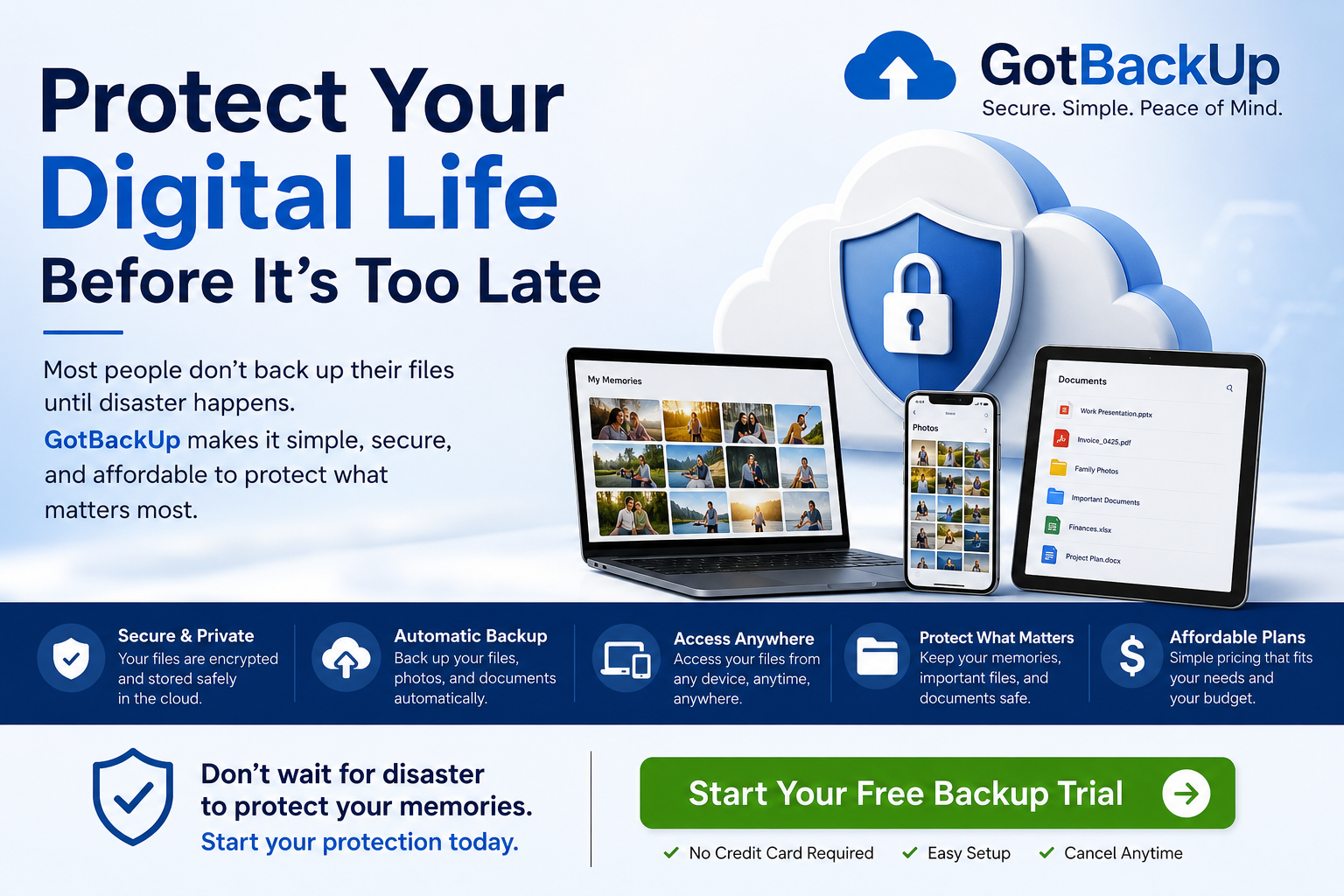
GotBackUp is designed to help people protect their digital files with secure cloud backup.

It is built for people who want a simple, affordable way to back up their photos, files, documents, and important memories.

The goal is not to overwhelm users with complicated technology.

The goal is to help everyday people take a smart step toward digital protection.

Whether you are protecting family memories, business files, personal documents, or creative projects, GotBackUp helps make backup easier and more accessible.

The Best Time to Back Up Is Before You Need It

This is the most important message:

  • The best time to back up your files is not after a computer crash.
  • It is not after your phone is lost.
  • It is not after your photos disappear.
  • It is not after your documents are gone.
  • The best time is before anything happens.

Preparation protects you from regret.

Common Signs You Need Cloud Backup Now

You should consider cloud backup if:

  • You have years of photos on your phone
  • You store important documents on your laptop
  • You use your computer for work or business
  • You have files you cannot easily replace
  • You have never created a backup plan
  • You rely on only one device
  • You are worried about losing family memories
  • You want peace of mind
  • You want a simple way to protect your files

If any of these apply to you, it may be time to take action.

A Simple Backup Mindset

You do not need to be a technology expert to protect your files.

You only need to understand one simple principle:

  • If something matters, it deserves a backup.

That includes your memories, documents, work, personal records, and digital history.

Cloud backup is not complicated when you see it as protection.

It is like locking your door, wearing a seatbelt, or keeping important papers in a safe place.

You hope you never need it, but you are grateful when you do.

Do Not Wait Until Your Files Are Gone To Think About Backup

Protect your photos, documents, business files, and digital memories today.

Your Digital Life Matters. Protect It Before Disaster Happens.


Affiliate & Educational Disclaimer

This article is for educational and informational purposes only. Results, experiences, and benefits may vary depending on each user’s needs, devices, internet connection, and usage habits. Always review the official GotBackUp website, terms, features, pricing, and policies before making a purchase decision. Some links may be affiliate or referral links, which means a commission may be earned if you decide to sign up, at no additional cost to you.

Publicado en Communication, Digital Citizenship, Digital Culture, Education, Social Media, Society, Technology

Cultural Conflicts on Social Media: A Challenge of the Digital Age

By Marvin Gandis

Social media has transformed the way people communicate, learn, express opinions, and connect with the world. Today, one post can reach people from different countries, languages, religions, traditions, and ways of thinking within seconds. This has created powerful opportunities to connect cultures, share knowledge, and open global conversations.

However, it has also created a very visible challenge: cultural conflicts on social media.

Many of these conflicts do not always begin with bad intentions. They often come from a lack of context, different values, stereotypes, misunderstandings, or different ways of interpreting a message. What may seem like a joke to one person may feel offensive to another. What is normal in one culture may be considered disrespectful in another.

That is why understanding cultural conflicts is essential if we want to communicate better in the digital world.


What Are Cultural Conflicts on Social Media?

Cultural conflicts on social media are disagreements, tensions, or confrontations that arise when people from different cultural backgrounds interpret a message, image, comment, video, trend, or online behavior differently.

These conflicts can appear because of differences in:

Religious beliefs, family values, language, humor, politics, traditions, symbols, music, clothing, customs, identity, history, and social norms.

In other words, social media is like a giant global public square where millions of people speak at the same time, but not everyone shares the same cultural context.


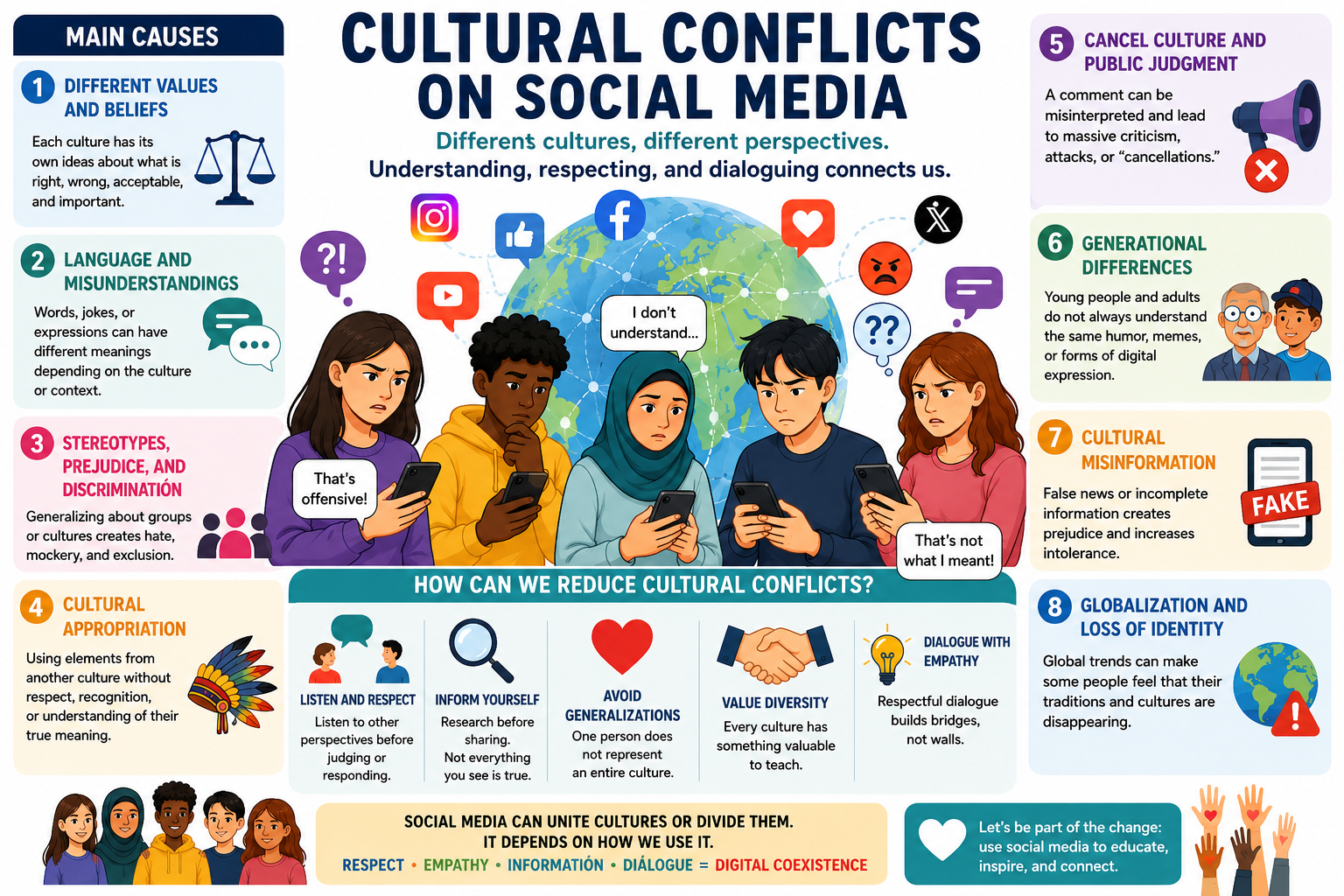
Differences in Values and Beliefs

One of the most common cultural conflicts on social media comes from different values. Topics such as religion, family, politics, freedom of speech, education, gender, and traditions can spark intense debate.

For example, an opinion that may be seen as normal in one society may be viewed as offensive, disrespectful, or even dangerous in another. This happens because every culture has its own way of understanding what is right, wrong, sacred, and acceptable.

The problem grows when people listen only to respond, attack, or win an argument instead of trying to understand.


Language and Misunderstandings

Language is one of the biggest sources of cultural conflict online. A word may have an innocent meaning in one country but be offensive in another. The same happens with jokes, sayings, memes, and popular expressions.

Automatic translations do not always capture tone, intention, or cultural context. This can create unnecessary confusion.

A sarcastic comment may seem aggressive. A direct sentence may appear disrespectful. An emoji may be interpreted differently depending on age, country, or culture.

On social media, it is not only about what is said, but also how it is understood.


Stereotypes, Prejudice, and Discrimination

Another serious conflict on social media is the spread of stereotypes. Many people make general comments about nationalities, races, religions, or cultures without truly understanding those communities.

Statements like “they are all the same,” “those people always do that,” or “that culture is backward” feed prejudice and division.

Social media can spread these messages quickly, creating racism, xenophobia, mockery, and personal attacks. When someone shares discriminatory content, even as a “joke,” it can cause real harm to entire communities.

Digital education must remind us that behind every profile there is a human being with a story, dignity, and culture.


Cultural Appropriation

Cultural appropriation happens when meaningful elements of a culture are used by people outside that culture without respect, understanding, or recognition of their true meaning.

This may include traditional clothing, hairstyles, religious symbols, music, dances, art, words, rituals, or celebrations.

Conflict appears when something that has historical, spiritual, or identity value for a community is used only as fashion, mockery, decoration, or commercial strategy.

Not every cultural exchange is negative. Learning from other cultures can be positive. The problem begins when there is no respect, credit, or sensitivity toward the origin of those cultural elements.


Cancel Culture and Public Judgment

On social media, one post can go viral very quickly. Sometimes a person says something without understanding the cultural impact of their words and receives a wave of criticism, insults, or public rejection.

This is often called “cancel culture.”

While it is important for people to take responsibility for offensive messages, it is also important to distinguish between a mistake, a lack of knowledge, and a real intention to harm.

Social media often reacts quickly, but not always fairly. Cultural conversations should seek correction, learning, and accountability — not only public destruction.


Generational Differences

Cultural conflicts do not only happen between countries. They also happen between generations.

Young people and adults often interpret memes, jokes, social movements, digital trends, and communication styles differently.

For one generation, a post may be funny. For another, it may seem immature, disrespectful, or dangerous. For some adults, certain youth expressions may seem offensive. For many young people, some traditional ideas may seem outdated.

This shows that culture also changes over time.


Misinformation About Cultures

Social media can also spread false or incomplete information about different cultures. An edited video, a fake story, or an unsupported opinion can create a distorted image of a country, religion, or community.

When people believe this information without checking it, prejudice becomes stronger.

Cultural misinformation can create fear, hatred, and division. That is why, before sharing content about a culture, it is important to ask:

  • Is this information true?
  • Do I understand the context?
  • Am I sharing this to educate or to provoke?
  • Could this reinforce a stereotype?

Globalization and Loss of Cultural Identity

Social media promotes global trends. Music, fashion, language, food, lifestyles, and ways of thinking are shared constantly. This can be positive because it connects the world, but it can also create concern.

Some communities feel that their traditions are being replaced by a dominant digital culture that is more commercial, fast-moving, and superficial.

When people begin to abandon their language, customs, or values only to fit into trends, they may feel a loss of identity.

The challenge is to participate in the digital world without forgetting cultural roots.


The Role of Algorithms in Cultural Conflicts

Social media algorithms often promote content that creates strong reactions. Many times, content that causes anger, controversy, or division gets more attention than educational or balanced content.

This can intensify cultural conflicts because people end up seeing posts that reinforce their own ideas and increase rejection toward other groups.

Instead of creating dialogue, social media can create bubbles where each person believes only their worldview is correct.

That is why it is important to follow diverse sources, listen to different perspectives, and not allow the algorithm to completely shape our way of thinking.


How Can We Reduce Cultural Conflicts on Social Media?

The solution is not to stop talking about cultural issues. The solution is to learn how to communicate with more respect, intelligence, and empathy.

Important practices include:

  • Listen before attacking.
    Many arguments could be avoided if people tried to understand before responding.
  • Research before sharing.
    Not everything online is true.
  • Avoid generalizations.
    One person does not represent an entire culture.
  • Respect symbols and traditions from other cultures.
    What looks like a simple decoration to one person may have a deep meaning for another community.
  • Accept correction.
    If someone explains that a comment was offensive, it is better to learn than to defend ourselves with pride.
  • Promote educational conversations.
    Social media can become a space for learning when used responsibly.

Conclusion

Cultural conflicts on social media are a reality of our time. We live in a world more connected than ever, but connection does not always mean understanding.

Social media can unite or divide. It can educate or confuse. It can promote respect or feed prejudice. Everything depends on how we use it.

Every user has a responsibility: think before posting, verify before sharing, and respect before judging.

Cultural diversity should not be seen as a threat. It should be seen as an opportunity to learn, grow, and build more human communication.

In a digital world full of voices, the real challenge is not to speak louder — it is to learn how to listen better.

Before you comment, share, or criticize on social media, take a moment to ask yourself:

Am I building dialogue or increasing conflict?

Social media needs more people who are willing to educate, respect, and listen. Start today by sharing content that unites, teaches, and helps others better understand cultural diversity.


Disclaimer

This article is for educational and informational purposes only. Its goal is to encourage reflection, respect, and cultural understanding in digital spaces. The opinions expressed do not replace professional, legal, psychological, or academic advice.