Publicado en Digital Security, Mindset, Personal Development, Personal Growth, Productivity, Technology

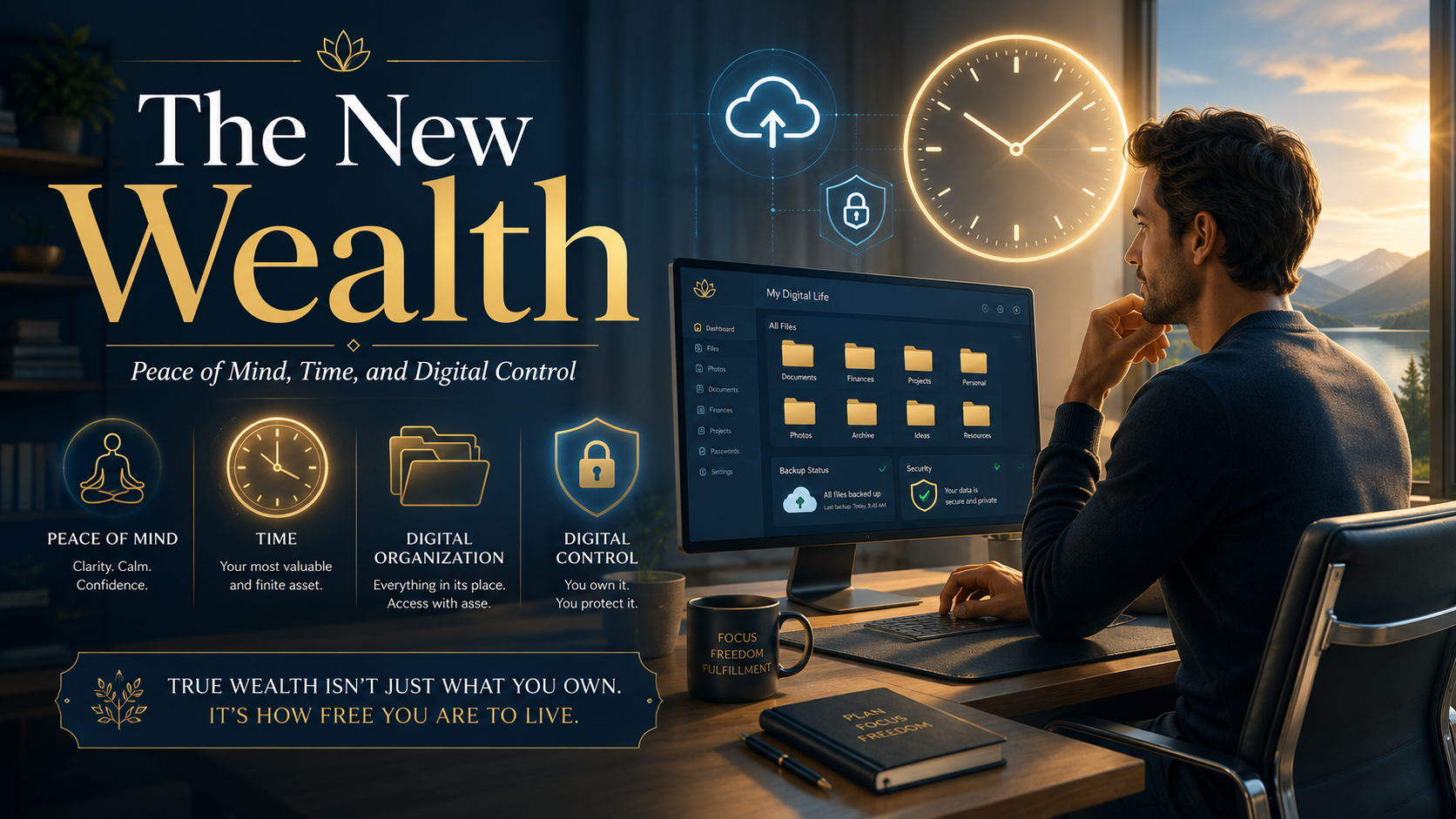
The New Wealth: Peace of Mind, Time, and Digital Control

By Marvin Gandis

Wealth Is No Longer Measured Only by Money

For a long time, many people associated wealth only with money, property, cars, luxury, or high income.

And while money is important, it is not the only form of wealth.

  • You can have money and still live exhausted.
  • You can have income and still have no peace.
  • You can have possessions and still live in disorder.
  • You can have technology and still have no control.
  • You can have opportunities and no time to enjoy them.

In the modern world, a new kind of wealth is becoming more valuable:

peace of mind, time, clarity, digital security, and control over your own life.

Because there is little value in earning more if every day you feel more overwhelmed, distracted, worried, and disconnected from what truly matters.

The new wealth is not only about accumulating more.

It is about living with less chaos and more direction.


Peace of Mind: A Wealth Many People Neglect

Peace of mind does not mean you have no problems.

It means your problems do not completely govern your inner life.

A person can have responsibilities, bills, challenges, projects, and concerns, but still learn to live with more order, faith, and self-control.

Peace of mind grows when you:

  • Organize your priorities.
  • Reduce unnecessary noise.
  • Stop constantly comparing yourself.
  • Respond with wisdom instead of reacting.
  • Learn to rest without guilt.
  • Protect your mind from toxic information.
  • Live aligned with your values.

Peace of mind is not bought like a product. It is cultivated like a discipline.

And in a tired, anxious, distracted society, inner peace is a deep form of wealth.


Time: The Resource You Cannot Recover

Lost money can be recovered.

But lost time does not return the same way.

That is why a truly wise person does not only ask:

“How much does this cost?”

They also ask:

  • “How much time does this consume?”
  • “How much energy does this take from me?”
  • “Does this move me closer to or farther from my purpose?”
  • “Am I using my time or only reacting to what feels urgent?”

Many people are not poor in money, but poor in time.

  • They live rushing.
  • They live answering messages.
  • They live putting out fires.
  • They live busy, but not necessarily progressing.

The new wealth includes learning to protect your schedule, your focus, and your most valuable hours.

Because your life is built on what you give your time to.


Digital Control: A Modern Necessity

We live in an age where much of our life exists in the digital world.

  • Family photos.
  • Personal documents.
  • Work files.
  • Passwords.
  • Emails.
  • Contacts.
  • Ideas.
  • Projects.
  • Memories.
  • Financial information.
  • Content created over the years.

But many people live as if that information could never be lost.

  • Until a phone breaks.
  • A computer fails.
  • An account gets locked.
  • A file disappears.
  • A hard drive stops working.
  • An important document cannot be found.
  • An irreplaceable photo is lost.

Digital control is part of the new wealth because it protects what cannot always be replaced.

It is not about living in fear. It is about living responsibly.


Digital Disorganization Creates Real Stress

Sometimes we think digital clutter does not matter because it is not visible like physical clutter.

But it does affect us.

  • A full inbox can exhaust you.
  • Lost files can delay projects.
  • Disorganized passwords can create anxiety.
  • Photos without backup can become a risk.
  • Important documents without order can cause problems.
  • Constant notifications can destroy focus.

Digital disorder occupies mental space.

And when your mind is filled with invisible pending tasks, your peace decreases.

Organizing your digital world is not a luxury. It is a way of caring for your peace.


Security Is Also Freedom

Many people think of security as something boring.

But security, properly understood, produces freedom.

  • When you know your important files are protected, you breathe easier.
  • When your documents are organized, you work with more clarity.
  • When your photos are backed up, you reduce worry.
  • When your digital tools are organized, you waste less time.
  • When your information is protected, you make better decisions.

Freedom is not living without responsibility.

Freedom is having systems that reduce chaos and increase confidence.

In modern life, a digitally disorganized person can lose time, money, opportunities, and peace.

That is why protecting your digital life is also protecting your future.


More Things Do Not Always Mean More Life

We live surrounded by invitations to have more.

  • More purchases.
  • More apps.
  • More subscriptions.
  • More content.
  • More notifications.
  • More commitments.
  • More goals.
  • More pressure.

But more does not always mean better.

Sometimes, more means more weight.

The new wealth also includes simplifying.

  • Simplify your priorities.
  • Simplify your tools.
  • Simplify your message.
  • Simplify your routines.
  • Simplify your digital space.
  • Simplify the way you work.

It is not about living with less out of obligation. It is about living with intention.

When you reduce what distracts, what matters increases.


True Productivity Is Not Doing More, But Moving Better

Many people confuse productivity with being busy.

But being busy does not always mean progressing.

  • You can answer messages all day and build nothing important.
  • You can consume content for hours and apply nothing.
  • You can have many tasks and no priority.
  • You can work a lot and still have no direction.

True productivity asks:

  • What action has the most value?
  • What should I do first?
  • What can I eliminate?
  • What can I automate?
  • What should I protect?
  • What moves me closer to my purpose?

The new wealth includes working intelligently, not only working tired.


Peace, Time, and Control Are Built With Systems

Life does not improve only through desire.

It improves through decisions and systems.

  • A system to organize your files.
  • A system to protect your data.
  • A system to manage your time.
  • A system to follow up.
  • A system to learn.
  • A system to rest.
  • A system to review your priorities.

Systems do not remove your humanity. They protect it.

When everything depends on your memory, emotion, or energy of the day, you become exhausted more quickly.

But when you have structure, you can move forward with less chaos.


The New Wealth Is Also Spiritual

For a person of faith, wealth cannot be separated from the soul.

  • You can have resources and still feel empty.
  • You can have achievements and still lose peace.
  • You can have opportunities and still forget your purpose.

The new wealth includes asking yourself:

  • Am I living with gratitude?
  • Am I caring for my relationship with God?
  • Am I using my resources wisely?
  • Am I working from purpose or only from pressure?
  • Am I protecting my peace or giving it away to every distraction?

Spiritual peace brings order to what the world often disorders.

It is not about rejecting progress. It is about not losing your soul in the process.


How to Start Building This New Wealth

First, review your peace.

What is stealing your calm? Comparison, disorder, debt, too much information, lack of rest?

Second, protect your time.

Define priorities. Reduce distractions. Learn to say no.

Third, organize your digital world.

Classify documents, clean unnecessary files, back up important information, and protect your access.

Fourth, simplify your commitments.

Not everything deserves your energy.

Fifth, create simple systems.

You do not need to make it perfect. You need to make it sustainable.

Sixth, return to your purpose.

True wealth should help you live better, serve better, and move forward with more clarity.


Being Wealthy Also Means Living With Less Chaos

My dear reader and friend, modern wealth is not only about how much money you have in an account.

  • It is also about how much peace you keep.
  • How much time do you protect?
  • How much control do you have over your digital world?
  • How much clarity guides your decisions?
  • How much freedom do you have to live with purpose?

Do not confuse accumulation with well-being.

  • True wealth does not always shout.
  • Sometimes it looks like a calm mind.
  • An organized calendar.
  • Protected files.
  • Healthy habits.
  • A life with direction.
  • Firm faith.
  • A peaceful heart.

In a world full of noise, disorder, and distractions, living with peace, time, and digital control can be one of the wisest forms of prosperity.

The new wealth is living with less chaos, more security, more clarity, and more purpose.



Disclaimer:


This article is provided for educational, motivational, inspirational, and informational purposes only. It is intended to encourage reflection, personal growth, digital awareness, better organization, responsible decision-making, and a healthier relationship with time, technology, and personal priorities.

The content should not be interpreted as financial, legal, medical, psychological, technological, cybersecurity, spiritual counseling, business, or professional advice. Any examples related to peace of mind, digital organization, digital security, productivity, time management, personal development, faith, business, or life improvement are not guarantees of specific results.

Individual outcomes may vary depending on personal circumstances, effort, consistency, available resources, discipline, technology used, market conditions, emotional readiness, and other factors beyond our control.

Readers are encouraged to use their own judgment, conduct their own research, and seek qualified professional guidance when necessary. The purpose of this content is to inspire and educate, not to promise instant results or replace professional advice.


Publicado en Emotional Intelligence, Faith, Mindset, Personal Development, Personal Growth, Productivity

The Danger of Living in Reaction to Everything

By Marvin Gandis

When Your Life Becomes a Constant Response

Some people do not live with direction. They live in reaction.

  • They react to problems.
  • They react to the news.
  • They react to comments.
  • They react to criticism.
  • They react to fear.
  • They react to debt.
  • They react to emotions.
  • They react to what others do, say, or post.

Little by little, their lives stop being guided by purpose and start being controlled by pressure.

The problem is not responding when something important happens. Life requires attention, responsibility, and action. The problem begins when everything outside you starts deciding your mood, your focus, your decisions, and your peace.

The person who lives reacting to everything eventually loses authority over their own life.

And recovering that authority is one of the most important decisions for living with clarity, faith, and purpose.


Reacting Is Not the Same as Responding

Reacting is acting from impulse.

Responding is acting from wisdom.

Reaction is usually fast, emotional, and poorly considered. Response requires pause, discernment, and direction.

Reaction says:
“I feel attacked, so I will attack.”

Response says:
“I will think before I speak.”

Reaction says:
“I am afraid, so I will make a desperate decision.”

Response says:
“I will evaluate the situation calmly.”

Reaction says:
“Someone ignored me, so I will give up.”

Response says:
“I will not measure my value by an external reaction.”

Maturity does not mean you do not feel. It means you do not allow every emotion to take the wheel.


The World Is Designed to Provoke Reactions

Many digital platforms live by capturing your attention.

  • The more you react, the longer you stay connected.
  • The more upset you become, the more you keep watching.
  • The more fear you feel, the more content you consume.
  • The more you compare, the more you keep checking.
  • Urgent news.
  • Alarming headlines.
  • Offensive comments.
  • Pressure-based offers.
  • Perfect-looking posts.
  • Endless debates.
  • Exaggerated promises.

Everything seems to shout: “React now!”

But not everything deserves your immediate response.

Some things only want your energy, not your growth.

That is why a wise person learns to ask:

“Does this deserve my attention, or is it only trying to steal my peace?”


Living in Reaction Exhausts the Mind

When you react to everything, your mind never rests.

  • One message upsets you.
  • One news story worries you.
  • One comparison discourages you.
  • One criticism consumes you.
  • One debt makes you desperate.
  • One problem paralyzes you.

Then you live in a constant state of alert.

An exhausted mind makes worse decisions.

  • It decides from fear.
  • It speaks from frustration.
  • It buys under pressure.
  • It posts from anxiety.
  • It quits from exhaustion.
  • It promises from emotion.

Mental exhaustion does not always come from working too much. Sometimes it comes from allowing too many things to control your inner life.


Reaction Makes You Lose Direction

When you live in reaction, your priorities become disordered.

  • Today, you follow a plan.
  • Tomorrow you change because you saw something new.
  • Then you quit because someone criticized you.
  • Then you get distracted because others seem to be moving faster.
  • Later, you become desperate because the results are taking time.

This turns your life into a series of movements without direction.

But a life with purpose cannot depend on every emotion of the day.

You need a center.

  • A vision.
  • Faith.
  • A plan.
  • A set of values.
  • A clear reason to continue.

Direction does not remove problems, but it prevents every problem from dragging you away.


Not Every Urgency Is Important

One of the modern traps is confusing urgency with importance.

Something can feel urgent and still not be valuable.

  • A notification can wait.
  • Someone’s opinion can wait.
  • An argument can wait.
  • A comparison can be ignored.
  • A pressure-based offer can be evaluated.
  • A negative comment may not deserve a response.

Important things do not always shout.

Sometimes the important things are quiet:

  • Your health.
  • Your family.
  • Your faith.
  • Your discipline.
  • Your learning.
  • Your rest.
  • Your strategy.
  • Your character.
  • Your relationship with God.
  • Your purpose.

If you only respond to what feels urgent, you may neglect what is truly important.


Emotions Are Signals, Not Rulers

Emotions have value.

  • Fear can alert you.
  • Sadness can show you a wound.
  • Frustration can reveal something that needs attention.
  • Joy can confirm something good.
  • Uneasiness can invite you to review.

But emotions should not rule every decision.

  • Feeling fear does not always mean you should stop.
  • Feeling tired does not always mean you should quit.
  • Feeling angry does not always mean you should speak.
  • Feeling doubt does not always mean you should abandon.
  • Feeling pressure does not always mean you should act quickly.

Emotions should be heard, but not always obeyed.

Wisdom means recognizing what you feel without becoming a slave to what you feel.


The Pause Can Save Your Decisions

One of the most powerful tools for stopping reaction-based living is learning to pause.

  • Pause before answering a difficult message.
  • Pause before making a financial decision.
  • Pause before posting from anger.
  • Pause before quitting.
  • Pause before believing a news story.
  • Pause before comparing yourself.
  • Pause before saying something you cannot take back.

The pause is not a weakness. It is self-control.

A pause can give you time to pray, think, breathe, review, and decide with more clarity.

Many bad decisions are born from emotion without pause.

Many wise decisions are born from a purposeful pause.


Living With Direction Requires Deciding What You Will Not Allow

It is not enough to know what you want. You must also know what you will not allow to control your life.

  • I will not allow every criticism to define my identity.
  • I will not allow every news story to steal my peace.
  • I will not allow every comparison to destroy my gratitude.
  • I will not allow every emotion to rule my decisions.
  • I will not allow every distraction to hijack my purpose.
  • I will not allow fear to decide my future.

This is not arrogance. It is a responsibility.

Your peace needs boundaries.

Your focus needs protection.

Your purpose needs direction.


How to Stop Living in Reaction

First, identify your triggers.

What makes you lose your calm? Criticism? Silence? Comparison? Money? News? Lack of results?

Second, create space before acting.

Breathe. Pray. Walk. Write. Wait. Not everything needs an immediate response.

Third, define your priorities.

When you know what matters, it becomes easier to ignore what distracts.

Fourth, reduce unnecessary noise.

You do not have to consume everything. You do not have to respond to everything. You do not have to know everything.

Fifth, practice self-control.

Self-control does not mean you do not feel. It means you wisely choose how to act.

Sixth, return to your purpose.

When the world gets loud, remember who you are, what you are building, and why you started.


Peace Is Not the Absence of Problems, It Is Inner Government

Many people wait to have peace until everything calms down.

But mature peace may not depend on everything being perfect.

Mature peace is learning not to surrender control of your inner life to every external situation.

  • You can have problems and still think clearly.
  • You can receive criticism and still keep your identity.
  • You can face delays and continue.
  • You can feel fear and still act with faith.
  • You can live in a noisy world and still keep your center.

This kind of peace does not happen by accident.

It is cultivated through faith, discipline, wisdom, boundaries, and direction.


Do Not Hand Over the Wheel of Your Life

My dear reader and friend, not everything happening around you deserves to control what happens inside you.

  • You do not have to react to every comment.
  • You do not have to chase every trend.
  • You do not have to absorb every news story.
  • You do not have to compare yourself with every person.
  • You do not have to respond to every emotion.
  • You can pause.
  • You can think.
  • You can pray.
  • You can choose.
  • You can respond with wisdom.

Living with direction does not mean ignoring reality. It means facing reality without allowing it to destroy your peace, focus, and purpose.

  • Do not live as a constant reaction.
  • Live as a person with center, values, and direction.

Because the person who learns to respond with wisdom recovers authority over their life.


Disclaimer:


This article is provided for educational, motivational, inspirational, and informational purposes only. It is intended to encourage reflection, emotional awareness, self-control, personal growth, faith, mental clarity, and responsible decision-making.

The content should not be interpreted as financial, legal, medical, psychological, spiritual counseling, business, or professional advice. Any examples related to emotional intelligence, personal development, faith, mindset, discipline, productivity, leadership, communication, or life improvement are not guarantees of specific results.

Individual outcomes may vary depending on personal circumstances, effort, consistency, emotional readiness, environment, available resources, support systems, timing, discipline, and other factors beyond our control.

Readers are encouraged to use their own judgment, conduct their own research, and seek qualified professional guidance when necessary. The purpose of this content is to inspire and educate, not to promise instant results or replace professional advice.

Publicado en Discipline, Faith, Mindset, Motivation, Personal Development, Personal Growth

Silent Discipline: What You Build When Nobody Is Watching

By Marvin Gandis

The Invisible Also Builds Your Future

There is a part of life almost nobody sees.

  • It does not appear in photos.
  • It does not receive applause.
  • It does not always generate comments.
  • It is not published as an achievement.
  • It does not look impressive from the outside.

But that silent part can be one of the most important.

It is what you do when nobody is watching.

  • The way you work when there is no recognition.
  • The way you keep learning when nobody congratulates you.
  • The honesty with which you fulfill your responsibilities.
  • The discipline with which you do what is right, even when nobody notices.
  • The faithfulness with which you keep planting, even when you do not yet see fruit.

We can call this silent discipline.

And many times, what a person builds in silence determines what they will be able to sustain in public.


Character Is Formed When Nobody Is Watching

Public image can impress, but private character sustains.

Many people want to be recognized, admired, and respected, but they neglect what they do in private.

However, life eventually reveals what a person has truly built.

  • If someone practices responsibility in silence, it eventually shows.
  • If someone develops patience in small things, it eventually shows.
  • If someone learns to be honest when nobody supervises them, it eventually shows.
  • If someone works with excellence even when nobody applauds, it eventually shows.

Character is not improvised in the moment of opportunity.

It is trained beforehand.


Discipline Does Not Always Feel Inspiring

Many times, we think discipline should feel exciting.

But real discipline is usually simple, repetitive, and humble.

  • Getting up and doing what is right.
  • Finishing what you started.
  • Studying even when you do not feel like it.
  • Organizing what you have postponed.
  • Responding with respect.
  • Correcting a mistake.
  • Keeping a promise.
  • Following up.
  • Trying again.

Discipline does not always come with emotion. Many times, it comes with a decision.

It does not say, “Today I feel motivated.”

It says, “Today I will do what is necessary.”

That attitude may look small, but over time, it builds a stronger life.


Small Things Repeated Have Power

A common mistake is despising small actions.

  • One post.
  • One email.
  • One call.
  • One prayer.
  • One written page.
  • One reading session.
  • One training.
  • One adjustment.
  • One honest conversation.
  • One daily improvement.

By themselves, they may seem small.

But repeated with consistency, they can change a life.

  • A drop may not seem strong, but over time it can mark stone.
  • A seed may seem small, but it can become a tree.
  • A habit may seem simple, but it can define a destiny.

Silent discipline understands that small things are not insignificant when repeated with purpose.


Public Life Cannot Sustain What Private Life Has Not Formed

Many people desire more opportunities, more audience, more sales, more leadership, more influence, and more results.

But they are not always ready to sustain what they desire.

  • A big opportunity can reveal how little preparation is needed.
  • A large platform can expose a weak character.
  • A major responsibility can break neglected discipline.
  • A great blessing can become a burden without maturity.

That is why, before asking for more, we should ask ourselves:

  • Am I strengthening my private life?
  • Am I faithful in small things?
  • Am I being responsible with what I already have?
  • Am I developing habits that can sustain growth?
  • Am I building character or only seeking visibility?

Silent preparation is not wasted time. It is a foundation.


Silent Discipline Protects Your Purpose

Purpose needs protection.

Not everything that distracts you looks bad. Some distractions seem urgent, interesting, or justified.

But little by little, they can steal focus.

  • Watching too much of what others are doing.
  • Constantly comparing yourself.
  • Changing direction every week.
  • Living in reaction to comments.
  • Quitting when results are not fast.
  • Depending on emotion to take action.

Silent discipline helps you return to the center.

  • It reminds you what you are building.
  • It helps you say no.
  • It helps you manage your time.
  • It helps you continue even when the process is slow.
  • It helps you work with direction, not only impulse.

A disciplined person does not live enslaved to every distraction.

They live guided by purpose.


Nobody Can Do Your Part For You

  • You can receive advice.
  • You can read books.
  • You can take courses.
  • You can listen to messages.
  • You can have mentors.
  • You can receive encouragement.
  • You can pray and ask for direction.

All of that helps.

But there is a part nobody can do for you.

  • Nobody can practice for you.
  • Nobody can organize your life for you.
  • Nobody can take action for you.
  • Nobody can develop your habits for you.
  • Nobody can defeat your excuse for you.
  • Nobody can be consistent for you.

Silent discipline begins when you accept personal responsibility without living under condemnation.

It is not about punishing yourself. It is about taking ownership.


God Also Sees What Others Do Not See

For a person of faith, this is deeply important:

God sees what others do not see.

  • He sees the prayer nobody heard.
  • He sees the effort nobody applauded.
  • He sees the tear nobody noticed.
  • He sees the right decision that nobody celebrated.
  • He sees the sacrifice nobody understood.
  • He sees faithfulness in small things.

This does not mean we should not seek excellence, results, or growth. But it does mean our value does not depend only on human approval.

There are silent acts of obedience that carry great spiritual weight.

There are hidden processes that form depth.

And there are private seasons where God prepares what He will later use with purpose.


Discipline Is Also Learned Through Failure

Being disciplined does not mean never failing.

It means learning to return.

  • There will be difficult days.
  • There will be moments of exhaustion.
  • There will be distractions.
  • There will be mistakes.
  • There will be weeks when you do not do everything as you wanted.
  • There will be times when you lose rhythm.

But a fall does not have to become abandonment.

Mature discipline says:

  • “I failed, but I return.”
  • “I fell behind, but I continue.”
  • “I made a mistake, but I corrected it.”
  • “I lost focus, but I return to my purpose.”

You do not need perfection to grow.

You need honesty, humility, and constant return.


How to Practice Silent Discipline

First, define what truly matters.

You cannot be disciplined in everything at the same time. Choose clear priorities.

Second, create small routines.

A simple routine sustained over time is worth more than a huge plan abandoned in three days.

Third, eliminate unnecessary distractions.

Not everything deserves your attention. Protect your focus.

Fourth, keep small promises.

Self-trust grows when you do what you said you would do.

Fifth, review your progress without destroying yourself.

Evaluate, correct, and continue. Do not use your mistakes as an excuse to quit.

Sixth, work even when nobody applauds.

The reward does not always come immediately, but character is being formed.

Seventh, keep your purpose in front of you.

When you remember why you are doing something, it becomes easier to endure the process.


What You Build in Silence May Speak Later

Maybe today nobody sees your effort.

  • Maybe nobody notices your habits.
  • Maybe nobody applauds your consistency.
  • Maybe nobody understands your process.
  • Maybe nobody recognizes how much it costs you to keep going.

But that does not mean you are not building.

  • You are building character.
  • You are building endurance.
  • You are building clarity.
  • You are building maturity.
  • You are building confidence.
  • You are building a foundation for what is coming.

And when the right time arrives, many things that seemed invisible will begin to make sense.


Silent Discipline Is Inner Power

My dear reader and friend, do not underestimate what you do when nobody is watching.

  • Do not underestimate the page you write.
  • Do not underestimate the prayer you pray.
  • Do not underestimate the habit you correct.
  • Do not underestimate the promise you keep.
  • Do not underestimate the small step you repeat.
  • Do not underestimate the right decision you make in silence.

Because the invisible also shapes your future.

Silent discipline does not seek to impress. It seeks to build.

It does not depend on applause. It depends on the purpose.

It is not fed only by emotion. It is sustained by a decision.

And even if nobody sees it today, what you are forming in private may sustain tomorrow’s opportunities.

What you do when nobody is watching reveals the kind of future you are preparing.


Disclaimer:


This article is provided for educational, motivational, inspirational, and informational purposes only. It is intended to encourage reflection, personal growth, discipline, faith, consistency, responsibility, and responsible decision-making.

The content should not be interpreted as financial, legal, medical, psychological, spiritual counseling, business, or professional advice. Any examples related to personal development, discipline, habits, faith, success, leadership, productivity, or life improvement are not guarantees of specific results.

Individual outcomes may vary depending on effort, consistency, personal circumstances, discipline, available resources, emotional readiness, timing, environment, and other factors beyond our control.

Readers are encouraged to use their own judgment, conduct their own research, and seek qualified professional guidance when necessary. The purpose of this content is to inspire and educate, not to promise instant results or replace professional advice.