Publicado en Communication, Emotional Intelligence, Human Relationships, Motivation, Personal Development, Reflection

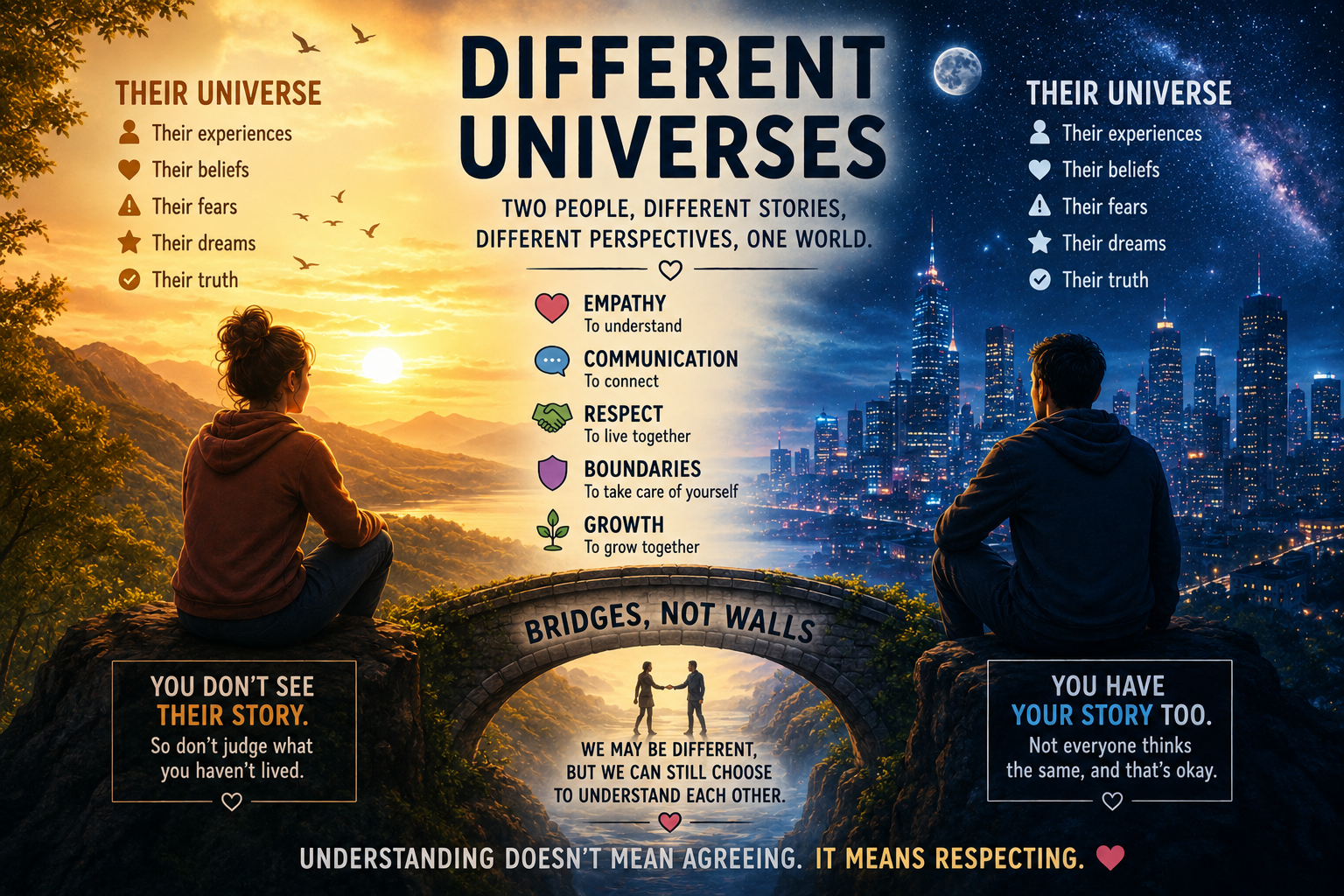
Different Universes: When Two People See Life from Completely Different Worlds

por Marvin Gandis

Introduction: Not Everyone Lives in the Same World

We may walk under the same sky, live on the same planet, and share the same moments in time, but the truth is this: not everyone lives in the same emotional, mental, or spiritual universe.

Some people see opportunity where others see problems. Some people experience silence as peace, while others feel it as rejection. Some people dream big, while others are simply trying to survive the day. Some love openly. Others love carefully because life taught them to protect their hearts.

That is why we can say that every person carries a different universe within.

These are not distant planets or invisible galaxies. These are the experiences, wounds, beliefs, values, dreams, fears, and memories that shape how each human being interprets life.

Many conflicts do not happen because someone is bad. They happen because two people are looking at the same situation from completely different universes.


Every Person Carries an Inner Universe

Every human being is a collection of stories.

What someone believes today did not appear out of nowhere. Their opinions, reactions, boundaries, insecurities, and decisions come from a path you may not fully know.

  • A person who has been betrayed may take longer to trust.
  • A person who grew up with scarcity may fear spending money.
  • A person who has been rejected may interpret correction as criticism.
  • A person who has failed many times may be afraid to try again.

This does not mean every behavior should be excused. But it does mean we should learn to look deeper than the surface.

Sometimes we judge a reaction without knowing the story that created it.

Every person lives inside a universe shaped by experience. When we understand this, we stop reacting with harshness and begin responding with wisdom.


The Problem Is Not Always Difference, But Lack of Understanding

Differences do not destroy relationships. The inability to understand them does.

Two people can think differently and still respect each other. They can disagree and still communicate with maturity. They can have different goals and still support one another.

The problem begins when we believe our universe is the only valid one.

Statements like these create distance:

  • “I am right.”
  • “You are wrong.”
  • “If you don’t think like me, you don’t understand.”
  • “Your way of seeing life makes no sense.”

But maturity begins when we can say:

  • “I don’t see it the same way, but I want to understand you.”
  • “I don’t share your opinion, but I respect your experience.”
  • “I don’t know your pain, but I am willing to listen.”
  • “We have not lived the same life, but we can still learn from each other.”

That attitude changes conversations. It heals wounds. It builds bridges where walls once stood.


Two People Can Look at the Same Thing and See Different Realities

Imagine two people looking at heavy rain.

One says:


“What a sad day.”

The other says:


“What a blessing for the earth.”

They are looking at the same rain, but they are not seeing the same reality.

Why? Because we do not only react to what happens. We react according to what it means to us.

  • For one person, starting over may feel exciting. For another, it may feel terrifying.
  • For one person, being alone may feel peaceful. For another, it may feel painful.
  • For one person, criticism may feel like growth. For another, it may feel like rejection.
  • For one person, change may feel like freedom. For another, it may feel like a loss.

The outside world may be the same, but the inner world changes the interpretation.

That is why, before saying, “You are overreacting,” maybe we should ask:


“What does this mean to you?”

That question can open a door that judgment never could.


Empathy Is the Bridge Between Different Universes

Empathy does not mean agreeing with everything. It means trying to understand where the other person is speaking from.

It is not saying:


“I would do the same thing.”

It is saying:


“I may not experience this the same way, but I understand that it matters to you.”

Empathy is a bridge. It connects worlds that seem far apart.

When a person feels heard, their defenses begin to lower. When they feel respected, they become more open. When they feel understood, they stop fighting so hard for validation.

Many arguments are not truly about finding an immediate solution. They are about being seen, heard, and acknowledged.

Sometimes people do not need you to win a debate. They need to feel that they are not alone in their pain, confusion, or struggle.


Not Everyone Is at the Same Level of Awareness

One of life’s greatest lessons is understanding that not everyone is at the same stage of growth.

  • Some people are awakening.
  • Some are healing.
  • Some are still trapped in old wounds.
  • Some are learning to forgive.
  • Some still do not know how to express what they feel.

You cannot always expect a mature response from someone who is still operating from pain. You cannot force someone to see a truth they are not ready to face.

This does not mean you should allow abuse, manipulation, or disrespect. It means you can set boundaries without hatred.

You can say:

  • “I respect you, but I cannot allow this behavior.”
  • “I understand that you are hurt, but that does not justify hurting me.”
  • “I wish you well, but I need to protect my peace.”
  • “We can think differently, but we cannot treat each other with contempt.”

Maturity is not tolerating everything. Maturity is knowing how to love, understand, and set limits when necessary.


Social Media Has Multiplied Different Universes

Today we are more connected than ever, but not always more united.

Social media allows us to see the thoughts, beliefs, emotions, and opinions of thousands of people. But it has also created echo chambers where each group believes its view is the only correct one.

  • Online, many people do not communicate to understand. They communicate to win.
  • They do not listen to learn. They listen to respond.
  • They do not always seek the truth. They seek applause.

That is why we see so many digital conflicts: cultural, political, religious, personal, and emotional.

But behind every comment is a person. Behind every opinion is a story. Behind every reaction is an inner universe we may not know.

  • Before attacking, we can pause.
  • Before mocking, we can think.
  • Before responding with anger, we can ask ourselves:
    “Am I building a bridge or starting a fire?”

Loving Someone Also Means Learning Their Universe

In personal, family, professional, or romantic relationships, love does not mean the other person thinks exactly like us.

Love also means learning their emotional language.

  • Some people express love with words.
  • Others with actions.
  • Others with time.
  • Others with service.
  • Others with protection.
  • Others with silence because they never learned how to say what they feel.

The mistake is believing everyone loves in the same way.

Sometimes someone does care, but they do not know how to show it in the way you expect. Sometimes, someone is fighting an inner battle while you believe they simply do not care.

That is why communication matters.

  • It is not enough to assume. We must ask.
  • It is not enough to wait. We must express.
  • It is not enough to love. We must learn to love in a way that the other person can recognize.

You Must Also Respect Your Own Universe

Understanding others does not mean abandoning yourself.

Your universe matters too. Your emotions, boundaries, dreams, values, and peace also deserve respect.

Sometimes we try so hard to understand others that we end up justifying what damages us. That is not empathy. That is self-abandonment.

  • You can be understanding without allowing yourself to be destroyed.
  • You can be patient without losing your dignity.
  • You can love without begging.
  • You can listen without carrying responsibilities that do not belong to you.

Respecting your own universe means recognizing:

  • “This affects me.”
  • “This is not healthy for me.”
  • “I need space.”
  • “I also deserve peace.”
  • “My way of feeling is valid too.”

True connection should never require you to disappear so someone else can feel comfortable.


Wisdom Is Learning Without Losing Yourself

Life brings us across people who are very different from us. Some inspire us. Others challenge us. Some heal us. Others teach us boundaries.

Every person can be a teacher, even when the lesson is painful.

  • Some teach you patience.
  • Others teach you discernment.
  • Others teach you not to trust too quickly.
  • Others teach you to open your heart again.
  • Others teach you to choose yourself.

Different universes are not always meant to stay together. Sometimes they cross paths only to teach each other something.

And that is okay.

Not every connection is meant to become permanent. Some people arrive as chapters, not entire books.

Wisdom is learning the lesson without remaining trapped in the pain.


How to Connect with People Who Live in Different Universes

Here are some practical keys:

Listen before responding

Do not listen only to defend yourself. Listen to discover what is behind the words.

Ask honest questions

Questions like “Why is this important to you?” can reveal more than an hour of arguing.

Do not immediately assume negative intention

Sometimes people are not trying to hurt you. They simply do not know how to communicate better.

Communicate your boundaries clearly

Understanding does not remove the need for respect.

Learn to release useless arguments

Not every discussion deserves your energy.

Practice humility

Your way of seeing life may be valid, but it is not the only one.

Protect your peace

You can love people from a distance if their universe has become destructive to yours.


We Can Be Different Without Becoming Enemies

Living in different universes does not have to separate us. It can teach us.

It teaches us that life is bigger than our opinion. That every person carries invisible battles. That empathy can open doors. That respect can heal conversations. That boundaries are also a form of self-love.

We do not have to think the same way to treat each other with dignity. We do not have to share the same story to listen with respect. We do not have to live in the same universe to build a bridge.

Maybe true growth begins when we stop demanding that everyone sees life the way we do and start asking:

  • “What does the world look like from where you are standing?”

Because when we learn to see from another universe, we do not lose our own. We expand it.


Today, before judging someone for thinking differently, pause.

Listen deeper. Ask with humility. Respond with wisdom.

And remember:

A true connection is not born when everyone thinks the same.

It is born when we learn to respect one another,

even when we see life from different universes.


Disclaimer

This article is for educational, motivational, and reflective purposes only. It does not replace professional psychological, medical, legal, spiritual, or personal counseling. Every person and situation is different. If you are experiencing deep emotional conflict, abusive relationships, or situations that affect your well-being, seek qualified professional support.
Publicado en Emotional Strength, Mindset, Motivation, Personal Development, Self-Mastery, Stoic Wisdom

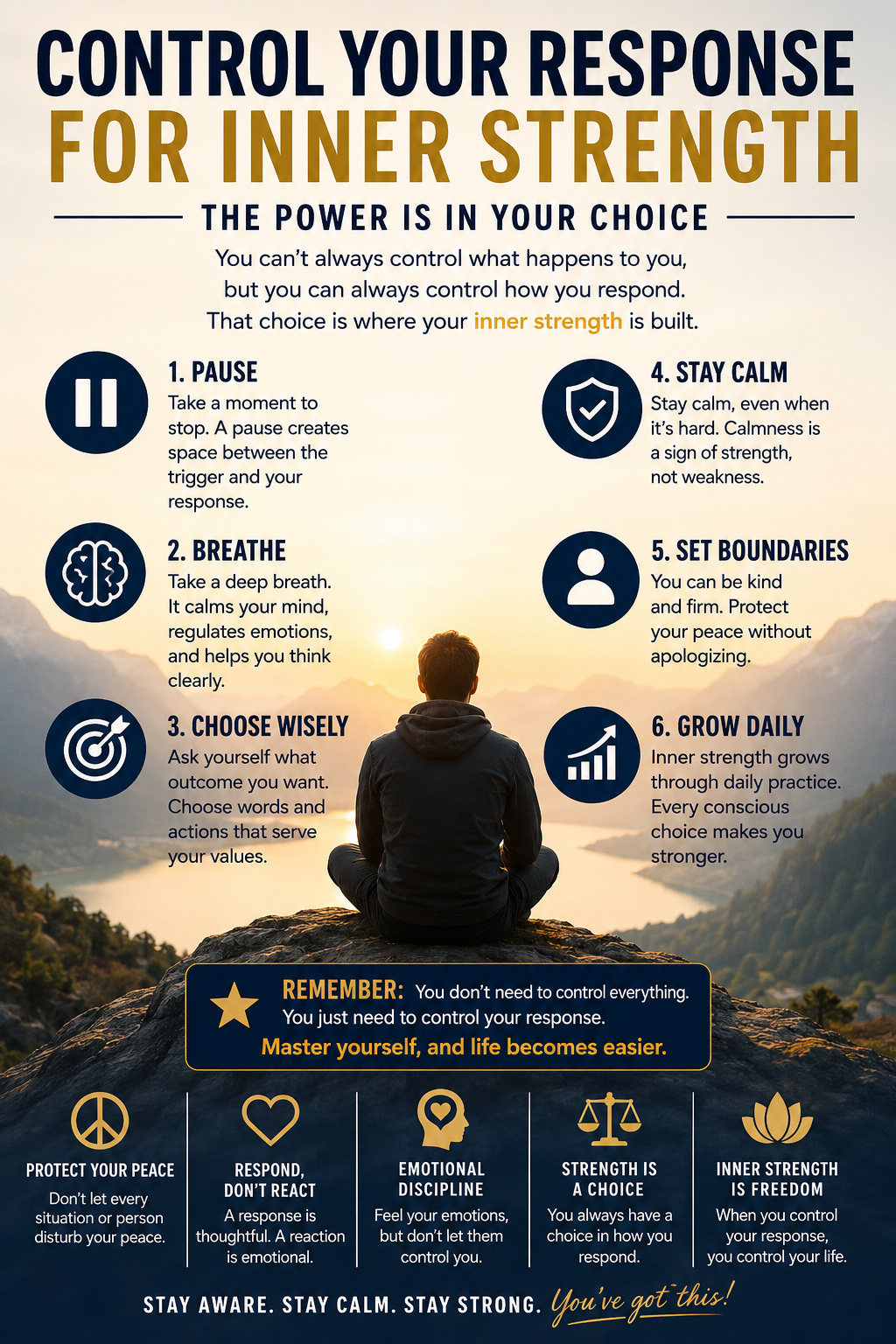
Control Your Response for Inner Strength: The Quiet Power of Self-Mastery

by Marvin Gandis

There is a powerful moment between what happens to you and how you respond.

That moment may be small. It may last only a few seconds. But inside that small space lives your strength, your wisdom, your peace, and your personal power.

Many people believe strength means speaking louder, reacting faster, or proving a point immediately. But true inner strength is often quiet. It is the ability to pause when emotions rise. It is the discipline to choose wisdom over impulse. It is the maturity to respond with purpose instead of reacting to pain.

Life will test everyone. People may disappoint you. Situations may change unexpectedly. Plans may fail. Words may hurt. Delays may frustrate you. But even when you cannot control everything around you, you can learn to control the way you respond.

That is where real strength begins.


The Difference Between Reacting and Responding

A reaction is usually emotional, fast, and uncontrolled. It often comes from anger, fear, pride, frustration, or insecurity.

A response is different. A response is chosen. It comes from awareness. It allows you to think, breathe, and decide what kind of person you want to be in that moment.

Reacting says, “I must defend myself right now.”

Responding says, “Let me handle this with wisdom.”

Reacting can damage relationships, create regret, and make a temporary problem worse. Responding can protect your peace, strengthen your character, and help you make better decisions.

You cannot always choose what happens, but you can choose whether your next action comes from weakness or strength.


Inner Strength Begins With the Pause

One of the most powerful habits you can develop is the pause.

Before answering a rude comment, pause.

Before sending an emotional message, pause.

Before deciding while angry, pause.

Before judging someone’s intention, pause.

The pause is not a weakness. The pause is power under control.

When you pause, you give your mind time to catch up with your emotions. You create space between the trigger and your response. In that space, you can ask yourself:

  • “Is this worth my peace?”
  • “Will my response solve the problem or make it worse?”
  • “Am I speaking from wisdom or from wounded pride?”
  • “What kind of example do I want to be right now?”

These questions can protect you from unnecessary conflict and emotional regret.


Emotional Control Is Not Emotional Suppression

Controlling your response does not mean pretending you are not hurt. It does not mean ignoring injustice. It does not mean allowing people to disrespect you.

Emotional control means you do not allow your emotions to drive without direction.

You can feel anger without becoming destructive.

You can feel pain without becoming bitter.

You can feel disappointment without losing your dignity.

You can set boundaries without cruelty.

You can speak the truth without losing control.

Real emotional strength is not about being cold or silent. It is about being clear, calm, and intentional.


Why Your Response Reveals Your Character

Anyone can act calm when life is easy. But pressure reveals what has been built inside.

Your response under pressure shows your level of discipline, patience, wisdom, and maturity. When you are provoked and still choose respect, that is strength. When you are misunderstood and still choose peace, that is strength. When you are disappointed and still choose faith, that is strength.

The strongest people are not those who never feel emotion. They are those who do not become slaves to every emotion they feel.

Your response is your signature. It tells the world what controls you.

Does anger control you?

Does fear control you?

Does pride control you?

Or do wisdom, faith, and discipline guide your actions?


The Cost of Uncontrolled Reactions

Uncontrolled reactions can be expensive.

They can cost you peace.

They can damage relationships.

They can close opportunities.

They can create unnecessary enemies.

They can cause you to say words you later wish you could take back.

A moment of reaction can create days, months, or even years of consequences.

This is why self-control is not just a personal virtue. It is a life strategy.

Every time you control your response, you protect your future. You protect your reputation. You protect your emotional energy. You protect the person you are becoming.


How to Control Your Response in Difficult Moments

The first step is awareness. Notice what triggers you. Is it criticism? Rejection? Delay? Disrespect? Feeling ignored? Feeling misunderstood?

When you know your triggers, you can prepare yourself instead of being controlled by surprise.

The second step is breathing. A slow breath can interrupt an emotional reaction. It gives your nervous system a signal that you are safe and do not need to explode.

The third step is choosing your words carefully. Not every thought needs to become a sentence. Not every emotion needs to become an announcement. Not every argument deserves your energy.

The fourth step is asking yourself what outcome you want. Do you want peace? Do you want clarity? Do you want a resolution? Do you want to protect your dignity?

Your response should serve your purpose, not your impulse.


Silence Can Be a Strong Response

Sometimes the strongest response is silence.

Silence does not always mean you have nothing to say. Sometimes it means you have too much wisdom to waste words in the wrong place.

You do not need to attend every argument.

You do not need to correct every misunderstanding.

You do not need to prove yourself to people committed to misjudging you.

Silence can protect your peace. Silence can give you time to think. Silence can prevent emotional damage. Silence can show that you are not controlled by every provocation.

But silence should be used with wisdom. There are moments to speak, and there are moments to step back. Inner strength is knowing the difference.


Boundaries Are Part of Inner Strength

Controlling your response does not mean allowing people to walk over you.

A calm person can still be firm.

A peaceful person can still say no.

A kind person can still create distance.

A mature person can still refuse disrespect.

Boundaries are not anger. Boundaries are clarity.

You can say:

“I need time to think before I answer.”

“I do not want to continue this conversation if it becomes disrespectful.”

“I understand your point, but I do not agree.”

“I choose not to respond in anger.”

“This is not healthy for me, so I need to step away.”

These statements are not weak. They are powerful because they are controlled, clear, and respectful.


Inner Strength Grows Through Daily Practice

Self-control is not built in one day. It is developed through small daily decisions.

Every time you choose patience instead of irritation, you grow stronger.

Every time you choose understanding instead of judgment, you grow stronger.

Every time you choose discipline instead of impulse, you grow stronger.

Every time you choose peace instead of drama, you grow stronger.

Inner strength is like a muscle. It grows through resistance.

The difficult person, the delay, the criticism, the disappointment, and the unexpected problem may all become training grounds for your character.

You do not have to like the test to grow from it.


Choose the Person You Want to Become

Before you respond, remember this:

Your response is not only about the situation. It is also about your identity.

Are you becoming a person of peace?

Are you becoming a person of wisdom?

Are you becoming a person of emotional maturity?

Are you becoming someone who can be trusted under pressure?

Every response is a vote for the person you are becoming.

Do not let temporary emotions make permanent decisions for you. Do not let someone else’s behavior pull you away from your values. Do not give your peace away to every situation that demands a reaction.

You are stronger when you are not easily controlled.

You are wiser when you do not answer everything immediately.

You are freer when your emotions inform you but do not rule you.


Final Reflection

Inner strength is not proven by how forcefully you react. It is proven by how wisely you respond.

Life will continue to bring pressure, conflict, disappointment, and unexpected challenges. But you can train yourself to pause, breathe, think, and choose.

That choice is your power.

Control your response, and you will protect your peace.

Control your response, and you will strengthen your character.

Control your response, and you will discover that real power is not found in controlling others.

Real power is found in mastering yourself.


Today, choose one situation where you normally react quickly

Pause before responding. Breathe. Think. Choose peace, wisdom, and strength.

Your response can become the doorway to your inner freedom.


Disclaimer

This article is for educational and motivational purposes only. It is not professional mental health, medical, legal, or financial advice. If you are dealing with severe emotional distress, trauma, abuse, or a crisis situation, please seek guidance from a qualified professional or trusted support service.

Publicado en Leadership, Mental Clarity, Mindset, Motivation, Personal Development, Productivity, Self-Improvement

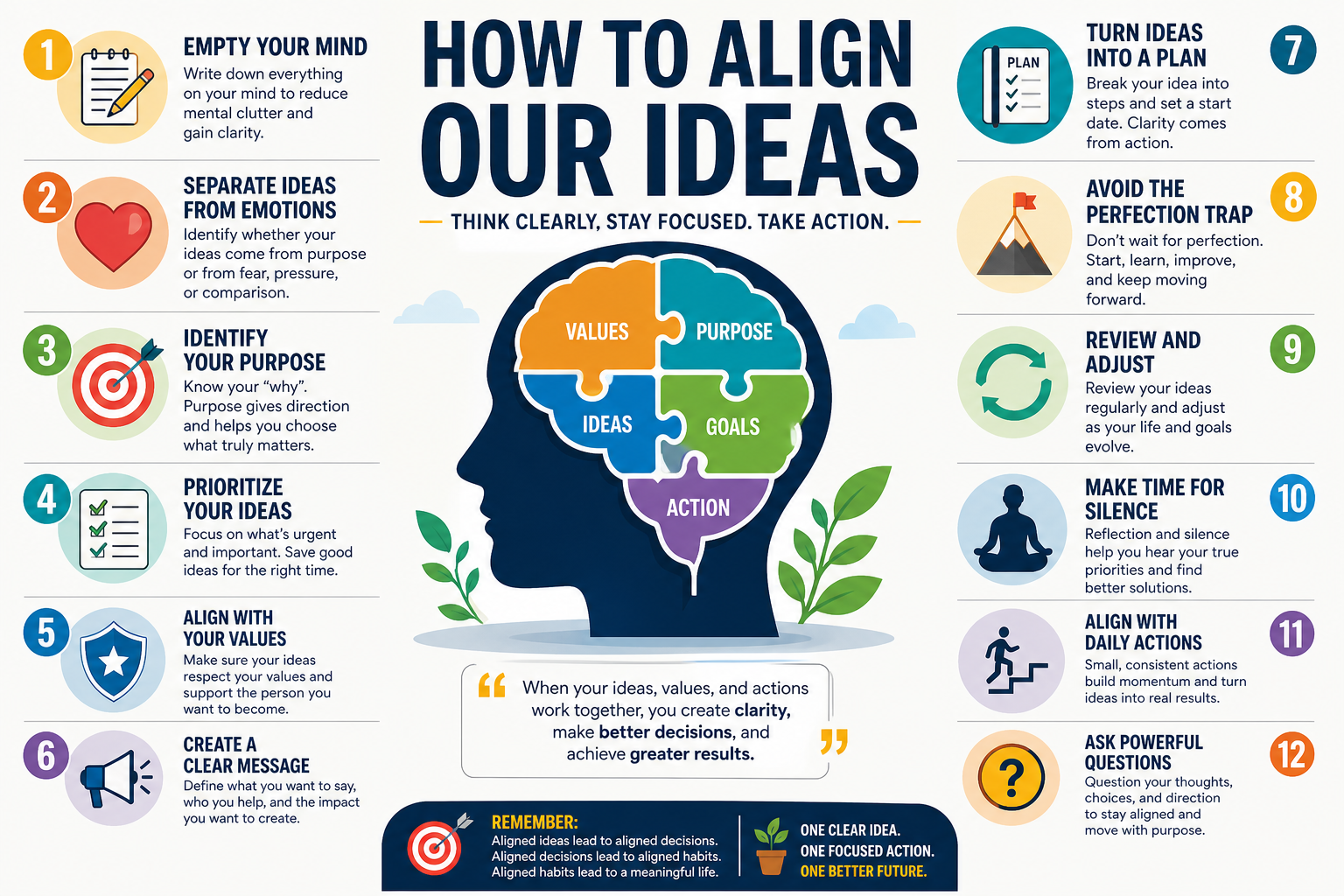
A Practical Guide to Think Clearly, Act with Purpose, and Create Better Results

Por Marvin Gandis

When Ideas Are Not Aligned, Life Feels Heavy

We all experience moments when the mind feels like a messy room: too many ideas, too many plans, too many worries, and not enough clarity.

  • We want to move forward, but we do not know where to begin.
  • We want to make decisions, but doubt gets in the way.
  • We want to create something meaningful, but our ideas seem to compete against each other.

The truth is simple: a scattered mind often creates scattered actions. But an aligned mind can turn confusion into direction, fear into decision, and loose ideas into real progress.

Aligning our ideas does not mean having everything perfect. It means learning how to organize what we think, understand what we truly want, and act according to our values, goals, and purpose.


What Does It Mean to Align Our Ideas?

Aligning our ideas means bringing our thoughts, goals, emotions, values, and actions into the same direction.

Many people live with conflicting ideas:

  • They want change, but keep repeating old habits.
  • They want peace, but feed worry every day.
  • They want success, but constantly doubt themselves.
  • They want to help others, but cannot organize their message.
  • They want progress, but never define priorities.

When our ideas are not aligned, we lose energy. When they are aligned, we gain clarity, confidence, and direction.

Alignment begins with one honest question:

Are my thoughts, words, and actions working together,

Or are they contradicting each other?


The First Step: Empty the Mind

Before we organize our ideas, we need to get them out of our heads.

Many times, we think we have a motivation problem when, in reality, we have a mental overload problem.

Take a notebook, a sheet of paper, or a digital note and write down everything on your mind:

  • Business ideas.
  • Concerns.
  • Unfinished goals.
  • Tasks.
  • Dreams.
  • Frustrations.
  • Projects.
  • Decisions you have been avoiding.

Do not judge anything at first. Just write. This exercise is powerful because it turns mental noise into visible information.

When an idea lives only in the mind, it may feel overwhelming. But once you write it down, you can look at it, evaluate it, and decide what to do with it.


Separate Ideas from Emotions

Not every idea that appears in your mind is in the right direction. Some ideas are born from inspiration, but others are born from fear, pressure, comparison, or frustration.

That is why it is important to ask:

  • Is this idea coming from purpose or anxiety?
  • Am I deciding from clarity or desperation?
  • Am I building something real or reacting to a temporary emotion?
  • Does this idea bring me closer to my values or pull me away from them?

Emotions matter, but they should not always drive the vehicle. An aligned idea may challenge you, but it should not destroy your inner peace.


Identify the Central Purpose

An idea without purpose becomes a distraction. An idea with purpose can become a mission.

Before you act, ask yourself:

Why do I want to do this?

It is not enough to say, “I want to make more money,” “I want to publish more content,” “I want to start a project,” or “I want to change my life.”

Go deeper:

  • I want to help my family.
  • I want to educate others.
  • I want to create freedom.
  • I want to use my experience to serve.
  • I want to leave a legacy.
  • I want to live with more peace and discipline.

When you understand the purpose behind your ideas, it becomes easier to decide which ideas deserve your energy and which ones are only distractions.


Prioritize: Not Every Idea Deserves Immediate Action

One reason many people do not move forward is that they try to do too much at once.

Having many ideas is not the problem. The problem is not knowing which idea should come first.

You can divide your ideas into four groups:

  • Urgent ideas: they need attention soon.
  • Important ideas: they support your main goals.
  • Future ideas: they are good, but not for this season.
  • Distracting ideas: they sound interesting, but pull you away from your path.

Mental maturity means understanding that not every good idea is an idea for today.

Sometimes saying “not yet” is a powerful way to protect your focus.


Align Ideas with Values

Your ideas must respect your values. If an idea promises results but requires you to betray your principles, it is not aligned.

Ask yourself:

  • Does this idea reflect who I want to become?
  • Can I execute it with honesty?
  • Does it help others or take advantage of them?
  • Will it give me peace or create inner conflict?
  • Is it sustainable long-term?

The most powerful ideas are not only profitable or attractive. They are ideas you can stand behind with integrity.

True alignment happens when your ambition does not destroy your character.


Create a Clear Message

Many people have good ideas, but they struggle to communicate them. And an idea that is not communicated clearly may lose its impact.

To clarify your message, answer these questions:

  • What do I want to say?
  • Who do I want to help?
  • What problem does this idea solve?
  • What transformation does it offer?
  • Why should the listener care?
  • What action do I want them to take?

An aligned idea should be easy to explain. If you need to make it too complicated, it may not be clear yet.

Clarity is not the absence of depth. Clarity is depth, well-organized.


Turn Ideas into a Plan

An idea without action remains a wish. To produce results, an idea must become a plan.

A simple plan may include:

  • Main objective.
  • Reason behind the objective.
  • Necessary steps.
  • Available resources.
  • Start date.
  • Weekly time commitment.
  • Expected result.
  • Way to measure progress.

You do not need every detail to be perfect. You need the next step to be clear.

Many people wait for complete clarity before they begin, but often clarity appears while we are already moving.


Avoid the Perfection Trap

Perfection is one of fear’s most elegant disguises. It makes us think we are preparing, when in reality we are avoiding action.

An aligned idea does not need to launch perfectly. It needs to launch with intention, structure, and honesty.

  • Publish.
  • Test.
  • Learn.
  • Correct.
  • Improve.
  • Repeat.

Imperfect action with direction is more valuable

than perfect intention without movement.


Review and Adjust Regularly

Aligning ideas is not something you do once. It is an ongoing process.

Life changes. Priorities change. Opportunities change. Your mindset must be reviewed, too.

Every week or every month, ask yourself:

  • Which ideas are still important?
  • What should I release?
  • What am I avoiding?
  • What is working?
  • What needs adjustment?
  • What action should I take now?

Alignment does not mean rigidity. It means direction with the ability to adjust.


The Importance of Silence and Reflection

We live in a noisy world. Social media, opinions, news, comparisons, messages, urgency, and distractions all compete for our attention.

That is why aligning our ideas requires moments of silence.

Silence reveals what noise hides.

In silence, you can hear your true priorities. You can distinguish between an authentic idea and external pressure. You can discover whether you are walking by conviction or comparison.

Do not underestimate the power of being still, thinking, praying, meditating, writing, or simply breathing.

Many great decisions are born in calm moments.


Align Ideas with Daily Action

The real test of an idea is not how beautiful it sounds, but how it shows up in your daily habits.

  • If you say you want to write, write.
  • If you say you want to serve, serve.
  • If you say you want to learn, study.
  • If you say you want to improve, practice.
  • If you say you want to grow, leave your comfort zone.

Alignment is proven through small, repeated actions.

You do not need to change your entire life in one day.

You need to begin living with more consistency each day.


Powerful Questions to Align Your Ideas

Use these questions when you feel confused:

  • What am I really trying to accomplish?
  • Why does this matter to me?
  • Which idea deserves my attention right now?
  • What should I save for later?
  • What thought is stealing my clarity?
  • What small action can I take today?
  • Is this decision aligned with my values?
  • Am I acting from purpose or pressure?
  • Am I building something that truly matters?

These questions do more than organize the mind. They awaken responsibility.


Clarity Does Not Happen by Accident

Aligning our ideas is an act of discipline, honesty, and purpose.

It is not about having a perfect mind. It is about learning how to direct your thoughts toward what truly matters.

When your ideas are aligned, your decisions become stronger. Your actions become more consistent. Your message becomes clearer. Your life begins to move with intention.

Remember this:

  • An idea aligned with purpose can change a decision.
  • An aligned decision can change a habit.
  • An aligned habit can change a life.

You do not need to have everything figured out today.

You only need to take the next step with clarity.


Today, take 15 minutes to write down your main ideas.

Then choose one idea that aligns with your values, your purpose, and your next season of growth.

Do not try to do everything. Begin with one clear idea, one honest action, and one firm commitment.

Your clarity begins when you decide to organize your mind and move with purpose.


Disclaimer

This article is for educational, informational, and motivational purposes only. It does not constitute professional, psychological, financial, legal, or medical advice. Every individual should evaluate their own situation, make responsible decisions, and seek professional guidance when necessary. Personal results may vary depending on discipline, circumstances, resources, decisions, and individual actions.