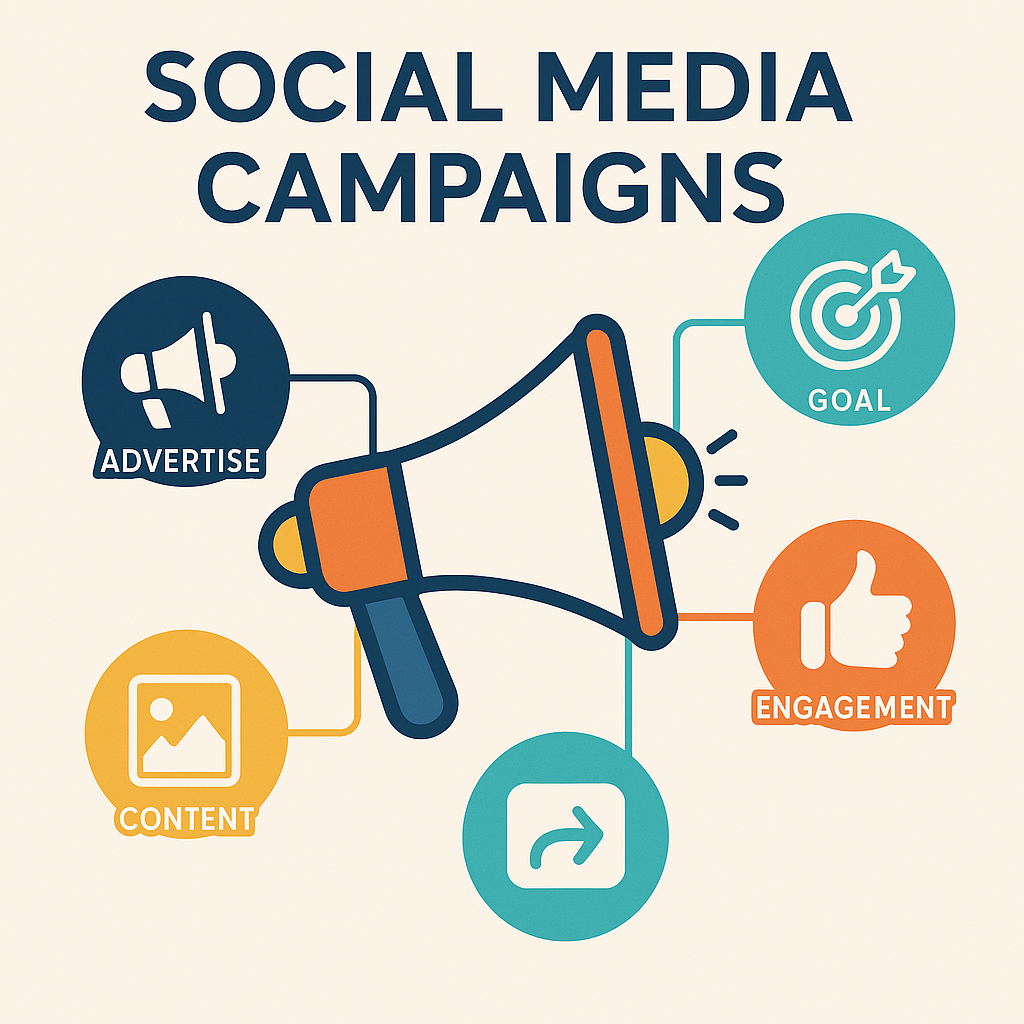
📢 Week 12: Social Media Campaigns
Learn how to design social media campaigns that captivate attention, inspire engagement, and drive real results. Discover strategies to plan, execute, and measure effective campaigns.
🌟 Introduction
Social media isn’t just about posting content — it’s about creating campaigns with purpose. A campaign is a coordinated series of posts, visuals, and messages built around a single goal — whether it’s growing followers, generating leads, or promoting a product.
When done strategically, social media campaigns have the power to turn casual scrollers into loyal fans and paying customers. In this week’s lesson, we’ll break down how to plan, execute, and analyze campaigns that deliver results.
🎯 1. What Is a Social Media Campaign?
A social media campaign is a focused marketing effort using one or more platforms to achieve a specific goal. Unlike random daily posts, campaigns are strategic, goal-oriented, and measurable.
Examples of common campaign goals:
- Boost brand awareness
- Promote a new product or event
- Drive traffic to a landing page
- Collect leads or email subscribers
- Encourage user-generated content
Every successful campaign starts with one clear question:
👉 What do I want my audience to do?
🧠 2. The Anatomy of a Great Campaign
Strong campaigns share a few essential traits — clarity, creativity, and consistency.
Here’s what every campaign should include:
- A Clear Objective: Know exactly what success looks like.
- A Defined Audience: Identify who you want to reach.
- A Compelling Message: Craft a central idea that resonates.
- Eye-Catching Visuals: Use design and video to grab attention.
- Engaging Content Mix: Combine posts, reels, polls, stories, and ads.
- A Measurable Timeline: Set a start and end date with trackable milestones.
Without a structure, campaigns lose direction — with one, they inspire action.
💡 3. How to Plan an Effective Campaign
A strong campaign doesn’t happen by accident. Follow these five steps:
Step 1: Set SMART Goals
Make your goals Specific, Measurable, Achievable, Relevant, and Time-bound.
Example: “Gain 1,000 new Instagram followers in 30 days.”
Step 2: Choose the Right Platform
Pick where your audience spends most of their time. Instagram might be best for visuals, while LinkedIn works better for professionals.
Step 3: Develop a Content Theme
Every campaign needs a consistent story — whether it’s empowerment, innovation, or fun.
Example: “30 Days of Motivation” or “New Product Countdown.”
Step 4: Create a Posting Schedule
Plan your posts ahead of time using tools like Later, Buffer, or Meta Business Suite.
Step 5: Track and Adjust
Monitor performance daily and adjust based on engagement and feedback.
📣 4. Types of Social Media Campaigns That Work
Here are some campaign styles proven to deliver high engagement and conversions:
✅ Giveaway Campaigns
Boost engagement by offering prizes in exchange for likes, shares, or tags.
Example: “Tag a friend for a chance to win our latest product!”
✅ Hashtag Challenges
Create your own branded hashtag to encourage user participation.
Example: #MyHealthyHabit or #TravelWithUs.
✅ Product Launches
Build anticipation with teaser posts, countdowns, and live unveilings.
✅ Awareness Campaigns
Promote a social cause or message that aligns with your brand values.
✅ Testimonial & Review Campaigns
Showcase happy customers or client success stories to build trust.
✅ Seasonal Campaigns
Leverage holidays or events (e.g., Black Friday, New Year, Valentine’s Day).
📊 5. Measuring Campaign Success
To know if your campaign worked, track key performance indicators (KPIs) such as:
- Engagement Rate (likes, shares, comments)
- Follower Growth
- Click-Through Rate (CTR)
- Conversions or Leads
- Reach and Impressions
Tools like Google Analytics, Meta Insights, and Hootsuite Reports can give you real-time performance data.
🧩 6. The Secret Ingredient: Emotional Connection
The best campaigns don’t just sell — they make people feel.
Use storytelling, empathy, and authenticity to create emotional resonance.
When your audience relates to your message, they’ll engage, share, and remember your brand long after the campaign ends.
🚀 Conclusion & Call to Action
Social media campaigns are your opportunity to inspire, engage, and convert. They’re not random posts — they’re carefully crafted experiences.
👉 This week, brainstorm one campaign idea for your business. Define the goal, choose the platform, and map out 5–7 post ideas. Start simple — consistency will do the rest.
Next week: Week 13 — Keyword Management: Mastering the Words That Drive Results.

Thank you for sharing this! I love how clearly you break down social media campaigns, from planning to execution. The emphasis on strategy, emotional connection, and measurable goals makes it easy for anyone to understand how to create impactful campaigns.
I especially appreciate the practical examples and step-by-step guidance. It’s a great resource for turning casual posts into purposeful content that truly engages and converts audiences.
Nazib, thank you for the thoughtful feedback.
I’m really glad the structure and examples helped make the process clearer. Social media campaigns can look complex from the outside, but when you break them into planning, emotional connection, and measurable outcomes, the whole strategy becomes much more practical to apply.
Your point about turning casual posts into purposeful content is exactly the goal. When posts are guided by intention—who they’re for, what problem they solve, and what action they invite—they start building real engagement instead of just visibility.
I appreciate you taking the time to read so carefully and share your perspective.
Hi Marvin… great piece on building social media campaigns that drive action! I noticed the examples around paid promotion on major platforms, which are clearly powerful tools.
For early-stage startups working with very tight budgets, do you have any tactical strategies or lower-cost alternatives to balance organic reach with the need for paid amplification, especially in the first 6–12 months?
Would love your thoughts on how smaller teams can cope with the heavier costs without losing momentum.
My dear friend Rohitash,
That’s an excellent question — and one that sits right at the heart of early-stage growth:
“How do we get momentum without burning the budget?”
Below are practical, low-cost but high-leverage strategies that help smaller teams balance organic reach with smart amplification — without losing speed in those first 6–12 months.
🚀 For Early-Stage Startups With Small Budgets
A practical, tactical roadmap
1️⃣ Build a “Content Engine” before buying traffic
Paid ads accelerate what already works — not what’s unclear.
So first 6–8 weeks should go into:
3–5 cornerstone posts (guides / lessons / breakdowns)
weekly content rhythm (1–2 posts per channel)
one thought leadership series (short form)
one evergreen lead magnet / value piece (optional)
These pieces become your organic proof of voice.
If you amplify noise, you pay for noise.
If you amplify clarity, you pay for results.
2️⃣ The “Micro-Paid Strategy” — spend slowly, not never
Instead of big campaigns, run:
$1–$5/day boosted posts to your best-performing organic content
retargeting audiences only (warm traffic)
video views campaigns (cheapest reach + best retention)
This builds awareness without bleeding budget.
Think of it as fueling a bicycle — not buying a car.
3️⃣ Lean into collaboration more than paid
Collabs cost time, not money — but bring reach:
guest posts & shared threads
co-written newsletters
podcast swaps
repost agreements
content “handshakes” (you feature them, they feature you)
This multiplies exposure without ad spend.
Borrow trust — don’t buy it.
4️⃣ Use “search-based social” — it’s the hidden advantage
Platforms where people search, not scroll:
YouTube Shorts (search + discover)
Pinterest idea pins
Quora answers
Reddit expertise threads
LinkedIn articles
These pieces work for years, not hours.
Paid ads disappear — searchable posts compound.
5️⃣ Build a “home base” early — even if tiny
Just one place to collect readers:
simple newsletter
Substack
Notion page
WhatsApp broadcast
Telegram channel
Momentum dies when people like your work … and then forget where to find you.
Audience ≠ followers.
Audience = returners.
6️⃣ Put your organic insights back into your micro-budget
Every 4–6 weeks:
Check which organic posts got saves or shares
Pick 1–2
Boost them lightly to warm audiences
Don’t advertise what you think is good —
advertise what the audience already proved good.
7️⃣ Momentum is emotional — protect it
Small teams lose steam when the content rhythm collapses.
So:
repurpose in cycles
(1 blog → 3 short posts → 1 quote → 1 video)
batch-create weekly
schedule lightweight posts in advance
Consistency is not pressure — it’s pacing.
✨ A 12-Month Momentum Blueprint (budget-friendly)
Quarter Focus Spend Output
Months 1–3 Clarity + Content Engine $0–50
Proof of message
Months 4–6 Micro-Amplification $30–100/mo
Warm audience
Months 7–9 Collab + Search Expansion $0
Authority signals
Months 10–12 Light Retargeting $50–200/mo
Lead flow begins
Result:
you stay visible, growing, and sane — without overspending.
🌱 Final Thought
Many startups try to buy momentum.
But you —
you’re trying to build momentum.
That’s the difference between burning and compounding.
Momentum is not money.
Momentum is motion.
Money just makes it faster.
And your question shows you already understand that.
Always here,
Marvin