
Suscríbete para seguir leyendo
Suscríbete para obtener acceso al contenido íntegro de esta entrada y demás contenido exclusivo para suscriptores.
Suscríbete para obtener acceso al contenido íntegro de esta entrada y demás contenido exclusivo para suscriptores.
Suscríbete para obtener acceso al contenido íntegro de esta entrada y demás contenido exclusivo para suscriptores.
By Marvin Gandis
Core idea: You don’t rule the outcome. You rule your conduct.
When you accept this, anxiety drops, clarity rises, and life becomes steadier.
Many people don’t suffer because of what happens… but because of what might happen.
We try to secure the future like it’s a contract. We want guarantees before we move:
But Stoicism arrives with a truth that—while uncomfortable—sets you free:
✅ Life doesn’t promise results.
✅ Life offers decisions.
That’s where this reminder is born:
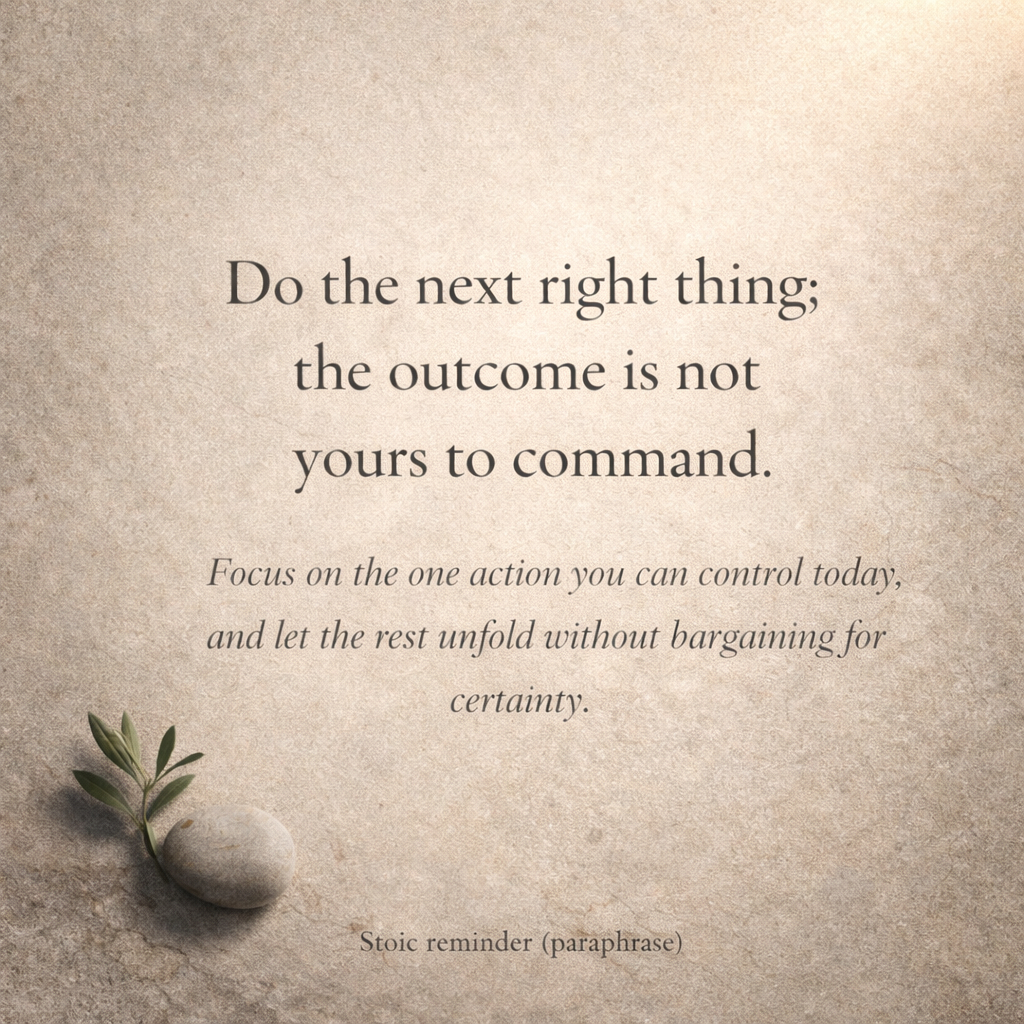
“Do the right thing now; the outcome is not yours to command.”
Epictetus taught it with precision:
The common mistake is this:
We turn the external world into a requirement for peace.
But real peace returns when your mind comes back to what you actually control.
✅ Stoic takeaway:
The right kind of control isn’t “out there.” It’s within.
“Doing the right thing” is not perfection.
It’s alignment with your values.
A Stoic asks this question:
“What is the most virtuous action I can take right now?”
Stoic virtue is often summarized in four pillars:
Doing the right thing means practicing those four pillars in everyday life:
✅ Stoic takeaway:
Virtue isn’t a speech—it’s behavior repeated.
An anxious mind does this:
“I’ll do this… but only if you guarantee it will work.”
And when life doesn’t sign that contract, you get:
The Stoic breaks that contract and replaces it with a different commitment:
“I do my part. Life decides the rest.”
That shift makes you stronger, because your peace no longer depends on reward.
✅ Stoic takeaway:
Outcomes are uncertain. Your character doesn’t have to be.
When you feel stuck, don’t try to solve your whole life.
Do this instead:
Instead of solving the year, solve the next 20 minutes.
What is the next right step?
Not the perfect one. Not the biggest one. The right one.
Examples:
Debate drains energy. Action restores it.
✅ Stoic takeaway:
The future is built with the right steps, not perfect thoughts.
Here’s a deep Stoic idea:
If you did the right thing, you already won.
Because you won something greater than the outcome:
You strengthened your character.
Sometimes the world doesn’t reward virtue immediately.
But virtue always gives you an advantage:
✅ Stoic takeaway:
Right actions produce invisible rewards before visible ones.
Instead of obsessing over sales:
You can’t control how others feel, but you can control:
You can’t control immediate results, but you can control:
You can’t control when you’ll “feel ready,” but you can control:
✅ Stoic takeaway:
Results are pursued through process; peace is protected through virtue.
Each morning or night, answer:
This trains your brain to live with clarity.
✅ Stoic takeaway:
Mental discipline is trained like the body—through repetition.
Stoicism doesn’t promise a life without problems.
It promises something more valuable:
✅ a stable mind
✅ consistent conduct
✅ peace that doesn’t depend on luck
That is freedom.
And that’s why this message is so powerful:
Do the right thing now.
The outcome is not yours to command.
But your character is.
Choose ONE:
Do it today—even if it’s small.
Because the right thing isn’t done when it’s easy. It’s done when it’s necessary.
Comment “Done” when you complete your action.
This article is for educational and informational purposes only and does not constitute financial, legal, medical, or professional advice. Results vary based on effort, experience, and circumstances. Always do your own research and consult qualified professionals when needed.
Debe estar conectado para enviar un comentario.