Publicado en Pasos para Comprar

Surrounding Yourself with People Who Have No Vision: The Power of Your Environment

By Marvin Gandis

Not everyone around you feeds your future.

  • Some people inspire you to grow.
  • Others keep you stuck.
  • Some challenge you with love.
  • Others feed your excuses.
  • Some remind you of your purpose.
  • Others pull you toward complaining, conformity, and a lack of direction.

One of the quietest ways to remain mentally, emotionally, and financially poor is to constantly surround yourself with people who have no vision.

In this tenth part of the series “The Reverse Question,” we will reflect on the power of environment, conversations, friendships, influences, and the voices we allow near our mind and heart.

  • This is not about rejecting people with arrogance.
  • This is not about feeling superior.
  • This is not about abandoning the people we love.

It is about understanding that your environment influences your direction.


Your environment shapes you more than you imagine

Many people believe they make decisions completely independently, but the truth is that the environment has a strong influence.

  • What you hear influences you.
  • What you see influences you.
  • Who you talk to influences you.
  • What is repeated around you influences you.
  • What your group considers normal influences you.
  • What they celebrate influences you.
  • What they criticize influences you.
  • What they allow influences you.

If every day you hear that nothing is possible, over time, you may begin to believe it.

If every day you are surrounded by complaints, excuses, mockery, fear, and negativity, your mind may begin to accept that way of thinking as normal.

Your environment may not always decide your destiny, but it can push you in a certain direction.


Conversations create atmospheres

Conversations have power.

  • Some conversations lift you.
  • Some conversations drain you.
  • Some conversations bring clarity.
  • Some conversations create confusion.
  • Some conversations inspire you.
  • Some conversations shut you down.

If your daily conversations revolve only around problems, gossip, complaints, criticism, fear, scarcity, and defeat, it is difficult to maintain a strong vision.

But if you begin to participate in conversations about solutions, learning, responsibility, faith, goals, discipline, business, service, and growth, your mind begins to breathe a different air.

Not all conversations are harmless. Some build. Others contaminate.


People without vision can silence dreams

Sometimes a person shares an idea, project, dream, or goal, and the first thing they receive is mockery.

  • “That will not work.”
  • “Who do you think you are?”
  • “You are too old for that.”
  • “Nobody makes money that way.”
  • “Do not waste your time.”
  • “That is too hard.”
  • “Just stay where you are.”

Often, these words do not come from evil but from fear. People who have never tried something different may feel uncomfortable when you decide to move forward.

But if you listen too much to people without vision, you may end up abandoning something that God, life, or your conscience was pushing you to build.

Not all advice comes from wisdom. Sometimes it comes from unhealed wounds, fear, or conformity.


Not everyone can understand your process

When you are building something new, not everyone will understand your path.

  • Some will not understand why you study.
  • Some will not understand why you save.
  • Some will not understand why you publish content.
  • Some will not understand why you work on an extra project.
  • Some will not understand why you change habits.
  • Some will not understand why you no longer participate in certain conversations.

That does not mean you are wrong.

Sometimes it means you are changing direction.

You cannot expect everyone to understand a vision they are not willing to carry.


The danger of normalizing conformity

Conformity is dangerous because it often disguises itself as reality.

  • “Nothing more can be done.”
  • “Life is just like this.”
  • “That is for other people.”
  • “It is better not to try.”
  • “We are all the same.”
  • “It is not worth the effort.”

These phrases may seem reasonable, but they can become mental chains.

A conformist person may not always want to destroy you. Sometimes they simply want you to stay where they feel comfortable.

But your life should not be limited by someone else’s comfort.


Surrounding yourself well does not mean abandoning everyone

Protecting your environment does not mean despising people.

  • You can love someone and still not allow them to influence every decision.
  • You can respect someone and still not accept their mindset.
  • You can help someone and still protect your focus.
  • You can listen to someone and still decide not to follow their advice.

Maturity means learning to love without absorbing everything.

Not everyone should have access to the steering wheel of your life.


Look for people who challenge you to grow

You need people who help you see higher, not only people who accompany you in sameness.

Look for people who:

  • Speak truth.
  • Accept responsibility.
  • Learn continuously.
  • Have discipline.
  • Protect their words.
  • Correct you with respect.
  • Celebrate your growth.
  • Do not feed your excuses.
  • Remind you of your purpose.
  • Inspire you to improve.

You do not need perfect people. No one is perfect. But you do need people with direction.


Your digital environment also counts

Today, we are not only surrounded by people physically. We are also surrounded by content.

  • The accounts you follow are part of your environment.
  • The videos you watch are part of your environment.
  • The messages you read are part of your environment.
  • The groups you participate in are part of your environment.
    The news you consume is part of your environment.

If your digital environment is full of negativity, comparison, fear, distraction, controversy, and empty consumption, your mind feels it.

Clean your digital environment.

  • Follow content that educates you.
  • Follow voices that inspire you.
  • Follow people who build.
  • Reduce what steals your peace, focus, and purpose.

Your mind needs nourishment, not constant garbage.


You are also an environment for others

This reflection is not only about the people around you. It is also about who you are for others.

  • Are you someone who encourages or discourages?
  • Do you build or criticize?
  • Do you bring peace or conflict?
  • Do you talk about solutions or only problems?
  • Do you inspire responsibility or feed excuses?
  • Do you help others grow or keep them small?

We are all an environment for someone.

If you want to be surrounded by people with vision, you must also become a person with vision.


How to improve your environment

1. Review your conversations

Ask yourself:

  • What do I talk about most of the time?
  • Do these conversations help me grow?
  • Do they leave me with clarity or more confusion?
  • Do they inspire me or drain me?

2. Identify negative influences

Not to hate anyone, but to set boundaries.

  • Some people always criticize.
  • Always complain.
  • Always mock.
  • Always discourage.
  • Always see impossibilities.
  • Always bring drama.

Sometimes you need to love from a distance and protect your direction.


3. Seek growth environments

Participate in places where people talk about learning, faith, business, habits, finances, service, leadership, and purpose.

It may be a group, community, course, church, team, mentor, reading habit, or intentional conversation.

Your environment should remind you where you are going.


4. Reduce exposure to what weakens you

You do not have to argue with everyone. Sometimes you simply need less exposure.

  • Less complaining.
  • Less comparison.
  • Less gossip.
  • Less distraction.
  • Less empty content.
  • Fewer voices that destroy your faith and focus.

5. Be intentional with your relationships

Do not wait for the right relationships to appear by themselves. Build healthy connections.

  • Ask.
  • Learn.
  • Serve.
  • Listen.
  • Share value.
  • Be grateful.
  • Honor those who help you grow.

Healthy relationships are also cultivated.


Vision needs protection

A new vision is like a seed. If you expose it too early to negative environments, it can die before it grows.

Protect what you are building.

  • Not everyone needs to give an opinion about your dreams.
  • Not everyone needs to know your plans.
  • Not everyone needs to validate your process.
  • Not everyone deserves access to your motivation.

There are moments to share. But there are also moments to work quietly.


Conclusion

Surrounding yourself with people who have no vision can keep you stuck without you realizing it. Little by little, the conversations, attitudes, and thoughts in your environment can affect your faith, discipline, focus, and decisions.

My dear reader or friend, this is not about judging anyone. It is about protecting your direction.

  • Love people, but protect your vision.
  • Listen to advice, but discern the source.
  • Help others, but do not allow everyone to define your path.
  • Be humble, but do not live limited by someone else’s fear.

Your environment matters.

Because a mind surrounded by excuses becomes weaker, but a mind surrounded by vision, responsibility, and growth begins to awaken.

Choose wisely the voices that will walk with you toward your future.


Disclaimer

This article is for educational, reflective, and informational purposes only. It should not be interpreted as psychological, legal, financial, professional, family, or investment advice. The purpose of this content is to encourage awareness about the influence of environment, relationships, conversations, mindset, and personal responsibility.

Talking about surrounding yourself with people who have vision does not mean rejecting, despising, shaming, or abandoning people who think differently or face difficulties. Every person has different circumstances, stories, wounds, limitations, and processes.

This content is not intended to encourage isolation, pride, family conflict, or irresponsible separation from important relationships. In situations involving abuse, manipulation, violence, emotional dependency, serious family conflict, or mental health concerns, it is recommended to seek qualified professional help.

The information shared is intended to inspire reflection, discernment, healthy boundaries, and responsible action, but it does not guarantee specific results.

Publicado en Financial Education, Personal Development, Personal Growth, Self-Improvement, Wealth Mindset

Blaming Everyone: How Lack of Responsibility Keeps You Stuck

By Marvin Gandis

One of the most silent ways to remain stuck is living in the habit of blaming everyone for your situation.

  • Blaming the government.
  • Blaming the economy.
  • Blaming the family.
  • Blaming the boss.
  • Blaming luck.
  • Blaming the past.
  • Blaming the system.
  • Blaming the lack of support.
  • Blaming circumstances.

And yes, we must recognize an important truth: unfair situations do exist. There are difficult economies, complicated families, a lack of opportunities, health problems, unequal systems, personal crises, and realities that many people did not choose.

But there is another truth we must also face with honesty: although we do not always choose what happens to us, we often choose how we respond.

In this fifth part of the series “The Reverse Question,” we will reflect on how a lack of responsibility can keep a person trapped in complaining, frustration, and lack of progress.

  • This is not about denying reality.
  • This is not about blaming victims.
  • This is not about saying everything depends only on the individual.

It is about recovering the power to ask:

What can I do now with what I have, from where I am?


Blaming can feel comfortable, but it does not build

Blaming others can give a temporary sense of relief. When we blame, we feel we have an explanation for our pain, frustration, or lack of results.

But the problem is that blaming does not necessarily change anything.

  • Blame looks outward.
  • Responsibility looks inward.
  • Blame points.
  • Responsibility corrects.
  • Blame keeps talking about the problem.
  • Responsibility begins with looking for a way forward.

A person may have real reasons to feel upset, disappointed, or tired. But if they live only from blame, they can remain in the same place for years.

Complaining may explain the problem, but it rarely solves it.


Responsibility does not mean blame

It is important to understand this difference.

  • Responsibility does not mean everything bad that happened to you was your fault.
  • Responsibility does not mean denying injustice.
  • Responsibility does not mean ignoring pain.
  • Responsibility does not mean excusing those who failed you.

Responsibility means recognizing that there is still something you can do.

  • You can learn.
  • You can correct.
  • You can ask for help.
  • You can organize yourself.
  • You can begin again.
  • You can make a different decision.
  • You can change a habit.
  • You can look for another opportunity.
  • You can stop repeating the same pattern.

Blame asks:
“Who did this to me?”

Responsibility asks:
“What will I do now?”

That question can change a life.


The permanent victim mindset

Some people have suffered real and painful situations. That deserves respect, compassion, and understanding.

But there is also a dangerous mindset: the permanent victim mindset.

This mindset causes a person to identify completely with what happened to them, to the point where they no longer see themselves as someone capable of rising again.

The person begins to say:

  • “I can’t because people failed me.”
  • “I don’t move forward because nobody helps me.”
  • “I don’t learn because I never had opportunities.”
  • “I don’t change because this is just how I am.”
  • “I don’t try because it will probably go wrong.”

The pain may be real, but if it becomes identity, it turns into a prison.

Healing does not mean denying what happened. Healing means refusing to let what happened control forever what you can become.


When blaming becomes an excuse not to act

Sometimes blame becomes a way to avoid responsibility.

  • If everything is someone else’s fault, then I do not have to review my decisions.
  • If everything is the system’s fault, then I do not have to improve my skills.
  • If everything is the economy’s fault, then I do not have to manage better.
  • If everything is my family’s fault, then I do not have to change my habits.
  • If everything is the past’s fault, then I do not have to build a different future.

But that way of thinking can steal years of progress.

Responsibility hurts at first because it forces us to look at the truth. But it also gives power back to us.

When a person accepts responsibility, they stop waiting for everything outside to change before changing something inside.


The difference between an explanation and an excuse

Some things explain why a person is in a certain situation. But not everything that explains should become an excuse to remain the same.

  • Poor education may explain a difficulty, but it does not have to stop you from learning now.
  • An economic crisis may explain a setback, but it does not have to stop you from reorganizing.
  • A difficult childhood may explain wounds, but it does not have to decide the entire future.
  • A poor decision may explain debt, but it does not have to stop correction.
  • A lack of support may explain exhaustion, but it does not have to stop you from seeking better relationships.

Explanations help us understand.
Excuses prevent us from moving forward.

A wise person recognizes what happened, but also asks what can be done from now on.


Financial responsibility begins with honesty

When it comes to money, blaming is very common.

  • “I don’t save because everything is expensive.”
  • “I am in debt because the economy is bad.”
  • “I don’t progress because nobody taught me.”
  • “I have no opportunities because others have advantages.”
  • “I can’t change because I have always lived this way.”

Some of these statements may contain part of the truth. But if they become a way to justify disorder, they can prevent change.

Financial responsibility begins when a person dares to look at their numbers, habits, and decisions.

  • How much do I spend without thinking?
  • What debts must I face?
  • What can I reduce?
  • What skill can I learn?
  • What can I sell, improve, or create?
  • What can I do differently this month?
  • What conversation do I need to have with my family?
  • What decision am I avoiding?

Honesty is not always comfortable, but it is necessary for healing.


Personal responsibility and growth

A responsible person is not perfect. They make mistakes, get tired, fail, and sometimes feel afraid.

The difference is that they do not remain forever looking for someone to blame. They learn, correct, and continue.

Personal responsibility creates growth because it forces a person to ask better questions.

Instead of asking:
“Why does nobody help me?”

Ask:
“How can I prepare myself better?”

Instead of asking:
“Why are others moving faster?”

Ask:
“What can I learn from those who are moving forward?”

Instead of asking:
“Why does this always happen to me?”

Ask:
“What pattern do I need to stop repeating?”

Instead of asking:
“Why don’t I have results?”

Ask:
“Am I applying the right process with enough consistency?”

Responsible questions open doors that complaining keeps closed.


You cannot control everything, but you can control something

One of the great truths of life is that we do not control everything.

  • We do not fully control the economy.
  • We do not control other people’s decisions.
  • We do not control the past.
  • We do not control every opportunity.
  • We do not control changes in the world.
  • We do not control everything that happens in a family, company, or society.

But we can control some things.

  • We can control our attitude.
  • We can control our willingness to learn.
  • We can control our effort.
  • We can control our words.
  • We can control some expenses.
  • We can control how we use time.
  • We can control what content we consume.
  • We can control whether we ask for help.
  • We can control whether we begin again.

Responsibility begins when we stop obsessing over what we cannot control and start working with what is still in our hands.


How to stop blaming and start moving forward

1. Recognize reality without exaggerating it

Do not deny what is difficult. But do not turn difficulty into a permanent sentence either.

You can say:

“This is difficult, but I can still make one decision.”

That phrase is powerful because it recognizes the problem without surrendering to it.


2. Identify your part

In every situation, ask yourself:

  • What did I do well?
  • What did I do wrong?
  • What did I ignore?
  • What did I allow?
  • What did I fail to learn?
  • What must I correct?
  • What can I do differently?

Not to live in guilt, but to recover direction.


3. Replace one complaint with one action

Every time you catch yourself complaining, ask a practical question:

“What is one small action I can take today?”

It may be calling someone, reviewing your numbers, learning something, organizing a debt, sending a message, creating content, looking for information, walking, praying, writing a plan, or finishing a pending task.

One small action is worth more than a big complaint repeated every day.


4. Learn from your mistakes without punishing yourself

Accepting responsibility does not mean living under self-condemnation.

We all make mistakes. We have all made poor decisions. We have all lost time, money, or opportunities.

The key is not to waste the mistake. Learn from it. Write it down. Correct it. Adjust. Apologize if necessary. Change the pattern.

A learned mistake can become wisdom.


5. Surround yourself with responsible people

The environment has a strong influence.

If you surround yourself with people who only complain, blame, criticize, and never act, that mindset can affect you.

Look for people who speak truth, accept correction, work, learn, take responsibility, and want to grow.

You do not need perfect people. You need awake people.


Freedom begins when you accept responsibility

Responsibility may feel heavy at first, but it actually brings freedom.

Because if everything depends completely on others, then you can do nothing. But if something is still in your hands, then you can begin.

  • You can begin small.
  • You can begin late.
  • You can begin afraid.
  • You can begin with little.
  • You can begin after failing.
  • You can begin without having everything clear.

But you can begin.

And many times, beginning with responsibility is the first step out of stagnation.


Conclusion

Blaming everyone may explain part of the story, but it should not become the end of the story.

Yes, there are injustices. Yes, there are difficult circumstances. Yes, some people have suffered deeply. But some decisions can still be made, habits that can be corrected, skills that can be learned, and paths that can be opened.

My dear reader or friend, do not allow blame to steal your power to act. Do not live waiting for everything outside to change before you begin changing something inside yourself.

Responsibility is not a condemnation. It is a key.

  • A key to learn.
  • A key to correct.
  • A key to rise again.
  • A key to recover direction.
  • A key to building a wiser life.

The question is not only:

“Who was to blame?”

The question that can transform your future is:

“What can I do now with what is in my hands?”


Disclaimer

This article is for educational, reflective, and informational purposes only. It should not be interpreted as financial, legal, psychological, professional, or investment advice. The purpose of this content is to encourage awareness about personal responsibility, growth, decision-making, discipline, and the importance of acting wisely in the face of difficulties.

Talking about responsibility does not mean denying injustice, minimizing pain, blaming people for all their circumstances, or ignoring social, economic, family, employment, structural, or health-related factors that may affect a person’s life.

Every person’s reality is different. Decisions, opportunities, resources, limitations, and results can vary widely. Before making important decisions related to money, debt, business, emotional health, relationships, work, or personal development, it is recommended to consult qualified professionals.

The information shared is intended to inspire reflection and responsible action, but it does not guarantee specific results.

Publicado en Financial Education, Personal Development, Personal Growth, Self-Improvement, Wealth Mindset

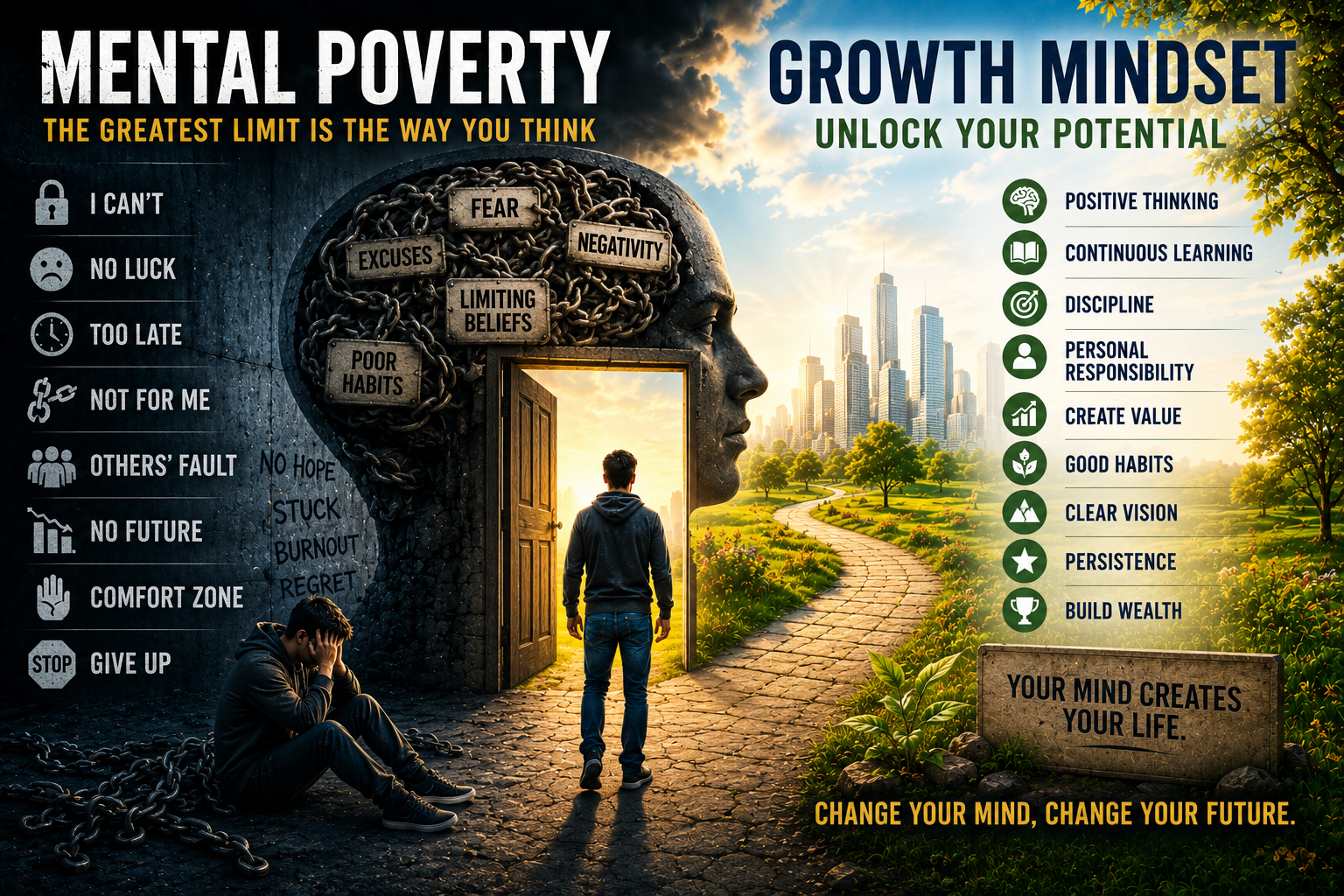
Mental Poverty: When the Greatest Limit Is the Way You Think

By Marvin Gandis

Before a person can change their financial situation, they often need to change the way they think.

Poverty does not always begin in the pocket. Many times, it begins in the mind: in beliefs, fears, excuses, lack of vision, the habit of expecting little from life, and the idea that nothing can change.

A person can have little money and still possess a rich mindset: faith, discipline, humility, willingness to learn, responsibility, and vision for the future.

But a person can also have money and still live with a poor mind: fear, disorder, pride, dependency, appearance, conformity, and lack of purpose.

That is why, in this second part of the series “The Reverse Question,” we will reflect on one of the most dangerous forms of poverty: mental poverty.

Not to judge anyone, but to awaken awareness.

Because many times, the greatest limit is not what a person has, but what they believe is possible.


What is mental poverty?

Mental poverty is a way of thinking that limits a person’s growth.

It is when someone believes they cannot learn, cannot improve, cannot begin again, cannot change their story, and cannot build something different.

Mental poverty appears in thoughts such as:

  • “I can’t.”
  • “That is not for me.”
  • “It is too late.”
  • “People like me never get ahead.”
  • “I am not lucky.”
  • “Others can do it, but I can’t.”
  • “Why try if nothing changes?”

These thoughts may seem small, but over time they become invisible chains.

A person who thinks this way can have opportunities in front of them and not see them. They can receive advice and reject it. They can have talent and never use it. They can have time and waste it. They can have an idea and never execute it.

Mental poverty does not always shout. Sometimes it hides behind resignation.


The danger of getting used to thinking small

One of the greatest dangers of mental poverty is that a person begins to settle for less than what they could become.

  • Not because they are incapable.
  • Not because they have no value.
  • Not because they have no talent.

But because they have become used to thinking small.

Thinking small does not mean living with humility. Humility is good. Thinking small means living limited by fear, excuses, and lack of vision.

A person may say they are being realistic when they are actually protecting their fear. They may say they do not need more when they are actually afraid to try. They may say they are waiting for the right moment when they are actually avoiding the beginning.

Mental poverty turns comfort into a prison.


Beliefs that keep a person stuck

1. Believing that money is evil

Money is not good or evil by itself. Money is a tool. What matters is the heart, the intention, and the way it is used.

With money, a person can help, build, serve, educate, create opportunities, and protect their family. It can also be used poorly, like any other tool.

The problem is not having money. The problem is loving money more than principles, family, truth, faith, and dignity.

A healthy mindset does not worship money, but it does not despise it either. It learns to manage it with wisdom.


2. Believing that learning is no longer necessary

Many people fall behind because they stop learning.

The world changes. Technology changes. Opportunities change. Business changes. The way we communicate changes.

But some people want new results with old knowledge.

Mental poverty says:
“I already know enough.”

A growth mindset says:
“I can still learn.”

The person who learns adapts.
The person who adapts finds new opportunities.


3. Believing that everything is always someone else’s fault

There are unfair situations. There are difficult systems. There are people who hurt others. There are complicated economies. There are painful stories.

But when a person always blames others, they lose power over their own life.

Responsibility does not mean denying pain. It means deciding what you will do with what is still in your hands.

The question that breaks mental poverty is not:

“Who is to blame?”

The powerful question is:

“What can I do now with what I have?”


4. Believing that failure defines your identity

Failing at something does not mean you are a failure.

  • A business may fail.
  • An idea may not work.
  • A sale may not happen.
  • A project may take longer than expected.
  • A strategy may need correction.

But none of that means the person has no value.

Mental poverty turns every mistake into a sentence. A wise mindset turns every mistake into a lesson.

The person who learns from mistakes is not falling behind. They are gaining experience.


5. Believing that others must rescue you

Help is valuable. Everyone needs support at some point. But always depending on someone else to fix your life can become a trap.

  • Mental poverty waits to be rescued.
  • A responsible mindset seeks direction.

This does not mean rejecting help. It means refusing to place your entire future in someone else’s hands.

  • Someone can give you an opportunity, but you must work it.
  • Someone can teach you, but you must learn.
  • Someone can open a door, but you must walk through it.

Mental poverty and lack of vision

A person without vision lives in reaction mode.

  • They react to debt.
  • They react to problems.
  • They react to fear.
  • They react to opinions.
  • They react to urgency.

But a person with vision begins to live with direction.

Vision does not mean having everything figured out. It means having a reason to move forward.

When a person has vision, they begin to care more about their decisions. They think before spending. They learn before quitting. They work even when results are not immediate. They rise after failing. They choose better relationships. They use their time more wisely.

Vision turns sacrifice into purpose.


How to begin breaking mental poverty

1. Change your questions

The questions you ask determine many of the answers you find.

Instead of asking:
“Why does this always happen to me?”

Ask:
“What can I learn from this?”

Instead of saying:
“I have no opportunities.”

Ask:
“What skill can I develop to create an opportunity?”

Instead of thinking:
“I can’t.”

Ask:
“What do I need to learn so I can?”


2. Protect what you consume mentally

We do not only consume food. We also consume ideas, conversations, news, social media, opinions, and content.

If a person consumes negativity every day, sooner or later their mind becomes weaker.

  • Protect what you watch.
  • Protect what you listen to.
  • Protect who you talk to.
  • Protect the voices you allow into your mind.

A mind fed by fear produces small decisions.
A mind fed by truth, learning, and direction produces better decisions.


3. Learn something new consistently

You do not need to learn everything at once. But you can learn something every day.

Read. Listen. Research. Ask questions. Practice. Take notes. Observe those who have made progress. Learn from your mistakes. Learn from your results. Learn from your failures.

Every new skill can become a door.

Continuous education is one of the most powerful ways to break mental poverty.


4. Surround yourself with people who challenge you to grow

Not everyone around you has to think like you. But you do need people who help you grow, not people who destroy your vision.

Look for people who talk about solutions, not only problems. People who act, not only criticize. People who learn, not only complain. People who remind you of your responsibility, not people who feed your excuses.

The right environment does not do the work for you, but it can help you stay awake.


5. Take one small action daily

Mental poverty is broken through action.

Positive thinking is not enough. Responsible action is necessary.

  • Make a call.
  • Read a page.
  • Save a small amount.
  • Pay down debt little by little.
  • Learn a skill.
  • Create content with purpose.
  • Organize your finances.
  • Correct a bad habit.
  • Finish something you started.

Small actions repeated with discipline can change a life.


Mental wealth before financial wealth

Mental wealth does not mean arrogance. It does not mean feeling superior. It does not mean denying difficulties.

Mental wealth means thinking responsibly, learning humbly, acting with discipline, and keeping hope alive even when the process is slow.

A person with mental wealth understands that:

  • They can learn.
  • They can improve.
  • They can correct mistakes.
  • They can begin again.
  • They can ask for help.
  • They can create value.
  • They can serve better.
  • They can build step by step.

Before money changes, the mind must awaken.


Conclusion

Mental poverty can be one of the hardest forms of poverty to overcome because it is not always visible from the outside. It can hide behind excuses, fear, resignation, pride, or conformity.

But it can be broken.

It breaks when a person decides to stop thinking like a permanent victim. It breaks when they accept responsibility. It breaks when they begin to learn. It breaks when they change their questions. It breaks when they protect their environment. It breaks when they act, even with small steps.

My dear reader or friend, do not allow your mind to become a prison. Maybe you cannot change everything today, but you can change one decision. You can change one question. You can learn one skill. You can take one step.

And many times, one right step is the beginning of a new life.

True wealth begins when the mind stops quitting before trying.


Disclaimer

This article is for educational, reflective, and informational purposes only. It should not be interpreted as financial, psychological, legal, professional, or investment advice. The purpose of this content is to encourage awareness, personal responsibility, learning, discipline, and the development of a growth mindset.

The term “mental poverty” is used as a reflection on limiting beliefs, thought patterns, lack of vision, and internal habits that may affect personal and financial growth. It is not intended to judge, blame, shame, or oversimplify the real challenges many people face.

Economic poverty can be influenced by personal, family, social, economic, structural, employment-related, and health factors. Every person’s situation is different, and results may vary.

Before making important decisions related to money, investments, debt, business, emotional well-being, or personal development, it is recommended to consult qualified professionals.