
Suscríbete para seguir leyendo
Suscríbete para obtener acceso al contenido íntegro de esta entrada y demás contenido exclusivo para suscriptores.

Suscríbete para obtener acceso al contenido íntegro de esta entrada y demás contenido exclusivo para suscriptores.
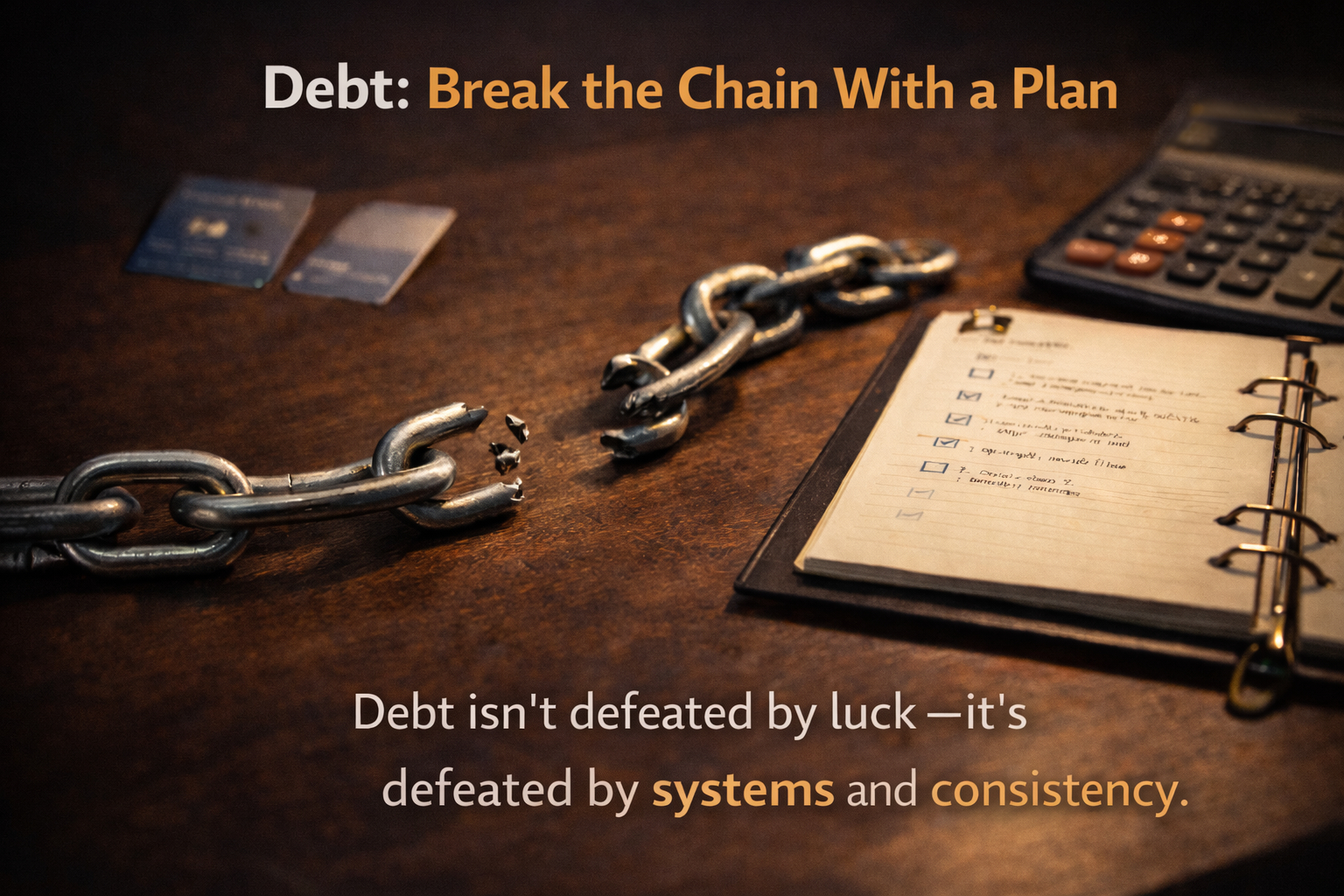
By Marvin Gandis
✅ ARTICLE 4
Debt doesn’t always start with irresponsibility. Often it starts with necessity: an emergency, a tight month, an unexpected hit.
But in uncertain times, debt—especially high-interest debt—becomes dangerous because it does two things at once:
This article isn’t here to judge you.
It’s here to give you a realistic, clear, executable plan to get out—without suffocating.
High interest behaves like a silent tax on your life:
Your goal isn’t “pay everything today.”
Your goal is to stop the bleeding.
Not all debt is equal. But in a crisis, these are the most dangerous:
Clear sign: if the debt steals your sleep, it’s toxic.
A simple system that works for most people:
Before aggressive payoff, build a small buffer ($200–$500 if possible).
It prevents a small emergency from throwing you back into debt.
✅ Avalanche: attack the highest interest first (most efficient).
✅ Snowball: attack the smallest balance first (most motivating).
Guidance:
Ask for:
✅ Freeze impulse spending for 24 hours
✅ List all debts (balance + interest + minimum)
✅ Build a mini buffer ($200–$500 if possible)
✅ Choose avalanche or snowball
✅ Automate minimum payments
✅ Set a fixed weekly extra payment
Getting out of debt isn’t punishment.
It’s getting your air back.
Financial freedom begins when debt stops making decisions for you.
This content is for educational purposes only and is not financial, legal, or investment advice. Consult a qualified professional before making decisions.

By Marvin Gandis
✅ ARTICLE 3
When the world feels unstable, peace doesn’t come from hoping things improve.
Peace comes from knowing:
If a financial hit happens today, I have breathing room.
That breathing room is called an emergency fund.
It’s not a luxury. It’s not “only for wealthy people.”
It’s the difference between:
And the best part? You don’t build it overnight.
You build it in stages.
An emergency fund is liquid, separate money that’s accessible and reserved for real emergencies.
Rule: if it can wait 30 days, it’s not an emergency.
Because it breaks the most expensive cycle:
Emergency → credit card → interest → stress → another emergency
A fund interrupts that cycle and gives you three advantages:
In a crisis, the winner has oxygen.
Forget “six months or nothing.”
That mindset prevents people from starting.
This handles the hits that usually push you into debt.
How to build it faster:
Housing, food, transport, utilities, insurance.
Don’t rush. Progress.
Rule: emergency money = liquid + safe.
Motivation fades. Systems don’t.
Example:
✅ Open a separate account (or digital envelope)
✅ Automate $10–$25/week
✅ Cut one spending leak this week
✅ Choose 3 items to sell this month
✅ Write your target: “Mini fund $1,000–$2,000.”
You can’t control the world.
But you can control your margin.
And margin gives you power.
An emergency fund doesn’t make you invincible…
but it makes you hard to destroy.
This content is for educational purposes only and is not financial, legal, or investment advice. Consult a qualified professional before making decisions.
Debe estar conectado para enviar un comentario.