Publicado en Debt, Family Budgeting, Financial Education, Personal Finance, Resilience

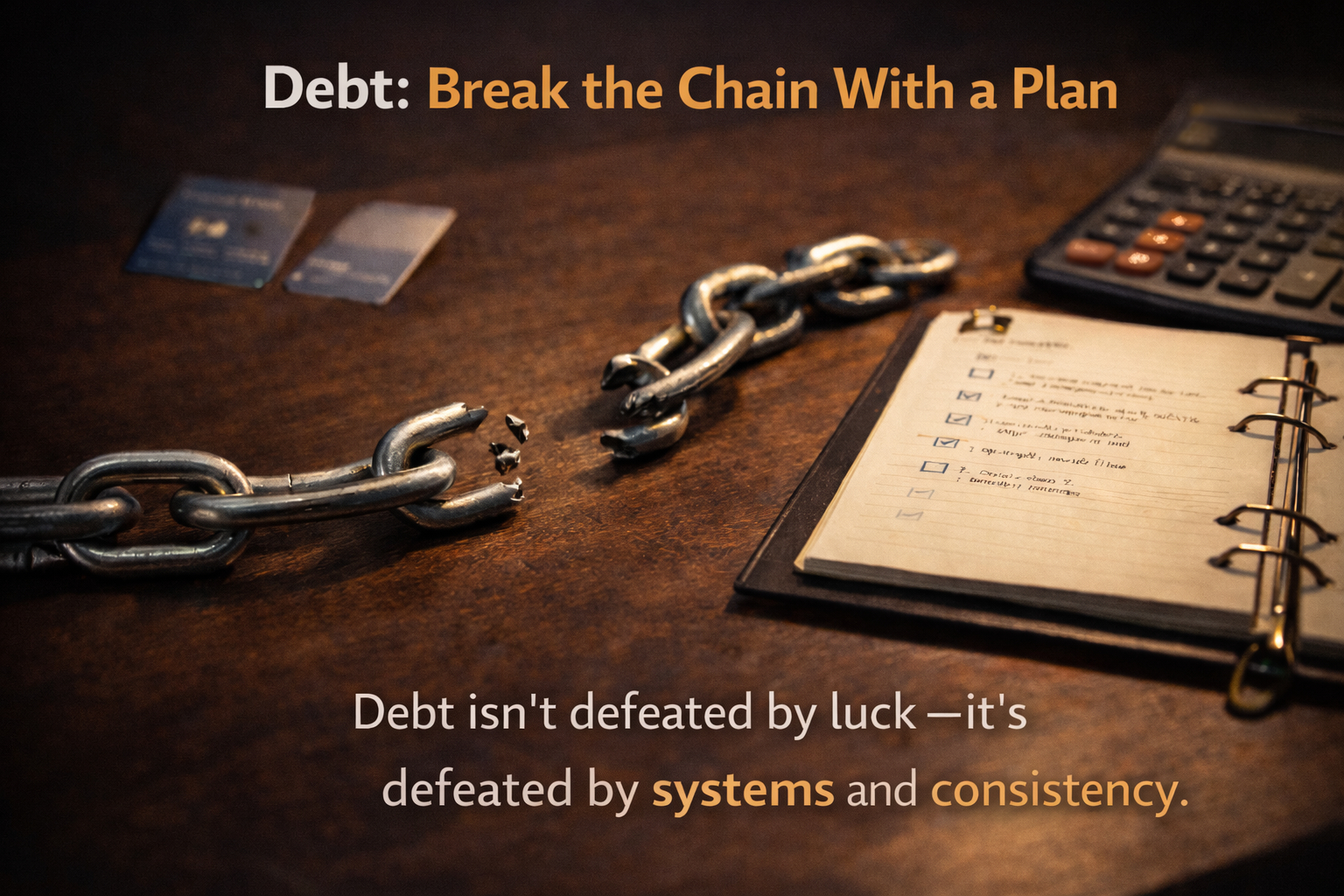
Debt in Hard Times: How to Get Out Without Suffocating (2026)

By Marvin Gandis

✅ ARTICLE 4

Introduction

Debt doesn’t always start with irresponsibility. Often it starts with necessity: an emergency, a tight month, an unexpected hit.

But in uncertain times, debt—especially high-interest debt—becomes dangerous because it does two things at once:

  1. It steals your margin today (monthly payments)
  2. It steals your future (compounding interest)

This article isn’t here to judge you.


It’s here to give you a realistic, clear, executable plan to get out—without suffocating.


1) In Crisis, the Real Problem Isn’t the Balance—It’s the Interest

High interest behaves like a silent tax on your life:

  • it grows even when you stand still,
  • It keeps you trapped month to month.

Your goal isn’t “pay everything today.”
Your goal is to stop the bleeding.


2) Identify “Toxic Debt”

Not all debt is equal. But in a crisis, these are the most dangerous:

🔥 Common toxic debt:

  • high-interest credit cards
  • loans with heavy monthly payments
  • impulse-financed purchases
  • living on minimum payments

Clear sign: if the debt steals your sleep, it’s toxic.


3) The 5-Step Anti-Suffocation Plan

A simple system that works for most people:

Step 1: Freeze the damage (today)

  • Stop using cards for spending, you can reduce
  • Eliminate impulse buys
  • Cancel invisible subscriptions

Step 2: Build a mini-buffer (even small)

Before aggressive payoff, build a small buffer ($200–$500 if possible).
It prevents a small emergency from throwing you back into debt.

Step 3: Choose your method (Avalanche or Snowball)

Avalanche: attack the highest interest first (most efficient).
Snowball: attack the smallest balance first (most motivating).

Guidance:

  • disciplined → avalanche
  • need momentum → snowball

Step 4: Negotiate and lower the cost

Ask for:

  • lower interest
  • payment plans
  • consolidation options (only if it truly reduces cost)

Step 5: Automate the win

  • autopay minimums
  • fixed extra payments weekly/biweekly
  • monthly review (15 min)

4) The 5 Rules to Avoid Falling Back

  1. If it’s not in the budget, don’t buy it.
  2. If you don’t have a mini fund, don’t treat debt like an emergency plan.
  3. Don’t live on minimum payments.
  4. Don’t finance “wants.”
  5. Keep one money review day monthly.

Checklist — Start Today

Freeze impulse spending for 24 hours
List all debts (balance + interest + minimum)
Build a mini buffer ($200–$500 if possible)
Choose avalanche or snowball
Automate minimum payments
Set a fixed weekly extra payment


Closing

Getting out of debt isn’t punishment.
It’s getting your air back.

Financial freedom begins when debt stops making decisions for you.


Disclaimer

This content is for educational purposes only and is not financial, legal, or investment advice. Consult a qualified professional before making decisions.


Publicado en Family Budgeting, Financial Education, Personal Finance, Resilience, Saving

Emergency Fund: Peace Has a Price (and You Can Build It Faster Than You Think) — 2026

By Marvin Gandis

✅ ARTICLE 3

Introduction

When the world feels unstable, peace doesn’t come from hoping things improve.
Peace comes from knowing:

If a financial hit happens today, I have breathing room.

That breathing room is called an emergency fund.

It’s not a luxury. It’s not “only for wealthy people.”
It’s the difference between:

  • handling a problem calmly, or
  • sliding into debt and stress for months.

And the best part? You don’t build it overnight.
You build it in stages.


1) What It Is (and What It Isn’t)

An emergency fund is liquid, separate money that’s accessible and reserved for real emergencies.

✅ Emergencies:

  • car repair needed to work
  • medical deductible
  • job loss
  • rent/mortgage during a hard month
  • Unexpected bill that destabilizes you

❌ Not emergencies:

  • vacations
  • “I deserve it” spending
  • new gadgets
  • impulsive investing
  • FOMO “deals”

Rule: if it can wait 30 days, it’s not an emergency.


2) Why an Emergency Fund Makes You “Richer”

Because it breaks the most expensive cycle:

Emergency → credit card → interest → stress → another emergency

A fund interrupts that cycle and gives you three advantages:

  1. Protection from toxic debt
  2. Emotional calm (better decisions)
  3. Opportunity power (when others are squeezed)

In a crisis, the winner has oxygen.


3) The Realistic 3-Stage Plan (for any income)

Forget “six months or nothing.”
That mindset prevents people from starting.

Stage 1: Mini fund ($1,000–$2,000)

This handles the hits that usually push you into debt.

How to build it faster:

  • cut one leak weekly (subscriptions, delivery, stress spending)
  • sell 3 unused items
  • automate $10–$25/week

Stage 2: One month of essentials

Housing, food, transport, utilities, insurance.

Stage 3: 3–6 months (based on stability)

  • 3 months: stable income
  • 6 months: variable income / larger household / higher risk

Don’t rush. Progress.


4) Where to Keep It (and Where Not)

✅ Yes:

  • a separate savings account (high-yield if available)
  • accessible but not easy to spend impulsively

❌ No:

  • volatile investments (stocks/crypto) if you may need it quickly
  • mixed into your main account
  • loaned to others

Rule: emergency money = liquid + safe.


5) The Automatic Method (what most people skip)

Motivation fades. Systems don’t.

Simple system:

  • fixed day (e.g., Monday)
  • fixed amount (small is fine)
  • separate account

Example:

  • $10–$25/week = $520–$1,300/year
    Plus leak cuts and item sales = faster growth.

Checklist — Start Today

Open a separate account (or digital envelope)
Automate $10–$25/week
Cut one spending leak this week
Choose 3 items to sell this month
Write your target: “Mini fund $1,000–$2,000.


Closing

You can’t control the world.
But you can control your margin.

And margin gives you power.

An emergency fund doesn’t make you invincible…
but it makes you hard to destroy.


Disclaimer

This content is for educational purposes only and is not financial, legal, or investment advice. Consult a qualified professional before making decisions.

Publicado en Family Budgeting, Financial Education, Mindset, Personal Finance, Resilience

The Anti-Crisis System: Protect, Stabilize, and Position Yourself (2026)

By Marvin Gandis

✅ ARTICLE 2

Introduction

When the world shakes, most people search for a prediction to feel safe.
But here’s the truth:

Safety doesn’t come from guessing the future. It comes from building a system.

Crises change names—wars, inflation, markets, jobs, shortages—but the emotional pattern is the same: noise, fear, rushed decisions, and mental exhaustion.

That’s why you need a simple structure you can repeat in any season:

PROTECT (don’t fall)
STABILIZE (absorb pressure)
POSITION (grow with discipline)


1) Why Most People Lose in Crisis

Because they mix everything at once.

  • They invest without an emergency fund
  • They “hustle” without expense control
  • They chase fast money while debt is growing
  • They want safety without a plan

In a crisis, the winner isn’t the fastest runner.
It’s the person with structure.


2) Layer 1 — PROTECT: Don’t Fall

This is your life jacket. Not glamorous—but life-saving.

A) Emergency fund (your first shield)

You don’t need six months today. You need phases:

  • Goal 1: $1,000–$2,000 (avoid emergency debt)
  • Goal 2: 1 month essentials
  • Goal 3: 3–6 months, depending on stability

Rule: if it’s not automated, it’s not real.

B) Stop leaks (money disappearing quietly)

Subscriptions, stress spending, fees, daily impulses—cut one leak per week.

C) Toxic debt (the silent enemy)

High-interest debt becomes a tightening rope in a crisis.

Basic plan:

  • attack highest interest first
  • freeze impulsive spending
  • Renegotiate when possible

Protect = breathe.


3) Layer 2 — STABILIZE: Absorb Pressure

This layer turns your household into a steady structure even when prices move.

A) Anti-inflation budget

Create 3 zones:

  • Essential (non-negotiable)
  • Flexible (adjustable)
  • Emergency cut (only if needed)

Add a volatility buffer (3–5%) for sudden spikes.

B) Home preparedness without paranoia

Stabilizing is not hoarding—it’s organizing:

  • 2–4 weeks of rotating essentials
  • essential meds
  • water
  • hygiene basics

C) Automatic cost reduction habits

Cook more, batch errands, compare prices, and cancel invisible spending.

Stabilize = withstand without breaking.


4) Layer 3 — POSITION: Grow With Discipline

Most people want to start here—but it only works if the first two layers are active.

A) Extra income (your real advantage)

Depending on one income is walking a tightrope.

You don’t need five streams—just one additional:

  • local service
  • freelancing (editing, design, admin, marketing)
  • sales
  • consulting from what you know

B) Investing with rules (not emotions)

  • Don’t invest money you need in 0–24 months
  • diversify
  • Use consistent contributions for long-term goals
  • avoid hype bets

C) Skill-building increases your market value

In a crisis, people pay for outcomes:
sales, communication, copywriting, virtual support, editing, and basic automation.

Position = turn uncertainty into advantage.


5) How to Use This System (Without Overwhelm)

The secret:

Don’t do it perfectly. Do it in order.

Weekly review (15 minutes)

  1. What did I do to PROTECT this week?
  2. What did I do to STABILIZE my budget/home?
  3. What did I do to POSITION (income/skill)?

One action per layer. That’s transformation.


Checklist — Start Today

✅ PROTECT: set aside $10–$20 for a mini emergency fund
✅ STABILIZE: define your essential expenses
✅ POSITION: choose one skill and practice 30 minutes
✅ Cut one leak this week
✅ Schedule your 15-minute weekly review


Closing

We can’t control the world.
But we can control the system we build.

Protect so you don’t fall.
Stabilize so you don’t break.
Position yourself so you can grow.

That’s not just survival.
That’s leadership.


Disclaimer

This content is for educational purposes only and is not financial, legal, or investment advice. Consult a qualified professional before making decisions.