🌎 Would you prefer to read this article in Spanish?Leer la versión en español
An inspiring reflection on faith, courage, perseverance, and the hope of discovering new possibilities when life seems overwhelming.
When Life Makes Everything Seem Impossible
There are moments when life places obstacles in front of us that seem too large to overcome.
Perhaps we have spent years pursuing a dream that has not yet become reality.
Maybe we are struggling financially, facing family difficulties, dealing with illness, grieving a painful loss, or navigating circumstances beyond our control.
Sometimes we work hard, make sacrifices, and do everything we believe is right, yet the results we hoped for never seem to arrive.
Eventually, we may find ourselves asking:
Is it really possible to overcome this situation?
The Scriptures offer a powerful invitation to look beyond our human limitations.
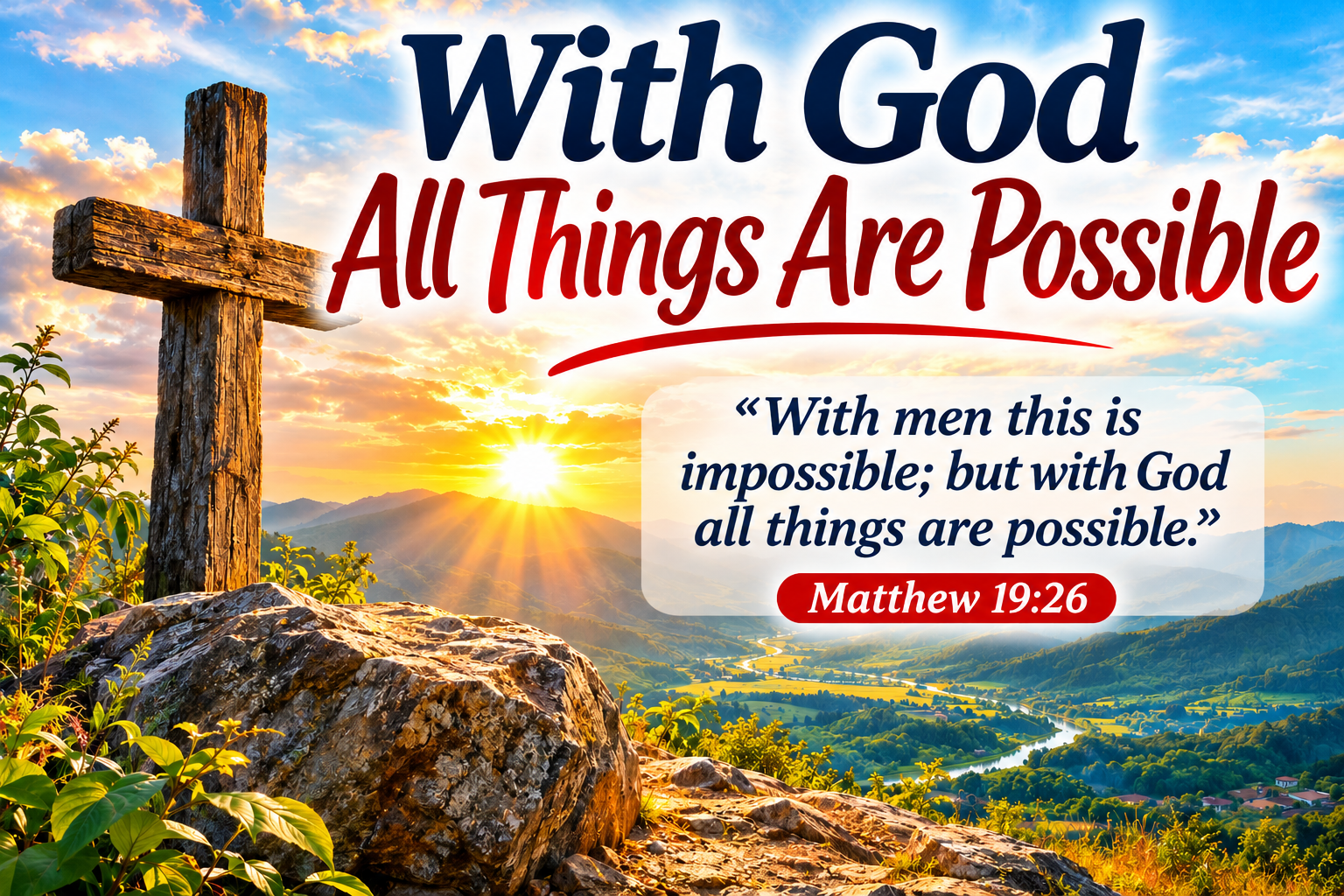
“With men this is impossible; but with God all things are possible.”
— Matthew 19:26, King James Version
These words from Jesus offer more than encouragement.
They remind us that God’s power and wisdom are greater than our own.
However, this biblical teaching does not mean that every personal wish will automatically come true.
Faith is not a guarantee that life will unfold according to our expectations.
It is the decision to trust God even when we cannot see or understand the entire journey.
Faith Begins Where Our Certainty Ends
Maintaining hope can feel relatively easy when life is going well.
But what happens when everything changes?
What happens when we lose an important opportunity, struggle to pay our bills, experience rejection, or discover that the people around us no longer believe in our dreams?
These experiences can challenge even our strongest convictions.
Throughout the Bible, we encounter individuals who had to move forward without knowing exactly what would happen next.
Abraham left his homeland because he trusted God’s promise.
Moses accepted a difficult mission despite doubting his own abilities.
David confronted an enemy who appeared far stronger than himself.
None of these individuals possessed complete control over their circumstances.
Yet their stories remind us that genuine faith does not require complete certainty before taking the next step.
Faith does not mean pretending our obstacles do not exist. It means recognizing that our obstacles do not necessarily have the final word.
God Can Make a Way Where We See Only Walls
Imagine someone who suddenly loses a job.
For weeks, this individual submits applications, attends interviews, and receives rejection after rejection.
Gradually, uncertainty begins to affect confidence and self-worth.
One possible response is to interpret every rejection as proof that nothing will ever improve.
Another is to recognize that this difficult season may create an opportunity to develop new skills, explore another profession, or pursue an idea that previously seemed out of reach.
Losing a job is not automatically a blessing, and suffering should never be minimized.
But difficult circumstances do not always eliminate the possibility of building a different future.
The prophet Isaiah records this declaration:
“Behold, I will do a new thing.”
— Isaiah 43:19, King James Version
In its original context, this passage speaks of God’s promise of restoration to His people.
It also encourages reflection on how easily we assume a situation is finished simply because we cannot imagine what might happen next.
Sometimes what we need most is not an instantly opened door.
Sometimes we need the wisdom to recognize which path is worth pursuing.
Believing in God Does Not Mean Doing Nothing
One of the most common misunderstandings about faith is the belief that trusting God requires us to remain passive.
Some people hope that their lives will improve while continuing the same ineffective habits, avoiding responsibility, or refusing to acquire new knowledge.
But faith and responsible action are not enemies.
The Bible teaches:
“Even so faith, if it hath not works, is dead, being alone.”
— James 2:17, King James Version
In context, James emphasizes that genuine faith expresses itself through meaningful action, especially through practical care for people in need.
This principle also invites us to examine whether our daily decisions reflect our beliefs.
If we want financial stability, we must learn to manage our resources wisely.
If we hope to start a business, we need preparation, knowledge, and consistent effort.
If we desire healthier relationships, we must practice communication, respect, and forgiveness when appropriate.
If we want to make a difference in our communities, we must turn good intentions into acts of service.
Prayer can strengthen our spirit, while responsible action allows us to participate meaningfully in the life we are building.
Both can belong to a life rooted in faith.
When God Does Not Answer the Way We Expect
This may be one of the most difficult lessons of spiritual maturity.
Many people have prayed sincerely for a sick loved one, a struggling marriage, an employment opportunity, or relief from overwhelming financial pressure.
And sometimes the outcome has been heartbreaking.
Does that mean their faith was insufficient?
No.
Scripture itself describes deeply faithful people who experienced suffering, loss, disappointment, and unanswered questions.
The apostle Paul wrote about an affliction from which he repeatedly asked to be delivered.
Rather than describing its immediate removal, he recorded a message about divine grace and strength:
“My grace is sufficient for thee: for my strength is made perfect in weakness.”
— 2 Corinthians 12:9, King James Version
This passage reminds us that God’s presence should not be measured only by the absence of difficulties.
Sometimes we find the strength to change our circumstances.
Sometimes we find the strength to endure them.
And sometimes we must acknowledge that we do not fully understand why certain things happen.
Mature faith does not demand that God fulfill every personal plan. It learns to trust Him even when those plans change.
Small Steps Can Lead to Meaningful Transformation
One powerful realization can change the way we approach difficult circumstances:
We do not have to solve every problem in a single day.
Sometimes progress begins with decisions so small that they almost seem insignificant.
Someone chooses to study for thirty minutes each day.
Another person begins saving a modest amount every week.
A struggling individual finds the courage to ask for help.
A family decides to have an honest conversation instead of allowing resentment to grow.
An aspiring entrepreneur, after repeated setbacks, tries a different approach based on lessons learned.
None of these actions guarantees immediate success.
But each represents a meaningful decision to move forward.
Perseverance does not mean repeating an unsuccessful strategy forever.
It also requires learning, adjusting, seeking guidance, and recognizing when a new direction is necessary.
Being faithful to our values does not mean remaining committed to decisions that are causing unnecessary harm.
Sometimes moving forward begins with the courage to start again.
True Success Is Not Always Measured in Money
Modern society frequently associates success with wealth, possessions, public recognition, and influence.
Financial stability and professional achievement can certainly be worthwhile goals.
But they are not the only measures of a meaningful life.
What value is extraordinary wealth if we sacrifice our integrity?
What is the purpose of public recognition if we neglect those who depend on us?
What have we truly gained if our achievements come at the expense of our health, relationships, or peace of mind?
Jesus asked a question that remains deeply relevant today:
“For what is a man profited, if he shall gain the whole world, and lose his own soul?”
— Matthew 16:26, King James Version
These words challenge us to examine our priorities.
Personal growth is not only about acquiring more possessions or accumulating achievements.
It is also about becoming more compassionate, responsible, generous, and aware of how our choices affect others.
A business that provides honest and useful solutions can become a form of service.
A parent who raises a child with love and wisdom may leave an extraordinary legacy.
Someone who supports a struggling neighbor can make a lasting difference without ever becoming famous.
Not everyone is called to public greatness, but everyone can discover opportunities to do meaningful good.
When Our Faith Becomes Someone Else’s Hope
Faith should not remain confined to our individual concerns.
It should also encourage us to recognize the needs of others.
Some of the most beautiful expressions of hope appear when ordinary people decide to help without expecting recognition or personal rewards.
Someone provides groceries to a family experiencing hardship.
A neighbor visits an elderly person who lives alone.
A volunteer teaches practical skills to someone searching for employment.
A community organizes assistance for families who have lost their homes.
These actions may not solve every injustice in the world.
But they can make a genuine difference.
Jesus’ teaching about loving our neighbors reminds us that spirituality is also expressed through compassion and service.
It is not enough to speak about hope when we have an opportunity to help create it.
We may not be able to change an entire community overnight.
But we can listen, encourage, teach, assist, or support one person.
And sometimes that single act becomes a turning point in another person’s life.
Five Practical Decisions for Living With Greater Faith and Purpose
Faith becomes more meaningful when it influences everyday choices.
- Begin each day with gratitude. Recognize what is good without denying the challenges that still need attention.
- Make time for prayer and reflection. Seek clarity, discernment, and inner strength before making important decisions.
- Take one practical step toward a goal. Choose a realistic, measurable action that can be completed today.
- Learn from mistakes. Review your results, seek wise counsel, and adjust your approach when necessary.
- Help someone else. Express your beliefs through kindness, generosity, honesty, and compassion.
These are not guaranteed steps toward wealth, perfect health, or a trouble-free life.
They are practical ways to cultivate a life shaped by responsibility, service, and spiritual confidence.
What If the Impossible Is an Invitation to Grow?
Perhaps someone reading these words is facing a situation that appears impossible to resolve.
Maybe a business has failed repeatedly.
Perhaps financial stability seems increasingly distant.
Someone may be recovering from a painful loss, searching for a new purpose, or struggling to find the courage to begin again.
The fear of another disappointment can be overwhelming.
But there is an important difference between acknowledging our circumstances and allowing those circumstances to define our entire identity.
We cannot control everything.
We cannot guarantee that every dream will come true.
We cannot eliminate uncertainty from our lives.
But we can choose how we respond to our challenges.
We can learn new skills.
We can ask for help.
We can protect our dignity.
We can develop healthier habits.
We can pursue opportunities with patience and discernment.
And we can maintain our faith while taking responsible steps toward a better future.
Most importantly, we can remember that our value as human beings is not determined solely by achievements or financial results.
Failure does not determine a person’s worth. Loss does not erase human dignity. And a difficult chapter does not mean the entire story is over.
With God, All Things Are Possible
The declaration “With God, all things are possible” carries a meaning far deeper than the idea that we can obtain anything we desire.
It reminds us that God’s power exceeds human limitations and that trust in Him can remain meaningful even during seasons of uncertainty.
Faith does not always change our circumstances immediately.
But it can change the way we respond to them.
It can inspire us to continue when we are exhausted, act wisely when we are afraid, and offer encouragement when someone else is losing hope.
Perhaps we cannot see the final outcome today.
Perhaps important questions remain unanswered.
But as long as we have life, we can continue seeking wisdom, building opportunities, and discovering ways to serve others.
An extraordinary life is not necessarily one without difficulties. It is a life in which we learn to move forward with faith, integrity, compassion, and purpose despite the challenges we encounter.
A Closing Prayer
Heavenly Father, thank You for remaining with us even during the moments we do not understand.
Give us wisdom to recognize the right paths, courage to confront our fears, and humility to accept what lies beyond our control.
Strengthen our faith when progress seems slow. Help us learn from our mistakes, persevere responsibly, and remain compassionate toward those who are struggling.
May our choices reflect love, justice, integrity, and hope.
And may we never forget that even when our strength is limited, we can find in You the courage to continue.
Amen.
A Question for Our Readers
Have you ever experienced a moment when your faith helped you move forward even though everything seemed impossible?
Share your experience in the comments. Your story may encourage someone facing a similar challenge today.
Editorial notice: This article offers Christian spiritual reflection and educational encouragement. It does not replace professional medical, mental health, legal, or financial advice. Faith does not guarantee specific material outcomes.
Debe estar conectado para enviar un comentario.