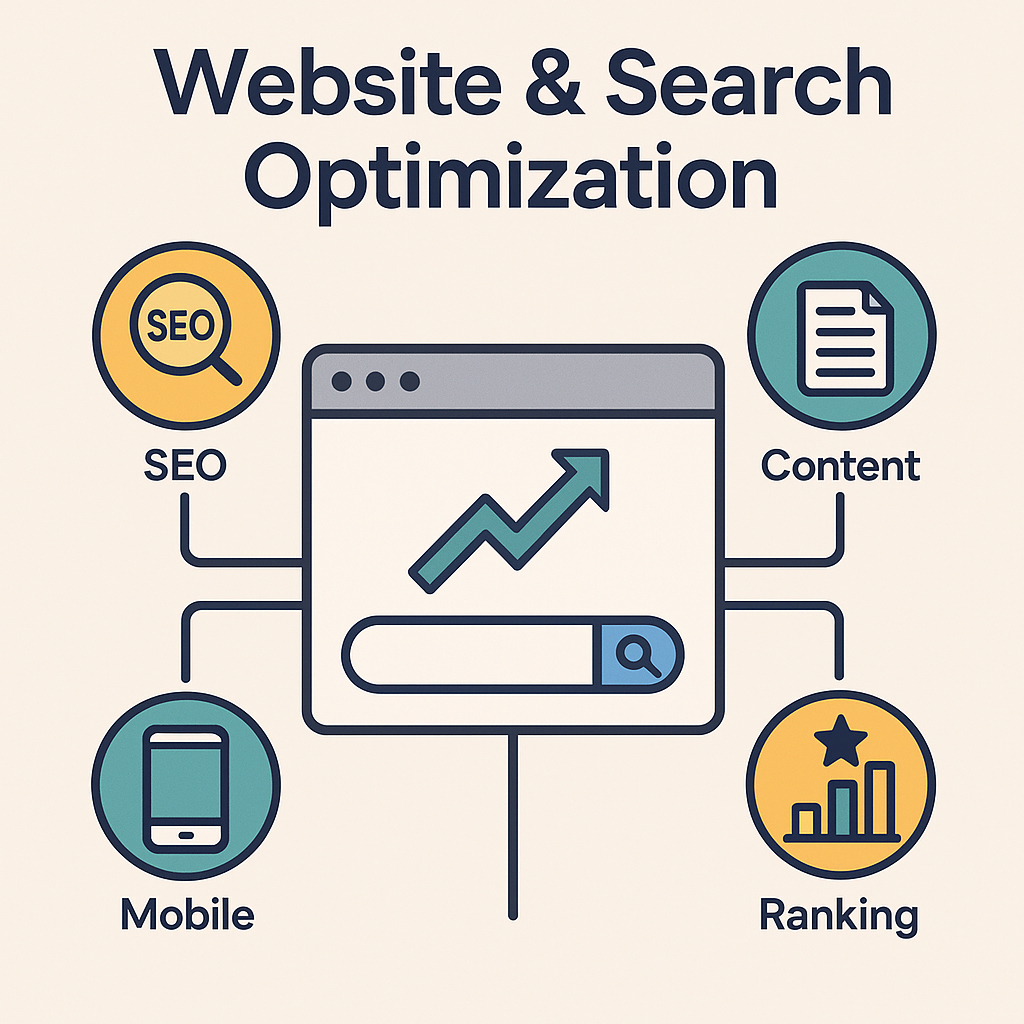
🌐 Week 6: Website & Search Optimization
Learn the key principles of website and search optimization. Discover how to improve your site’s performance, visibility, and rankings on Google using smart SEO and technical strategies.
🌟 Introduction
Your website is the heart of your digital presence — the place where visitors form their first impression of your brand. But even the most beautiful site won’t help your business if no one can find it.
That’s where website and search optimization (SEO) comes in. It’s the process of improving your website’s performance, content, and structure so that search engines — and users — love it. Let’s explore how to make your site more visible, user-friendly, and profitable.
🔍 1. What Is Website & Search Optimization?
Website and search optimization, often referred to as SEO (Search Engine Optimization), is about ensuring your site appears when people search for products, services, or information you offer.
In simple terms:
SEO = Visibility + Relevance + Experience
It combines technical improvements, strategic keyword usage, and user experience design to rank higher in search engines like Google and Bing.
⚙️ 2. The Core Pillars of SEO
Three main types of SEO work together to make your website successful:
1. On-Page SEO
Optimizing elements within your website pages, such as:
- Keywords in titles, headers, and content
- Meta descriptions
- Image alt text
- Internal links
- Fast loading times
2. Off-Page SEO
External factors that improve your site’s credibility:
- Backlinks from reputable websites
- Brand mentions on social media
- Guest articles or collaborations
3. Technical SEO
Improving your site’s backend structure for better crawling and indexing:
- Mobile responsiveness
- Secure HTTPS protocol
- Sitemap and robots.txt
- Site speed optimization
When all three pillars work together, your website becomes both search-friendly and user-friendly.
🧠 3. How Search Engines Work
Search engines use bots to crawl websites and algorithms to decide which pages best match a user’s search query.
These algorithms analyze:
- Keyword relevance
- Page authority
- User engagement (time on page, bounce rate)
- Site performance (speed, mobile usability)
Your goal is to signal to search engines that your website provides valuable, trustworthy information — faster and better than competitors.
🏗️ 4. Building a Strong SEO Foundation
Here’s how to build a well-optimized website from the ground up:
✅ Use a Responsive Design:
Your website should adapt seamlessly to mobile, tablet, and desktop screens.
✅ Speed Matters:
Use tools like Google PageSpeed Insights or GTmetrix to analyze and improve load time.
✅ Clean Navigation:
Ensure users can easily find what they need in 3 clicks or fewer.
✅ Use SEO-Friendly URLs:
Example:
❌ /page?id=234
✅ /best-digital-marketing-tools
✅ Add Schema Markup:
This helps Google understand your content better and display rich snippets (like ratings or FAQs).
💬 5. The Power of Keywords
Keywords are the backbone of SEO. They tell search engines what your content is about.
Steps to Find and Use Keywords Effectively:
- Research: Use tools like Google Keyword Planner or Semrush.
- Select Long-Tail Keywords: (e.g., “best affordable SEO tools for beginners”).
- Place Naturally: Include them in headings, paragraphs, and metadata.
- Avoid Keyword Stuffing: Keep your writing natural and valuable.
Example:
Instead of repeating “buy shoes online” ten times, use variations like “shop trendy footwear online” or “find stylish shoes for any occasion.”
📈 6. Measure and Improve
SEO is an ongoing process — not a one-time task.
Track your performance using tools like:
- Google Analytics: Monitor traffic and behavior.
- Google Search Console: Track rankings and fix errors.
- Ahrefs or Semrush: Monitor backlinks and keyword positions.
Review your analytics monthly and adjust your strategy to focus on what’s working.
🚀 Conclusion & Call to Action
A well-optimized website is your best salesperson — working 24/7 to attract, engage, and convert visitors.
👉 This week, audit your website. Check your speed, mobile design, and SEO keywords. Small improvements today will lead to exponential growth tomorrow.
Next week: Week 7 — Content Marketing: Turning Words Into Profit.

Debe estar conectado para enviar un comentario.