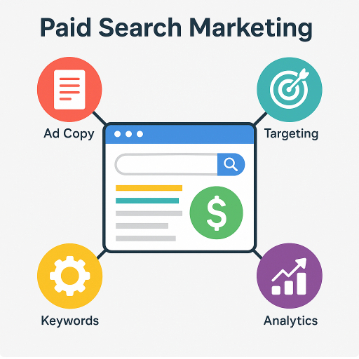
💰 Week 8: Paid Search Marketing
Learn how paid search marketing (PPC) helps you target people ready to buy. Discover how to create effective ads, manage budgets, and measure results for higher ROI.
🌟 Introduction
Imagine having your business appear at the exact moment someone searches for what you offer. That’s the power of Paid Search Marketing (PPC) — a fast, measurable way to reach people who are already looking for your products or services.
Unlike organic marketing, which takes time to grow, paid search ads deliver instant visibility and results. The key is learning how to craft campaigns that convert — not just clicks, but customers.
Let’s explore how to make paid search your most profitable marketing channel.
🔎 1. What Is Paid Search Marketing?
Paid Search Marketing (also called Pay-Per-Click Advertising, or PPC) is a model where advertisers pay each time someone clicks on their ad.
These ads appear on search engines like Google, Bing, or Yahoo, typically above or beside organic search results.
Example:
If you sell eco-friendly shoes, and someone searches “best eco-friendly sneakers,” your ad can appear at the top — ready to attract a motivated buyer.
💡 2. How Paid Search Works
Here’s how PPC functions behind the scenes:
- Keywords: You choose search terms related to your offer.
- Ad Auction: Search engines hold an instant auction every time someone searches.
- Bidding: You set how much you’re willing to pay per click.
- Ad Rank: Your ad’s position depends on your bid and quality score (relevance, landing page quality, CTR).
- Click: When someone clicks, they’re taken to your landing page — and you pay for that click.
It’s a precise, performance-based way to attract ready-to-buy customers.
📈 3. Benefits of Paid Search Marketing
Why use paid search when SEO exists? Because it offers speed, control, and measurable results.
Top Benefits:
- ⚡ Instant Visibility: Your brand appears on page one immediately.
- 🎯 Highly Targeted: Reach people based on keywords, location, or even device.
- 💰 Pay Only for Results: You only pay when someone clicks your ad.
- 📊 Data-Driven: Every impression, click, and conversion is tracked.
- 🔁 Scalable: You can start small and increase your budget as you see results.
PPC is like a light switch — turn it on and your traffic flows instantly.
🧠 4. Crafting an Effective PPC Campaign
To succeed with paid search, you need a smart, structured approach.
Step 1: Research the Right Keywords
Use tools like Google Keyword Planner or Semrush to find terms your target audience actually searches for.
👉 Focus on long-tail keywords (e.g., “affordable SEO consultant in Las Vegas”) — they’re cheaper and more targeted.
Step 2: Write Compelling Ad Copy
Your ad must grab attention and promise value.
Example:
“Secure Your Files in the Cloud – 7-Day Free Trial. Protect What Matters Most!”
Always include a CTA (Call to Action) like Get Started, Learn More, or Try Free.
Step 3: Optimize Your Landing Page
When users click, they should land on a page that matches your ad promise.
- Use a clear headline
- Highlight benefits
- Include testimonials
- Add one strong CTA
Step 4: Set Your Budget & Bids
Start small, analyze, then scale what works. Google Ads allows you to set daily limits, so you’ll never overspend.
Step 5: Track, Test, and Improve
Use Google Ads Dashboard and Google Analytics to monitor conversions, cost per click (CPC), and ROI.
💬 5. The Power of Remarketing
One of PPC’s most effective strategies is remarketing — showing ads to people who visited your site but didn’t convert.
It’s like a gentle reminder saying:
“Hey, remember us? Here’s that offer you viewed earlier.”
This keeps your brand top of mind and increases your chances of turning visitors into buyers.
⚙️ 6. Tools to Boost Your PPC Performance
Here are some powerful tools to improve your paid search campaigns:
- Google Ads Editor: Manage campaigns offline.
- Semrush / Ahrefs: Keyword research and competition tracking.
- SpyFu: See what ads competitors are running.
- Optmyzr: Automate PPC optimization.
- Hotjar: Analyze user behavior after they click your ad.
🚀 Conclusion & Call to Action
Paid search marketing is one of the most effective ways to drive instant traffic and sales. When done right, it connects you with people who already have buying intent — no convincing required.
👉 This week, try setting up a simple Google Ads campaign targeting one of your best keywords. Test, measure, and refine. You’ll be surprised how fast you can get results!
Next week: Week 9 — Social Media Marketing: Building Connections That Convert.


Debe estar conectado para enviar un comentario.