
Publicado en Character, Habits, Identity, Marvin Gandis, Mindset, Personal Development, Personal Growth, Self Reflection, The Inverse Question

WHAT ARE YOU REHEARSING EVERY DAY THAT IS QUIETLY BECOMING YOUR IDENTITY?

“Whatever you practice repeatedly becomes easier to repeat—and eventually it can begin to feel like who you are.”
— Marvin Gandis

Every day, whether we realize it or not, we rehearse.

We rehearse how we respond to pressure.

How we speak to ourselves.

How quickly we become discouraged.

How we handle money.

How we use our time.

How we respond when someone disagrees with us.

How long we remain focused before reaching for distraction.

How we behave when nobody is watching.

These repetitions may seem insignificant because they do not produce dramatic results immediately.

But repetition is training.

And training eventually becomes familiarity.

Familiarity becomes automatic behavior.

Automatic behavior can become part of identity.

That is why Day 11 of The Inverse Question asks:

What are you practicing so often that it is quietly becoming part of who you are?


YOU ARE PRACTICING SOMETHING EVERY DAY

We usually associate practice with intentional improvement.

An athlete practices.

A musician practices.

A speaker practices.

A writer practices.

But practice is not always intentional.

You can practice impatience.

You can practice distraction.

You can practice complaining.

You can practice avoiding uncomfortable conversations.

You can practice spending impulsively.

You can practice giving up when progress becomes slow.

You can practice assuming the worst.

You can also practice:

Patience.

Focus.

Courage.

Gratitude.

Financial discipline.

Consistency.

Listening.

Responsibility.

What matters is not merely what you say you value.

It is what you repeatedly rehearse.


REPETITION MAKES BEHAVIOR FAMILIAR

Think about learning to drive.

At first, everything requires attention.

Mirrors.

Pedals.

Signals.

Traffic.

Speed.

Steering.

Eventually, many actions become automatic.

Why?

Because repetition reduces the amount of conscious effort required.

Our personal behaviors can develop in similar ways.

The first time you postpone something important, it may bother you.

Repeat it often enough and postponement becomes familiar.

The first time you establish a difficult boundary may feel uncomfortable.

Practice it responsibly, and clarity becomes easier.

The first time you speak publicly may feel terrifying.

Practice changes the experience.

Repetition trains response.


✦ THE INVERSE QUESTION ✦

For Day 11, ask yourself:

What behavior have I repeated so often that I no longer question it?

That question is important because the most influential patterns are often the ones we stop noticing.

Maybe you automatically:

Reach for your phone when uncomfortable.

Spend when stressed.

Complain when frustrated.

Avoid when uncertain.

Interrupt when challenged.

Assume failure before beginning.

Say yes when you want to say no.

Procrastinate until urgency forces action.

Or perhaps you have trained yourself to:

Prepare.

Save.

Listen.

Reflect.

Keep commitments.

Learn.

Recover after setbacks.

Continue when motivation disappears.

Both kinds of repetition matter.


YOUR REACTIONS ARE ALSO REHEARSALS

Habits are not limited to visible activities.

We also rehearse emotional responses.

Someone criticizes us.

Do we immediately become defensive?

Something goes wrong.

Do we automatically look for someone to blame?

An opportunity appears.

Do we immediately imagine why it will fail?

A challenge arrives.

Do we panic—or pause and evaluate?

Every response reinforces a pattern.

That does not mean emotions are wrong.

Emotions provide information.

But the response we repeatedly attach to them can become trained behavior.


YOU CAN PRACTICE PAUSING

One of the most useful habits is surprisingly simple:

Pause.

Before answering.

Before purchasing.

Before reacting.

Before sending the message.

Before making the decision.

Before assuming someone’s intention.

A pause creates space.

And space creates choice.

Without that space, old rehearsals often take control.

A few seconds can sometimes separate reaction from judgment.


YOUR INNER CONVERSATION IS TRAINING TOO

What do you repeatedly tell yourself?

“I never get anything right.”

“I am too old to begin.”

“I always fail.”

“Nothing works for me.”

“I am terrible with money.”

“I cannot learn this.”

Repeated statements can become mental rehearsals.

They influence what we expect.

And expectations influence behavior.

This does not mean replacing reality with empty positive statements.

A better approach is accurate language.

Instead of:

  • “I cannot do this.”

Try:

  • “I do not know how to do this yet.”

Instead of:

  • “I always fail.”

Try:

  • “This attempt did not work. What can I learn?”

Accuracy is more powerful than exaggeration—negative or positive.


ATTENTION IS SOMETHING WE PRACTICE

Modern life constantly competes for our attention.

Notifications.

Videos.

Messages.

News.

Advertisements.

Social feeds.

Entertainment.

Our attention becomes fragmented.

Then we wonder why sustained concentration feels difficult.

But perhaps we have been practicing interruption.

Every time we abandon an important task at the first notification, we reinforce a pattern.

Focus also requires rehearsal.

Ten uninterrupted minutes.

Then twenty.

Then thirty.

Protecting attention is not only productivity.

It is training the mind to remain present.


WHAT YOU REHEARSE UNDER EASY CONDITIONS APPEARS UNDER PRESSURE

Pressure reveals preparation.

An athlete does not invent technique during competition.

Training prepared the response.

Life often works similarly.

If we practice calm decision-making when circumstances are manageable, we may respond more effectively when difficulty arrives.

If we regularly manage money responsibly, an unexpected expense may be easier to navigate.

If we practice honest communication, conflict may become less destructive.

If we practice discipline when motivation is high, we are better prepared when motivation disappears.

Daily practice prepares us for days that are not ordinary.


FINANCIAL BEHAVIOR IS REHEARSAL

Every financial choice teaches something.

Checking your spending teaches awareness.

Saving regularly teaches delayed gratification.

Ignoring statements teaches avoidance.

Impulse purchases reinforce immediate reward.

Following a budget reinforces intentionality.

Again, one purchase does not create an identity.

But repetition can.

Ask:

What financial behavior am I rehearsing every month?

Your future finances may eventually reflect the answer.


RELATIONSHIPS ARE BUILT THROUGH REHEARSAL

Strong relationships are not created through one extraordinary conversation.

They are built through repetition.

Listening.

Showing up.

Respect.

Honesty.

Forgiveness.

Boundaries.

Gratitude.

Reliability.

Unfortunately, harmful patterns are also repeated.

Sarcasm.

Silence.

Disrespect.

Avoidance.

Defensiveness.

Neglect.

Every interaction teaches the relationship what to expect next.


✦ THE MIRROR ✦

Take a few minutes and examine your rehearsals.

When I feel stressed, I usually: __________

When I feel uncertain, I usually: __________

When I make a mistake, I usually tell myself: __________

When something becomes difficult, I usually: __________

When I receive money, I usually: __________

When I have free time, I usually: __________

When someone disagrees with me, I usually: __________

Now ask:

If these responses became stronger over the next five years, would I like the person they create?

If not, identify one rehearsal worth changing.


STOP PRACTICING THE FUTURE YOU DO NOT WANT

Sometimes growth begins not by adding something, but by interrupting a rehearsal.

Stop rehearsing:

“I will start tomorrow.”

Stop rehearsing:

“I need to feel motivated first.”

Stop rehearsing:

“I cannot change.”

Stop rehearsing:

“It is everyone else’s fault.”

Stop rehearsing:

“One more purchase will not matter.”

Stop rehearsing:

“I do not have time.”

Some statements describe temporary circumstances.

But when repeated constantly, they can become scripts.

And scripts influence behavior.


REPLACE, DO NOT ONLY REMOVE

Breaking a pattern is easier when we create an alternative.

Instead of scrolling immediately when bored:

Read five pages.

Walk.

Write.

Reflect.

Instead of purchasing impulsively:

Wait twenty-four hours.

Instead of reacting immediately when angry:

Pause.

Instead of postponing an intimidating project:

Work on it for ten minutes.

Instead of complaining about a recurring problem:

Identify one action within your control.

The goal is not simply:

  • Stop doing this.

It is:

Practice something better instead.


SMALL REHEARSALS CAN PRODUCE LARGE CHANGES

You do not need a dramatic transformation tomorrow morning.

Practice arriving five minutes earlier.

Practice saving a small percentage.

Practice completing one important task before checking social media.

Practice reading instead of scrolling for ten minutes.

Practice asking one more question before giving your opinion.

Practice finishing something you normally abandon.

Tiny repetitions can create new evidence.

New evidence can change self-perception.


CONSISTENCY OUTPERFORMS OCCASIONAL INTENSITY

A dramatic effort feels impressive.

Five hours of exercise one day.

A huge burst of work.

An extreme financial restriction.

A weekend of nonstop study.

But sustainable change usually comes from repeatable behavior.

Twenty minutes repeated may accomplish more than five hours performed once.

A small amount saved consistently may matter more than one occasional deposit.

A page written every day eventually becomes a manuscript.

The question is not:

  • “How intense can I be today?”

It is:

“What can I realistically continue practicing?”


BE CAREFUL WHAT YOU PRACTICE WHEN YOU ARE TIRED

Fatigue reduces resistance.

When exhausted, we often return to familiar behavior.

That makes our automatic patterns especially important.

Under fatigue, do you:

Eat impulsively?

Spend impulsively?

React emotionally?

Abandon routines?

Scroll endlessly?

Or have you created systems that reduce dependence on willpower?

Good systems protect good rehearsals.


YOUR ENVIRONMENT CAN REHEARSE FOR YOU

Leave your phone beside you while working, and distraction becomes easier.

Prepare healthy food, and better choices become easier.

Automate savings, and financial discipline requires less repeated decision-making.

Schedule focused work, and important projects gain protected space.

Environment is powerful because it changes the friction around behavior.

Ask:

Is my environment making the person I want to become easier—or harder—to practice?


WHAT YOU REPEAT BECOMES WHAT YOU EXPECT

If you repeatedly abandon your commitments, you may begin expecting yourself to quit.

If you repeatedly follow through, you begin expecting reliability.

If you repeatedly recover after setbacks, difficulty stops feeling like the end.

Expectation grows from evidence.

This is why small victories matter.

Each one changes the story you can honestly tell about yourself.


IDENTITY SHOULD BE FLEXIBLE ENOUGH TO GROW

There is another danger.

Sometimes we become proud of an identity that no longer serves us.

“I am always busy.”

“I am the person everyone depends on.”

“I never need help.”

“I always say yes.”

“I work harder than everyone.”

Those identities may initially sound admirable.

But they can become unhealthy when they prevent boundaries, rest, delegation, or change.

Identity should guide us.

It should not imprison us.


PRACTICE THE RESPONSE BEFORE YOU NEED IT

Suppose you know a difficult conversation is coming.

Do not only worry about it.

Practice what you want to say.

Suppose you tend to overspend in certain situations.

Decide the rule before temptation arrives.

Suppose you become overwhelmed by criticism.

Prepare a question:

“Is there something useful here that I can learn?”

Rehearsal can be intentional.

We do not have to wait for the moment to decide who we will be.


COURAGE IS SOMETHING WE CAN PRACTICE

Courage is not the absence of fear.

It is action despite fear when action is appropriate.

That means courage can be rehearsed.

Speak when you normally remain silent.

Ask the question.

Submit the work.

Say no respectfully.

Try again.

Admit the mistake.

Start before you feel completely ready.

Each courageous action becomes evidence.

And evidence makes the next courageous action slightly more familiar.


PATIENCE IS ALSO A PRACTICE

We often say:

  • “I am not a patient person.”

But patience is not only personality.

It can also be behavior.

Waiting before reacting.

Listening without interrupting.

Allowing progress to take time.

Accepting that some results cannot be forced.

Continuing responsible effort without demanding immediate reward.

Every act of patience is rehearsal.


WHAT HAPPENS WHEN NOBODY IS WATCHING?

Public behavior is influenced by reputation.

Private behavior reveals standards.

Do you complete the work when nobody will know?

Do you keep the promise you made only to yourself?

Do you behave according to your values when there is no recognition?

Private rehearsals matter because identity is strongest when it does not depend on an audience.


YOUR DAILY LIFE IS YOUR TRAINING GROUND

You do not need a special retreat to begin changing.

Today contains enough opportunities.

The next interruption.

The next temptation.

The next purchase.

The next disagreement.

The next difficult task.

The next moment of boredom.

The next promise.

Each one gives you a chance to rehearse.

The question is:

What response do you want to make more automatic?


MY DEAR READER AND FRIEND

By Day 10, we asked:

  • Who are you becoming through the choices you repeat every day?

Day 11 goes one level deeper.

Because before behavior becomes identity, it is usually rehearsal.

Something practiced.

Again.

And again.

And again.

So pay attention to what you practice.

Not only during your best moments.

During your ordinary ones.

Because ordinary repetition has extraordinary power.

You are training yourself every day.

The only question is:

What are you training yourself to become?


WHAT ARE YOU REHEARSING EVERY DAY THAT IS QUIETLY BECOMING YOUR IDENTITY?

Your future character may be developing in moments that seem insignificant today.

One response.

One decision.

One repeated thought.

One boundary.

One act of courage.

One excuse rejected.

One promise kept.

You do not need to change everything at once.

Choose one rehearsal.

Make it intentional.

Repeat it.

And give the person you want to become something new to practice.

With gratitude,

Marvin Gandis
Author of La Pregunta Inversa and The Inverse Question


CONTINUE THE JOURNEY

This is Day 11 of The Inverse Question English series.

Day 1: Today Begins a New Chapter
Day 2: Why Did I Write The Inverse Question?
Day 3: The Question That Changed the Way I Think
Day 4: Maybe You Have Been Looking for Answers to the Wrong Question
Day 5: The Roots No One Sees Determine the Fruit Everyone Sees
Day 6: Not Everything That Looks Like Progress Is Moving You Forward
Day 7: What Are You Tolerating Today That Is Building the Future You Do Not Want?
Day 8: Do Not Confuse Movement With Direction
Day 9: What Are You Doing Today That Your Future Self Will Thank You For?
Day 10: Who Are You Becoming Through the Choices You Repeat Every Day?
Day 11: What Are You Rehearsing Every Day That Is Quietly Becoming Your Identity?

Next:

Day 12 — How Much Is It Costing You to Keep Being the Same Person?

Because staying unchanged can feel safe while quietly becoming one of the most expensive decisions we make.

DISCLAIMER

This article is provided for educational, informational, motivational, and personal-reflection purposes only. It does not constitute medical, psychological, mental-health, legal, financial, business, career, relationship, or other professional advice.

The discussion of habits, self-talk, emotional responses, attention, identity, finances, relationships, discipline, and personal growth is general and may not apply equally to every person or circumstance.

Persistent emotional, behavioral, psychological, medical, financial, relationship, or other significant difficulties may require support from an appropriately qualified professional.

No specific personal, professional, financial, business, relationship, health, or life result is promised or guaranteed.

The Inverse Question series is intended to encourage thoughtful reflection, learning, awareness, responsible decision-making, intentional growth, and independent judgment.

Publicado en Character, Discipline, Habits, Identity, Marvin Gandis, Mindset, Personal Development, Personal Growth, The Inverse Question

WHO ARE YOU BECOMING THROUGH THE CHOICES YOU REPEAT EVERY DAY?

“Your habits do more than shape your results. They quietly shape the person you are becoming.”
— Marvin Gandis

We often judge our choices by what they produce.

Did this help me earn more?

Did this move the project forward?

Did this improve my health?

Did this make life easier?

Those are reasonable questions.

But there is another question that may be even more important:

Who am I becoming through the choices I repeat every day?

Because habits do not only create outcomes.

They create identity.

The things we do repeatedly begin to influence what feels normal.

What feels natural.

What we expect from ourselves.

What we tolerate.

What we believe we are capable of.

Over time, repeated choices become evidence.

And that evidence begins to answer one of the deepest questions in life:

What kind of person am I becoming?


RESULTS MATTER, BUT IDENTITY MATTERS TOO

Imagine two people who reach the same goal.

Both become successful.

Both earn more.

Both complete the project.

Both gain recognition.

But one becomes more disciplined, patient, generous, and grounded in the process.

The other becomes anxious, arrogant, exhausted, and disconnected from everything that once mattered.

Did they achieve the same result?

On paper, perhaps.

In reality, no.

Because success is not only about what you achieve.

It is also about what the process turns you into.


EVERY HABIT CASTS A VOTE

Every repeated behavior is a small vote for an identity.

When you keep a promise to yourself, you cast a vote for reliability.

When you study consistently, you cast a vote for discipline.

When you tell the truth when dishonesty would be easier, you cast a vote for integrity.

When you procrastinate repeatedly, you cast a vote for avoidance.

When you overspend repeatedly, you cast a vote for financial disorder.

When you complain without acting, you cast a vote for helplessness.

One vote does not define you.

But repeated votes begin to build a pattern.

And patterns become identity.


✦ THE INVERSE QUESTION ✦

For Day 10, ask yourself:

If someone observed my repeated choices for the next year, what kind of person would they say I am becoming?

Do not answer based on intention.

Answer based on evidence.

Your schedule.

Your spending.

Your words.

Your habits.

Your reactions.

Your priorities.

Your follow-through.

Your treatment of others.

Your willingness to learn.

Your response to difficulty.

That evidence may reveal more than your goals do.


IDENTITY IS BUILT IN ORDINARY MOMENTS

We often imagine identity being shaped through dramatic experiences.

And sometimes it is.

But most identity is built quietly.

You wake up when you said you would.

Or you do not.

You complete the task.

Or delay it.

You speak respectfully.

Or react impulsively.

You save.

Or spend.

You practice.

Or avoid.

You apologize.

Or defend your ego.

You listen.

Or interrupt.

These moments seem small.

But they are training.

Everyday choices teach you who you are willing to be.


THE PERSON YOU PRACTICE BECOMES EASIER TO BE

Repetition reduces friction.

The first disciplined decision may feel difficult.

The tenth may feel easier.

The hundredth may begin to feel normal.

The same is true for poor habits.

The more often we repeat something, the less resistance we feel.

That means habits are not neutral.

They are rehearsal.

You are practicing a version of yourself.

The question is:

Which version?


YOU CAN BECOME SUCCESSFUL AND STILL BECOME SOMEONE YOU DO NOT LIKE

This is worth saying plainly.

Achievement does not automatically improve character.

Money can expose poor judgment.

Recognition can expose insecurity.

Power can expose ego.

Pressure can expose impatience.

Success can magnify what already exists.

That is why personal growth should not focus only on capacity.

It should also focus on character.

Ask:

If I receive more responsibility, who will I become under that pressure?

That question matters before success arrives.


DISCIPLINE CHANGES MORE THAN YOUR SCHEDULE

Discipline is not merely time management.

It changes self-perception.

When you repeatedly do what you said you would do, you begin trusting yourself more.

You stop needing constant motivation.

You rely less on mood.

You become more dependable.

That becomes part of your identity.

You begin thinking:

  • I am someone who follows through.

That belief was not created through affirmation alone.

It was built through evidence.


THE SAME IS TRUE OF INTEGRITY

Integrity grows through repetition.

You tell the truth when nobody would know otherwise.

You keep promises that are inconvenient.

You refuse shortcuts that violate your values.

You admit mistakes.

You correct them.

These decisions build something invisible.

Character.

And eventually, other people can feel it.

Trust is often the visible fruit of invisible integrity.


WHAT YOU TOLERATE FROM YOURSELF ALSO SHAPES IDENTITY

We often think identity is created only by what we do.

It is also influenced by what we allow.

If you tolerate chronic lateness from yourself, you begin normalizing unreliability.

If you excuse repeated procrastination, delay becomes part of your self-story.

If you accept poor preparation, you lower your internal standard.

If you continually abandon goals, you may begin believing:

  • “I never finish anything.”

That belief then influences future behavior.

The cycle reinforces itself.


✦ THE MIRROR ✦

Complete these sentences:

One habit that is helping shape me into the person I want to become is: __________

One repeated choice that is moving me away from that person is: __________

One standard I need to raise is: __________

One behavior I need to stop excusing is: __________

One quality I want to strengthen is: __________

One action that would give me evidence of that quality is: __________

Now ask:

What identity am I reinforcing through the choices I repeat most often?

That is the heart of Day 10.


YOUR LANGUAGE ABOUT YOURSELF MATTERS

We often reinforce identity through language.

“I am terrible with money.”

“I am not disciplined.”

“I always procrastinate.”

“I am bad at relationships.”

“I cannot stay consistent.”

Those statements feel descriptive.

But repeated often enough, they can become instructions.

A healthier approach is not pretending the problem does not exist.

It is separating identity from behavior.

Instead of:

  • “I am undisciplined.”

Try:

  • “I have been inconsistent, and I am building better habits.”

Instead of:

  • “I am bad with money.”

Try:

  • “My current financial habits need improvement.”

Behavior can change.

Identity should not become a prison built from old evidence.


YOUR FUTURE IDENTITY NEEDS CURRENT EVIDENCE

You cannot become confident only by saying:

  • “I am confident.”

Confidence grows when you collect evidence.

You speak.

You practice.

You fail.

You recover.

You improve.

You survive uncomfortable situations.

Evidence changes belief.

If you want to become disciplined, create evidence of discipline.

If you want to become reliable, create evidence of reliability.

If you want to become generous, practice generosity.

If you want to become courageous, take small courageous actions.

Identity grows from repeated proof.


THE GOAL IS NOT TO PERFORM FOR OTHERS

There is a danger here.

We can become obsessed with appearing disciplined.

Appearing successful.

Appearing wise.

Appearing generous.

But appearance and identity are not the same thing.

Social media rewards visible performance.

Character is often built when nobody is watching.

The question is not:

  • “What do people think I am becoming?”

It is:

“Who am I becoming when there is no audience?”

That answer is often more honest.


WHAT YOU DO UNDER PRESSURE REVEALS TRAINING

Pressure does not always create character.

Often it reveals it.

When stressed, what do you default to?

Patience?

Anger?

Planning?

Avoidance?

Honesty?

Blame?

Discipline?

Impulse?

We tend to fall back on what we have practiced.

That is why daily choices matter before the crisis.

You are training your responses.


YOUR ENVIRONMENT PARTICIPATES IN YOUR IDENTITY

The people around you influence what seems normal.

If everyone around you avoids responsibility, responsibility can feel unusual.

If everyone around you is learning, growth can feel normal.

If your environment rewards distraction, distraction becomes easier.

If your environment rewards discipline, discipline becomes easier.

Ask:

What kind of person does my environment make easier to become?

That question deserves attention.


IDENTITY CAN CHANGE WITHOUT DENYING YOUR PAST

You are not required to remain loyal to an old version of yourself.

You may have been inconsistent.

You can become consistent.

You may have been financially careless.

You can become thoughtful.

You may have avoided difficult conversations.

You can learn to face them.

You may have quit before.

You can finish now.

Growth does not require pretending the past did not happen.

It requires refusing to let the past permanently define what happens next.


YOU BECOME WHAT YOU REHEARSE

Think of habits as rehearsal.

Every day you practice something.

Focus.

Distraction.

Patience.

Impatience.

Courage.

Avoidance.

Generosity.

Selfishness.

Responsibility.

Excuses.

Rehearsal matters because repetition makes behavior easier to access.

Eventually, the practiced response becomes the natural response.

That is how identity becomes automatic.


WHAT YOU REPEAT IN PRIVATE EVENTUALLY APPEARS IN PUBLIC

Private preparation becomes public competence.

Private discipline becomes public reliability.

Private study becomes public expertise.

Private financial habits become public stability.

Private character becomes public reputation.

The visible version is often the delayed result of invisible repetition.

That is why no private choice is completely insignificant.


YOUR GOALS SHOULD ASK FOR A PERSON, NOT ONLY A RESULT

Instead of asking only:

  • “What do I want to achieve?”

also ask:

  • “Who must I become to sustain it?”

A business may require discipline.

A healthy relationship may require patience.

Financial stability may require self-control.

Leadership may require humility.

A creative career may require persistence.

Achievement asks for action.

Sustainable achievement often asks for identity.


BECOMING TAKES TIME

Identity does not change instantly.

You may make one disciplined choice and still feel undisciplined.

That is normal.

The old identity has accumulated more evidence.

Keep creating new evidence.

One decision.

Then another.

Then another.

Eventually the balance begins to change.

You do not become a new person through one declaration.

You become through repeated behavior.


BE CAREFUL WHAT YOU REWARD

Behavior that receives reward tends to repeat.

If procrastination allows you to escape discomfort, procrastination gets rewarded.

If complaining earns attention, complaining may repeat.

If discipline produces satisfaction, discipline strengthens.

If generosity deepens connection, generosity strengthens.

Pay attention to the rewards hidden inside your habits.

Sometimes an unhealthy pattern continues because it is providing an immediate benefit.

Even when the long-term cost is high.


IDENTITY GROWS STRONGER WHEN VALUES AND ACTION ALIGN

There is peace in alignment.

When your actions match what you say matters.

When your spending reflects your priorities.

When your schedule reflects your values.

When your relationships reflect your standards.

When your habits support your goals.

Misalignment creates internal tension.

Alignment builds integrity.

That may be one of the clearest signs that you are becoming the person you intend to be.


MY DEAR READER AND FRIEND

You are becoming someone.

The process is already happening.

The question is not whether identity is being shaped.

It is whether it is being shaped intentionally.

Do not wait for a dramatic transformation.

Look at today.

What did you practice?

What did you reinforce?

What did you excuse?

What did you choose?

What did you repeat?

Then ask:

Is this the person I want to keep becoming?

If yes, continue.

If not, change one vote.

One habit.

One decision.

One repeated choice.

That is how identity begins to move.


WHO ARE YOU BECOMING THROUGH THE CHOICES YOU REPEAT EVERY DAY?

You are not only building a future.

You are building the person who will live in it.

That may be the most important project of all.

So ask yourself:

If I continue practicing today’s habits, will I respect the person they eventually create?

Your answer does not require shame.

It requires honesty.

And if something needs to change, the next vote can begin today.

With gratitude,

Marvin Gandis
Author of La Pregunta Inversa and The Inverse Question


CONTINUE THE JOURNEY

This is Day 10 of The Inverse Question English series.

Day 1: Today Begins a New Chapter
Day 2: Why Did I Write The Inverse Question?
Day 3: The Question That Changed the Way I Think
Day 4: Maybe You Have Been Looking for Answers to the Wrong Question
Day 5: The Roots No One Sees Determine the Fruit Everyone Sees
Day 6: Not Everything That Looks Like Progress Is Moving You Forward
Day 7: What Are You Tolerating Today That Is Building the Future You Do Not Want?
Day 8: Do Not Confuse Movement With Direction
Day 9: What Are You Doing Today That Your Future Self Will Thank You For?
Day 10: Who Are You Becoming Through the Choices You Repeat Every Day?

Next:

Day 11 — What Are You Rehearsing Every Day That Is Quietly Becoming Your Identity?

Because repetition does not only improve behavior.

It turns behavior into something that begins to feel like you.

DISCLAIMER

This article is provided for educational, informational, motivational, and personal-reflection purposes only. It does not constitute medical, psychological, mental-health, legal, financial, business, career, relationship, or other professional advice.

The ideas presented about habits, identity, discipline, character, and personal growth are general and may not apply equally to every person or circumstance. People experiencing significant emotional, behavioral, psychological, medical, financial, or other difficulties should seek appropriately qualified professional guidance when needed.

No specific personal, professional, financial, relationship, business, health, or life outcome is promised or guaranteed.

The Inverse Question series is intended to encourage thoughtful reflection, learning, responsible decision-making, personal awareness, intentional growth, and independent judgment.

Publicado en Decision Making, Discipline, Future Planning, Habits, Intentional Living, Marvin Gandis, Personal Development, Personal Growth, The Inverse Question

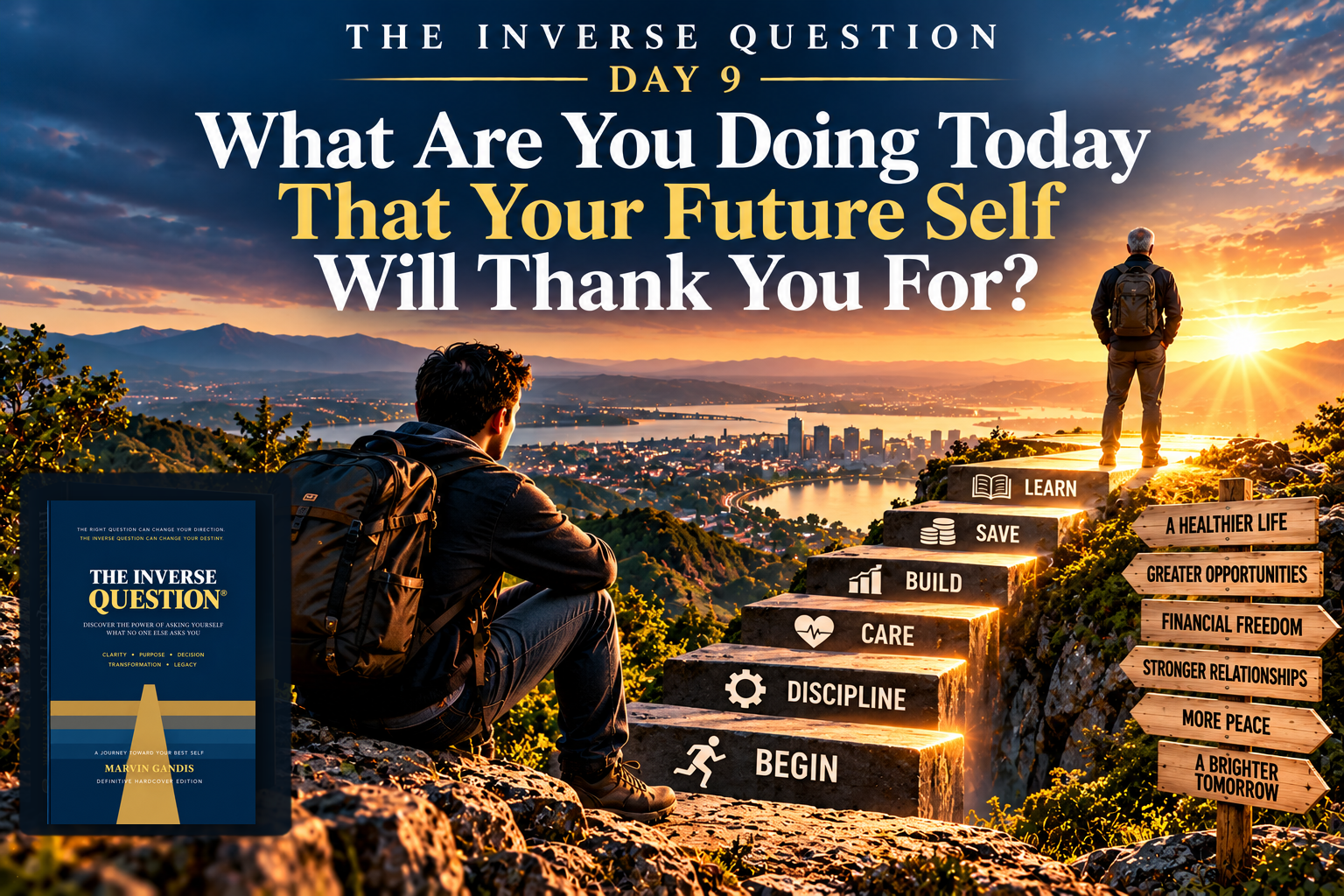
WHAT ARE YOU DOING TODAY THAT YOUR FUTURE SELF WILL THANK YOU FOR?

“Your future is not built in one dramatic moment. It is built through the decisions you repeat before anyone sees the result.”
— Marvin Gandis

We often think about the future as something waiting for us.

A destination.

A season that will eventually arrive.

A better year.

A stronger financial position.

A healthier body.

A more peaceful life.

A completed project.

A successful business.

A deeper relationship.

But the future is not only something we enter.

It is something we build.

And much of that construction happens quietly.

Through ordinary decisions.

Through habits nobody notices.

Through sacrifices that do not receive applause.

Through preparation that seems small today but becomes valuable tomorrow.

That is why Day 9 of The Inverse Question asks:

What are you doing today that your future self will thank you for?


YOUR FUTURE SELF IS LIVING WITH TODAY’S DECISIONS

Every day creates consequences.

Some immediate.

Some delayed.

You spend today.

Your future finances respond.

You exercise today.

Your future health responds.

You learn today.

Your future opportunities respond.

You avoid a problem today.

Your future circumstances may become harder.

You build discipline today.

Your future choices may become easier.

The future may feel distant.

But it is already being shaped.


THE FUTURE RARELY SENDS A WARNING IN ADVANCE

Most long-term consequences do not feel urgent at the beginning.

One skipped workout does not feel serious.

One unnecessary purchase does not feel dangerous.

One postponed project does not feel costly.

One ignored conversation does not seem devastating.

One hour wasted does not appear important.

But repetition changes scale.

What feels small today can become significant later.

That is why the question is not only:

  • “What happens if I do this once?”

It is:

“What happens if this becomes my pattern?”


✦ THE INVERSE QUESTION ✦

For Day 9, ask yourself:

If your future self could speak to you today, what would they ask you to begin, continue, or stop?

Would they ask you to save more?

Learn something?

Take care of your health?

Finish the project?

Spend more time with someone you love?

Stop delaying?

Take a risk?

Set a boundary?

Leave a harmful habit?

Begin creating something meaningful?

What would tomorrow’s version of you wish today’s version had taken seriously?

That question can change priorities quickly.


FUTURE GRATITUDE IS OFTEN BUILT THROUGH PRESENT DISCOMFORT

Many of the choices our future selves appreciate are not the easiest ones today.

Saving instead of spending.

Exercising instead of remaining comfortable.

Studying instead of scrolling.

Having the difficult conversation.

Saying no.

Starting before feeling ready.

Practicing when nobody is watching.

Choosing discipline over impulse.

Present discomfort can become future freedom.

Present convenience can become future cost.

That does not mean every difficult choice is automatically good.

But many meaningful choices require some immediate sacrifice.


MONEY IS ONE OF THE CLEAREST EXAMPLES

Imagine two versions of yourself.

One says:

  • “I will start saving later.”

The other begins today, even with a small amount.

One ignores financial education.

The other starts learning.

One spends every increase in income.

The other creates margin.

Years later, the difference may be dramatic.

Not because one decision was enormous.

But because time multiplied the pattern.

Your future finances often depend less on one perfect decision and more on repeated behavior.


THE SAME IS TRUE OF HEALTH

Health rarely changes because of one meal.

One walk.

One night of sleep.

One workout.

But habits accumulate.

The body keeps a record.

So ask:

What am I doing today that my future body will either thank me for or struggle because of?

Again, the goal is not perfection.

It is direction.


FUTURE YOU WILL REMEMBER WHAT PRESENT YOU KEEPS POSTPONING

There are projects we delay because they feel difficult.

Writing the book.

Starting the business.

Learning the skill.

Updating the résumé.

Creating the website.

Building the savings plan.

Making the appointment.

Repairing the relationship.

The longer we delay, the more emotional weight the task often gains.

Sometimes the best gift you can give your future self is simply:

Begin.

Not finish.

Begin.


DISCIPLINE IS A FORM OF RESPECT FOR YOUR FUTURE

Discipline is often described as restriction.

But it can also be understood as protection.

You protect future time.

Future money.

Future health.

Future opportunities.

Future peace.

When you make a disciplined choice, you are often saying:

  • “What happens later matters enough to influence what I choose now.”

That is not punishment.

It is stewardship.


YOUR FUTURE SELF DOES NOT NEED YOUR PERFECTION

This matters.

You do not need to get everything right today.

You will make mistakes.

Plans will change.

Priorities will shift.

Unexpected events will happen.

The future does not require perfect preparation.

It requires useful preparation.

Small progress.

Better decisions.

Consistent adjustment.

Humility.

Learning.

You do not have to control tomorrow.

You can still prepare for it.


✦ THE MIRROR ✦

Complete these sentences:

One thing my future self would thank me for starting today is: __________

One habit my future self would thank me for continuing is: __________

One habit my future self would thank me for stopping is: __________

One financial decision that would help my future is: __________

One relationship that deserves more attention is: __________

One skill worth developing is: __________

One difficult conversation I should stop avoiding is: __________

Now ask:

What is one action I can take today that would make tomorrow easier, stronger, or more meaningful?

Make it specific.

Make it small enough to begin.


FUTURE PROGRESS IS OFTEN INVISIBLE AT FIRST

The first week of saving may not look impressive.

The first month of learning may feel slow.

The first workouts may not create dramatic change.

The first pages may not feel like a book.

The first customers may not feel like a business.

The early stage is often unimpressive.

That does not make it unimportant.

Beginnings are supposed to look small.


DO NOT UNDERESTIMATE COMPOUNDING

Compounding applies to more than money.

Knowledge compounds.

Relationships compound.

Reputation compounds.

Health habits compound.

Writing compounds.

Experience compounds.

Discipline compounds.

Small improvements repeated over time can become difficult to recognize from day to day and impossible to ignore over years.

The reverse is also true.

Small neglect compounds too.

That is why today’s choices matter.


YOUR FUTURE SELF WILL THANK YOU FOR LEARNING BEFORE YOU NEED THE LESSON

There is enormous value in preparation.

Learn financial basics before a crisis.

Learn communication before conflict becomes severe.

Learn new skills before your current ones become obsolete.

Learn about health before symptoms force your attention.

Learn how to manage stress before burnout.

Preparation creates options.

Waiting until something becomes urgent reduces them.


BUILD MARGIN BEFORE YOU NEED IT

Margin means space.

Financial margin.

Time margin.

Emotional margin.

Energy margin.

When every resource is fully consumed, even small problems become emergencies.

Saving creates financial margin.

Planning creates time margin.

Rest creates energy margin.

Healthy boundaries create emotional margin.

Your future self may not remember every sacrifice used to create margin.

But they will appreciate having it when life becomes difficult.


SOME OF THE BEST FUTURE GIFTS ARE THINGS YOU REMOVE

We often think improvement means adding.

Another habit.

Another tool.

Another goal.

Another commitment.

But future gratitude may come from subtraction.

Removing debt.

Removing clutter.

Removing an unhealthy commitment.

Removing unnecessary expenses.

Removing distractions.

Removing repeated excuses.

Sometimes less creates a better future than more.


TAKE CARE OF RELATIONSHIPS BEFORE REGRET TEACHES THE LESSON

There are messages we assume we can send later.

Visits we postpone.

Thank-yous we delay.

Apologies we avoid.

Conversations we put off.

But time is uncertain.

One of the most important future questions may be:

If I lost the opportunity tomorrow, what would I wish I had said or done today?

That does not mean living anxiously.

It means valuing what matters while it is still available.


YOUR FUTURE SELF WILL THANK YOU FOR SAYING NO TO SOME THINGS

Every yes consumes something.

Time.

Money.

Attention.

Energy.

Opportunity.

If you say yes to everything, your priorities receive whatever remains.

A thoughtful no can protect an important yes.

No to distraction.

No to unnecessary debt.

No to commitments that do not fit.

No to pressure that violates your values.

No to patterns that consume your future.

Saying no can be an investment.


FUTURE YOU MAY CARE LESS ABOUT THINGS THAT FEEL URGENT TODAY

Think about worries from five years ago.

How many still matter?

Some undoubtedly do.

Many probably do not.

We give enormous emotional energy to things that eventually disappear.

The future can help provide perspective.

Ask:

Will this matter in five years?

If yes, give it appropriate attention.

If no, perhaps it does not deserve all of today’s peace.


DELAYED REWARDS REQUIRE TRUST

When you save money, you trust that future security matters.

When you study, you trust that future competence matters.

When you exercise, you trust that future health matters.

When you build something patiently, you trust that today’s unseen work has value.

Delayed rewards require belief in a future you cannot yet see.

That can be difficult.

But many worthwhile outcomes depend on it.


BUILD FOR THE PERSON YOU ARE BECOMING

Sometimes our current environment reflects who we were.

Old habits.

Old friendships.

Old routines.

Old expectations.

Old limits.

But growth requires us to ask:

What will the next version of me need?

Different skills?

Better habits?

Stronger boundaries?

A new environment?

More discipline?

A different network?

Greater courage?

Preparing for your future identity is part of becoming it.


YOU ARE ALWAYS LEAVING SOMETHING FOR YOUR FUTURE SELF

Every decision leaves a gift or a burden.

A saved dollar.

Or debt.

A strengthened relationship.

Or unresolved resentment.

A completed task.

Or unfinished pressure.

A healthy habit.

Or accumulated neglect.

You cannot eliminate every future difficulty.

But you can decide whether today’s behavior is helping or harming the person who will eventually have to live with it.


MY DEAR READER AND FRIEND

Imagine yourself five years from today.

Not as a fantasy.

As a real person.

Older.

More experienced.

Living with the consequences of thousands of decisions you are making now.

What would that person say?

Would they thank you for starting?

For stopping?

For saving?

For learning?

For protecting your health?

For taking the risk?

For staying patient?

For leaving something harmful?

For spending more time with people who mattered?

For finally believing that the future deserved preparation?

Listen carefully.

That future voice may already be telling you what matters.


WHAT ARE YOU DOING TODAY THAT YOUR FUTURE SELF WILL THANK YOU FOR?

You do not need to transform your entire life today.

Choose one thing.

One deposit.

One page.

One conversation.

One walk.

One boundary.

One hour of study.

One decision.

One beginning.

Then repeat it.

Because your future self is not waiting for one dramatic act.

They are waiting for the accumulated benefit of the choices you make while the future still feels far away.

So ask:

What can I do today that will make tomorrow stronger?

Then give your future self something worth thanking you for.

With gratitude,

Marvin Gandis
Author of La Pregunta Inversa and The Inverse Question


CONTINUE THE JOURNEY

This is Day 9 of The Inverse Question English series.

Day 1: Today Begins a New Chapter
Day 2: Why Did I Write The Inverse Question?
Day 3: The Question That Changed the Way I Think
Day 4: Maybe You Have Been Looking for Answers to the Wrong Question
Day 5: The Roots No One Sees Determine the Fruit Everyone Sees
Day 6: Not Everything That Looks Like Progress Is Moving You Forward
Day 7: What Are You Tolerating Today That Is Building the Future You Do Not Want?
Day 8: Do Not Confuse Movement With Direction
Day 9: What Are You Doing Today That Your Future Self Will Thank You For?

Next:

Day 10 — Who Are You Becoming Through the Choices You Repeat Every Day?

Because the most important result of your habits may not be what they produce.

It may be who they are turning you into.

DISCLAIMER

This article is provided for educational, informational, motivational, and personal-reflection purposes only. It does not constitute medical, psychological, mental-health, legal, financial, investment, business, career, relationship, or other professional advice.

The examples and principles discussed are general and may not apply equally to every individual or circumstance. Decisions involving finances, health, employment, relationships, or other significant matters should be evaluated according to your personal situation and, when appropriate, with guidance from qualified professionals.

No specific personal, professional, financial, investment, business, relationship, health, or life outcome is promised or guaranteed.

The Inverse Question series is intended to encourage reflection, preparation, responsible decision-making, learning, intentional living, and independent judgment.