⭐ ARTICLE 4
Introduction
Tools don’t make you successful — the right tools do.
Most beginners get stuck because they don’t know which tools to use, where to start, or how complicated everything needs to be.
Good news:
You only need a small, simple toolbox to begin creating powerful automations that businesses will pay for.
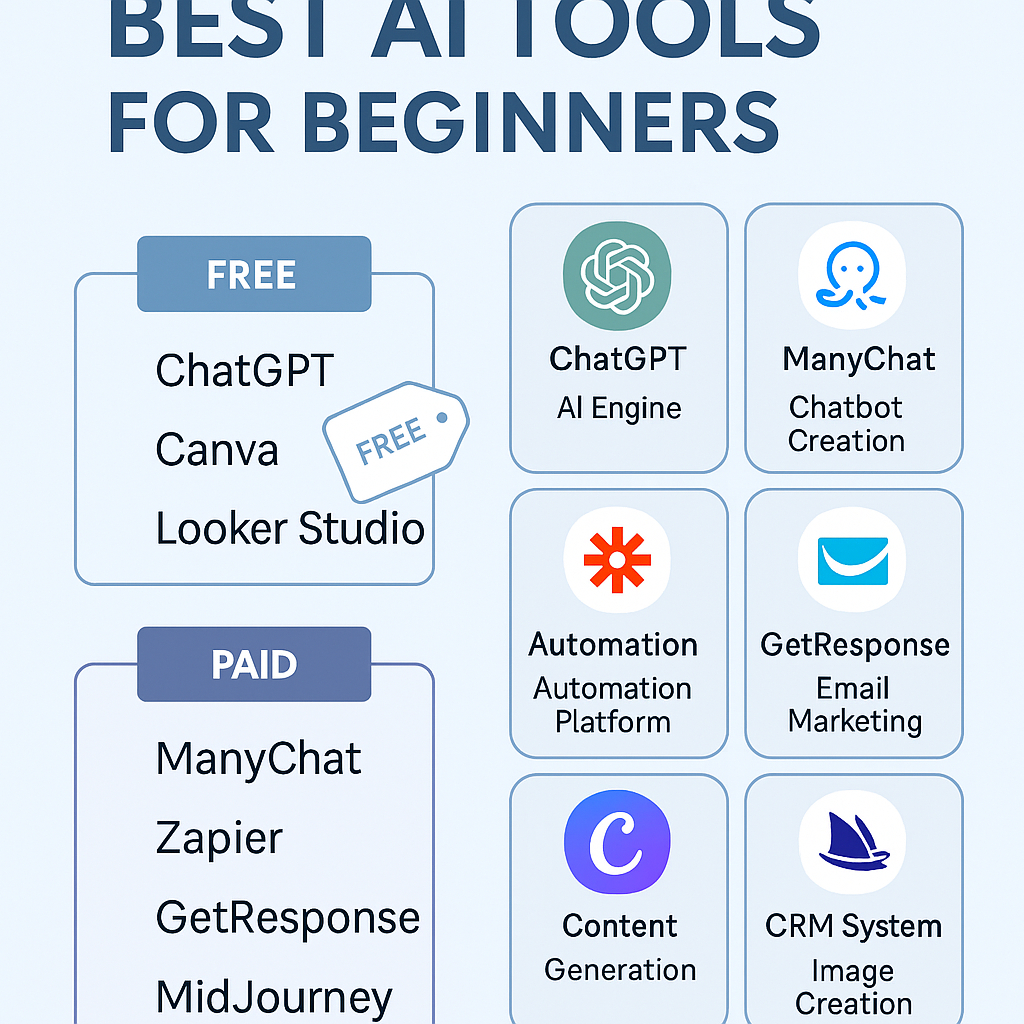
This article breaks down the essential AI tools—free and paid—that beginners can use to build chatbots, automate tasks, generate content, manage leads, and deliver profitable AI solutions.
Let’s simplify your path to $ 5,000–$ 7,000/month.
🤖 1. ChatGPT (OpenAI) — Your Main AI Engine
Why you need it:
ChatGPT is the core tool for:
- Writing content
- Creating automations
- Building chatbot workflows
- Crafting sales scripts
- Brainstorming client solutions
- Writing emails
- Interpreting data
Free or paid?
- The free version works for basic tasks
- Paid version offers faster, smarter responses and advanced features
How it helps your business:
It becomes your assistant, strategist, copywriter, researcher, and automation brain—24/7.
💬 2. Bot Builders (No Coding Required)
To build AI chatbots for businesses, use these simple builders:
Recommended tools:
- ManyChat — Great for Messenger, IG, WhatsApp
- Tidio — Perfect for websites
- Botpress — More advanced but powerful
- Chatbase — Train a bot on any document or website
What you can build:
- FAQ bots
- Lead capture bots
- Appointment bots
- Product recommendation bots
Why businesses love them:
Bots reduce support time and convert more leads.
⚙️ 3. Automation Platforms (Make & Zapier)
These tools let you automate tasks between apps:
Examples:
- New lead → send email
- Customer message → chatbot response
- Form submitted → add to CRM
- Appointment booked → send confirmation + reminder
Tools:
- Zapier (Beginner-friendly)
- Make (More advanced, cheaper, more powerful)
These are required to connect all your tools into a smooth, automated system.
📧 4. Email Marketing Tools (GetResponse, MailerLite, AWeber)
If you want to sell automated email sequences:
Tools:
- GetResponse (highly recommended)
- MailerLite
- AWeber
- ActiveCampaign
Use them for:
- Welcome sequences
- Lead nurturing
- Abandoned carts
- Promotions
- Follow-ups
Why it matters:
Email is still the highest ROI marketing channel.
🗂️ 5. CRM Systems (Client & Lead Management)
Businesses need better organization.
You can automate sales pipelines using:
- GoHighLevel (GHL)
- HubSpot (free)
- Pipedrive
What you can automate:
- Lead tracking
- Follow-ups
- Appointment reminders
- Sales workflows
A CRM is the backbone of sales automation.
🎨 6. AI Content & Design Tools
Perfect for social media, blogs, websites, and marketing.
Tools you can use:
- Canva (AI image generator + design editor)
- ChatGPT for text content
- MidJourney / DALL·E for images
- InVideo / Canva Video for video creation
What you can produce:
- Social posts
- Carousels
- Scripts
- Ads
- Thumbnails
- Flyers
- Short videos
This is one of the easiest services to sell.
🛒 7. E-Commerce AI Tools
Great for online stores.
Tools:
- Shopify AI
- AutoDS AI features
- Tidio AI
- ChatGPT product writing
Automations you can offer:
- Smart customer responses
- Product description generation
- Upsell suggestions
- Cart recovery messages
E-commerce is a goldmine for automation.
📊 8. Data Tools (Insights Without Being a Data Scientist)
You don’t need advanced math.
Tools:
- ChatGPT with data upload
- Google Sheets + AI add-ons
- Looker Studio
Use them to create:
- Performance reports
- Trends
- Business insights
- Recommendations
Businesses love data explained simply.
🚀 Conclusion
You don’t need 20 tools.
You need a small toolbox + consistent action.
The tools in this article give you everything you need to build:
- Chatbots
- Sales automations
- Marketing systems
- Content engines
- Analytics reports
This is how you start and scale your AI automation business quickly.
In the next article, we will guide you through building your first real automation step by step.
⚠️ Disclaimer :
This article is for educational purposes only. Tool performance and availability may change over time.
