By Marvin Gandis
Social media has transformed the way people communicate, learn, express opinions, and connect with the world. Today, one post can reach people from different countries, languages, religions, traditions, and ways of thinking within seconds. This has created powerful opportunities to connect cultures, share knowledge, and open global conversations.
However, it has also created a very visible challenge: cultural conflicts on social media.
Many of these conflicts do not always begin with bad intentions. They often come from a lack of context, different values, stereotypes, misunderstandings, or different ways of interpreting a message. What may seem like a joke to one person may feel offensive to another. What is normal in one culture may be considered disrespectful in another.
That is why understanding cultural conflicts is essential if we want to communicate better in the digital world.
What Are Cultural Conflicts on Social Media?
Cultural conflicts on social media are disagreements, tensions, or confrontations that arise when people from different cultural backgrounds interpret a message, image, comment, video, trend, or online behavior differently.
These conflicts can appear because of differences in:
Religious beliefs, family values, language, humor, politics, traditions, symbols, music, clothing, customs, identity, history, and social norms.
In other words, social media is like a giant global public square where millions of people speak at the same time, but not everyone shares the same cultural context.
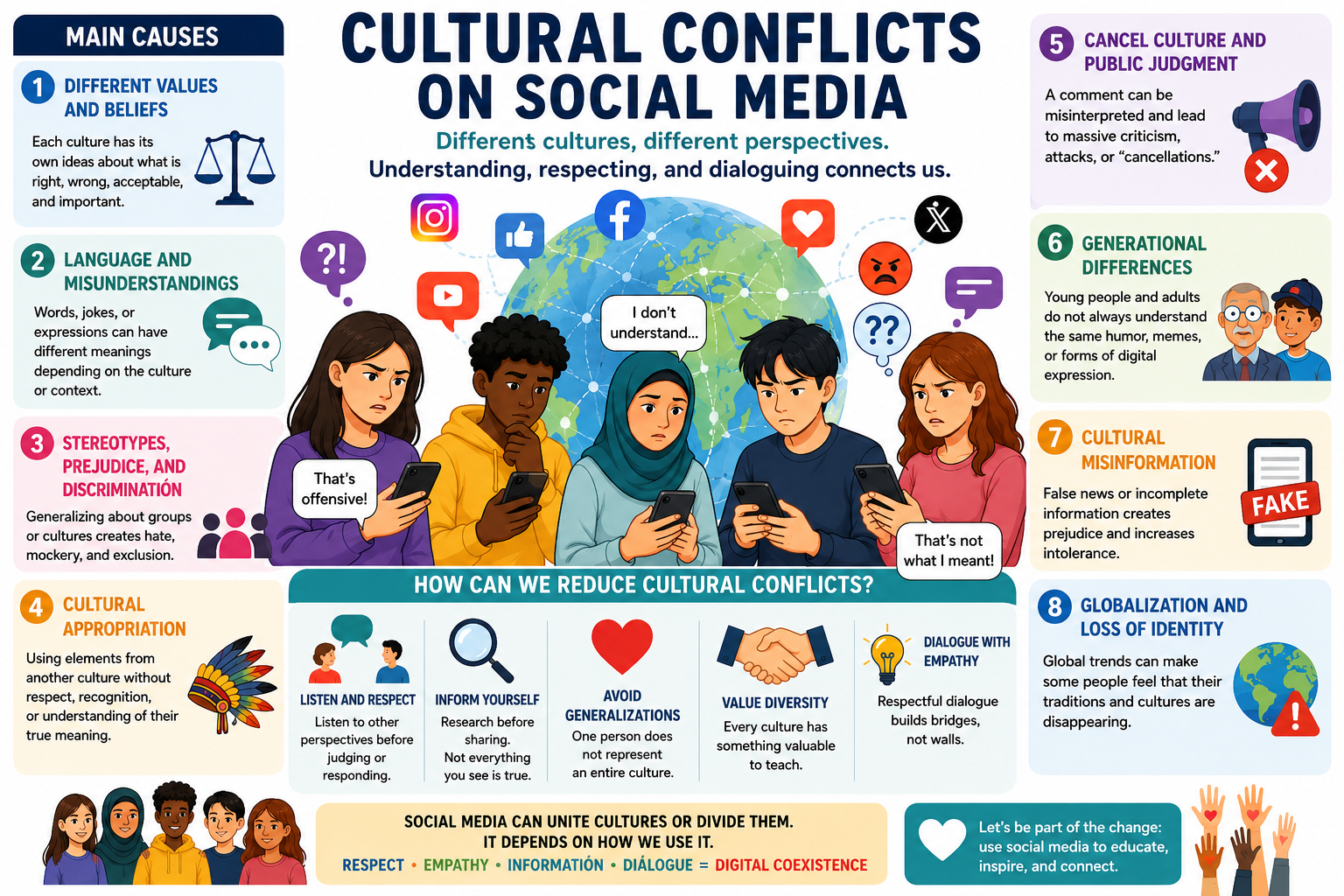
Differences in Values and Beliefs
One of the most common cultural conflicts on social media comes from different values. Topics such as religion, family, politics, freedom of speech, education, gender, and traditions can spark intense debate.
For example, an opinion that may be seen as normal in one society may be viewed as offensive, disrespectful, or even dangerous in another. This happens because every culture has its own way of understanding what is right, wrong, sacred, and acceptable.
The problem grows when people listen only to respond, attack, or win an argument instead of trying to understand.
Language and Misunderstandings
Language is one of the biggest sources of cultural conflict online. A word may have an innocent meaning in one country but be offensive in another. The same happens with jokes, sayings, memes, and popular expressions.
Automatic translations do not always capture tone, intention, or cultural context. This can create unnecessary confusion.
A sarcastic comment may seem aggressive. A direct sentence may appear disrespectful. An emoji may be interpreted differently depending on age, country, or culture.
On social media, it is not only about what is said, but also how it is understood.
Stereotypes, Prejudice, and Discrimination
Another serious conflict on social media is the spread of stereotypes. Many people make general comments about nationalities, races, religions, or cultures without truly understanding those communities.
Statements like “they are all the same,” “those people always do that,” or “that culture is backward” feed prejudice and division.
Social media can spread these messages quickly, creating racism, xenophobia, mockery, and personal attacks. When someone shares discriminatory content, even as a “joke,” it can cause real harm to entire communities.
Digital education must remind us that behind every profile there is a human being with a story, dignity, and culture.
Cultural Appropriation
Cultural appropriation happens when meaningful elements of a culture are used by people outside that culture without respect, understanding, or recognition of their true meaning.
This may include traditional clothing, hairstyles, religious symbols, music, dances, art, words, rituals, or celebrations.
Conflict appears when something that has historical, spiritual, or identity value for a community is used only as fashion, mockery, decoration, or commercial strategy.
Not every cultural exchange is negative. Learning from other cultures can be positive. The problem begins when there is no respect, credit, or sensitivity toward the origin of those cultural elements.
Cancel Culture and Public Judgment
On social media, one post can go viral very quickly. Sometimes a person says something without understanding the cultural impact of their words and receives a wave of criticism, insults, or public rejection.
This is often called “cancel culture.”
While it is important for people to take responsibility for offensive messages, it is also important to distinguish between a mistake, a lack of knowledge, and a real intention to harm.
Social media often reacts quickly, but not always fairly. Cultural conversations should seek correction, learning, and accountability — not only public destruction.
Generational Differences
Cultural conflicts do not only happen between countries. They also happen between generations.
Young people and adults often interpret memes, jokes, social movements, digital trends, and communication styles differently.
For one generation, a post may be funny. For another, it may seem immature, disrespectful, or dangerous. For some adults, certain youth expressions may seem offensive. For many young people, some traditional ideas may seem outdated.
This shows that culture also changes over time.
Misinformation About Cultures
Social media can also spread false or incomplete information about different cultures. An edited video, a fake story, or an unsupported opinion can create a distorted image of a country, religion, or community.
When people believe this information without checking it, prejudice becomes stronger.
Cultural misinformation can create fear, hatred, and division. That is why, before sharing content about a culture, it is important to ask:
- Is this information true?
- Do I understand the context?
- Am I sharing this to educate or to provoke?
- Could this reinforce a stereotype?
Globalization and Loss of Cultural Identity
Social media promotes global trends. Music, fashion, language, food, lifestyles, and ways of thinking are shared constantly. This can be positive because it connects the world, but it can also create concern.
Some communities feel that their traditions are being replaced by a dominant digital culture that is more commercial, fast-moving, and superficial.
When people begin to abandon their language, customs, or values only to fit into trends, they may feel a loss of identity.
The challenge is to participate in the digital world without forgetting cultural roots.
The Role of Algorithms in Cultural Conflicts
Social media algorithms often promote content that creates strong reactions. Many times, content that causes anger, controversy, or division gets more attention than educational or balanced content.
This can intensify cultural conflicts because people end up seeing posts that reinforce their own ideas and increase rejection toward other groups.
Instead of creating dialogue, social media can create bubbles where each person believes only their worldview is correct.
That is why it is important to follow diverse sources, listen to different perspectives, and not allow the algorithm to completely shape our way of thinking.
How Can We Reduce Cultural Conflicts on Social Media?
The solution is not to stop talking about cultural issues. The solution is to learn how to communicate with more respect, intelligence, and empathy.
Important practices include:
- Listen before attacking.
Many arguments could be avoided if people tried to understand before responding.
- Research before sharing.
Not everything online is true.
- Avoid generalizations.
One person does not represent an entire culture.
- Respect symbols and traditions from other cultures.
What looks like a simple decoration to one person may have a deep meaning for another community.
- Accept correction.
If someone explains that a comment was offensive, it is better to learn than to defend ourselves with pride.
- Promote educational conversations.
Social media can become a space for learning when used responsibly.
Conclusion
Cultural conflicts on social media are a reality of our time. We live in a world more connected than ever, but connection does not always mean understanding.
Social media can unite or divide. It can educate or confuse. It can promote respect or feed prejudice. Everything depends on how we use it.
Every user has a responsibility: think before posting, verify before sharing, and respect before judging.
Cultural diversity should not be seen as a threat. It should be seen as an opportunity to learn, grow, and build more human communication.
In a digital world full of voices, the real challenge is not to speak louder — it is to learn how to listen better.
Before you comment, share, or criticize on social media, take a moment to ask yourself:
Am I building dialogue or increasing conflict?
Social media needs more people who are willing to educate, respect, and listen. Start today by sharing content that unites, teaches, and helps others better understand cultural diversity.
Disclaimer
This article is for educational and informational purposes only. Its goal is to encourage reflection, respect, and cultural understanding in digital spaces. The opinions expressed do not replace professional, legal, psychological, or academic advice.
Debe estar conectado para enviar un comentario.