By Marvin Gandis
Music occupies an important place in the life of the church. Through music, we worship, teach, remember biblical truth, express gratitude, and proclaim our faith.
Yet many churches are facing an increasingly debated question:
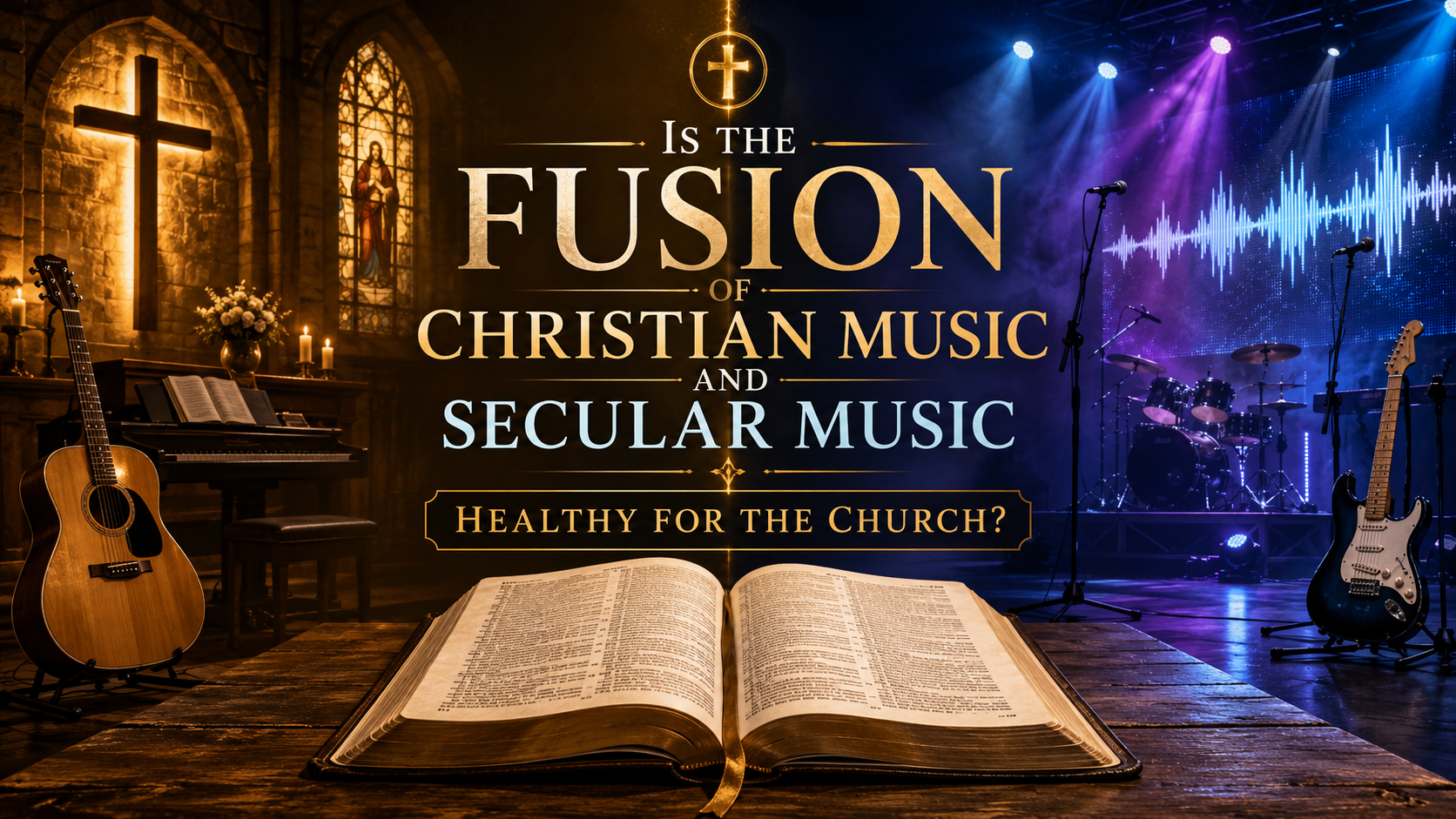
Is it healthy for the church to combine Christian music with styles, sounds, or elements associated with secular music?
Some believers believe certain rhythms, instruments, and styles should remain completely outside the church.
Others argue that a musical genre is not inherently righteous or sinful and that the most important issue is the message.
A biblical answer requires more than personal preference.
We must examine the lyrics, purpose, message, environment, intention of the heart, and spiritual effect of the music.
The question should not simply be:
“Does this sound Christian or secular?”
The deeper question is:
“Does this music glorify God, communicate biblical truth, and spiritually build up the church?”
Music has an important place in Scripture
Music appears throughout the Bible.
God’s people sang during moments of:
- worship,
- victory,
- celebration,
- sorrow,
- thanksgiving,
- prayer.
The Psalms provide one of the clearest examples.
David wrote:
“Sing unto the LORD a new song: sing unto the LORD, all the earth.”
— Psalm 96:1
Psalm 150 also describes numerous musical instruments being used in praise.
This reminds us that Scripture does not restrict worship to one musical instrument or one particular musical form.
The spiritual issue has never simply been the existence of an instrument, but what it is being used to communicate.
Is there really such a thing as a “Christian rhythm” and a “worldly rhythm”?
This requires careful thought.
The Bible does not provide a list of approved and forbidden rhythms.
Scripture does not say:
- this beat belongs to God,
- that beat belongs to the world,
- this tempo is holy,
- that percussion is sinful,
- this instrument is Christian,
- that instrument is worldly.
Modern genres such as:
- rock,
- jazz,
- salsa,
- pop,
- reggae,
- hip-hop,
- country,
- classical music,
- gospel
developed long after the biblical period.
Therefore, we should be careful not to transform our cultural preferences into divine commandments.
An instrument has no morality of its own.
A guitar can accompany worship or vulgarity.
A piano can accompany a powerful hymn or a morally destructive song.
A drum set can be used in secular entertainment or Christian worship.
The instrument itself does not automatically determine the spirituality of the message.
The real issue is the message carried by the music
Although sound alone does not necessarily determine whether something is holy or sinful, content matters deeply.
Proverbs 4:23 teaches:
“Keep thy heart with all diligence; for out of it are the issues of life.”
Music has an extraordinary ability to enter our memory and influence emotion.
Therefore, we should ask:
What ideas is this song planting in my mind and heart?
Many secular songs promote:
- promiscuity,
- infidelity,
- violence,
- drunkenness,
- drugs,
- pride,
- materialism,
- revenge,
- sensuality,
- hopelessness,
- the worship of money,
- glorification of self.
When a song celebrates what Scripture identifies as destructive or sinful, Christians should exercise discernment.
Christians should not embrace the world’s value system
First John 2:15 says:
“Love not the world, neither the things that are in the world.”
This does not necessarily mean Christians must reject every artistic expression created outside the church.
In this context, “the world” particularly refers to a value system opposed to God.
The danger appears when the church begins copying without discernment:
- sensuality,
- celebrity culture,
- materialism,
- fame,
- ego,
- entertainment,
- emotional manipulation.
The church may use cultural tools.
But it should never allow the culture of the world to define what Christian worship should become.
Transformation instead of conformity
Romans 12:2 declares:
“Be not conformed to this world: but be ye transformed by the renewing of your mind.”
This principle is essential.
The church can engage culture without becoming merely a religious copy of culture.
Churches may use:
- modern instruments,
- digital technology,
- audiovisual production,
- contemporary styles,
- online platforms,
- lighting,
- professional sound systems.
But these tools must remain servants of the gospel rather than masters of the church.
We should continually ask:
Are we using culture as a tool, or is culture reshaping our message?
Christian music should communicate truth
Colossians 3:16 gives an important standard:
“Let the word of Christ dwell in you richly in all wisdom; teaching and admonishing one another… in psalms and hymns and spiritual songs.”
Notice the relationship between:
the Word of Christ + teaching + admonition + singing.
Therefore, congregational music should not be evaluated only by musical quality.
We should also examine its theology.
Ask:
- Are the lyrics biblically accurate?
- Do they correctly present God?
- Do they correctly present Jesus Christ?
- Is the gospel reflected?
- Is biblical truth being taught?
- Could the lyrics create a false understanding of God?
A song can be emotionally powerful while being theologically weak.
Emotion must never replace truth.
The difference between worship and entertainment
This may be one of the greatest concerns facing modern churches.
Professional music can be excellent.
A church may have:
- talented musicians,
- excellent singers,
- strong production,
- sophisticated lighting,
- outstanding sound.
None of these things are automatically wrong.
The danger begins when the congregation changes from participants in worship into spectators watching a performance.
Congregational worship is not primarily about admiring singers.
It is about directing our attention toward God.
We should ask:
Is the platform revealing Christ or creating religious celebrities?
When the artist becomes more important than the message
John the Baptist expressed an important principle:
“He must increase, but I must decrease.”
— John 3:30
This should influence every music ministry.
The true worship leader does not seek to become the center.
The goal should be to point people toward God.
When singers depend heavily upon:
- applause,
- recognition,
- followers,
- fame,
- admiration,
- personal branding,
worship can slowly become self-promotion.
Talent can become ministry.
But talent can also become an idol.
Christian language does not automatically make a song biblically sound
Another common mistake is assuming that every song mentioning:
- God,
- Jesus,
- heaven,
- blessing,
- faith,
- victory
must automatically be spiritually healthy.
That is not necessarily true.
The entire message should be examined.
Some songs may focus heavily on:
- personal success,
- prosperity,
- self-esteem,
- feelings,
- material victories,
while barely speaking about:
- repentance,
- holiness,
- grace,
- sacrifice,
- obedience,
- the cross,
- resurrection,
- service.
Christian music should reflect the richness of biblical truth rather than only the parts people enjoy hearing.
Not all secular music is automatically immoral
We should also avoid the opposite extreme.
Not every secular song contains morally destructive content.
Some songs deal with:
- friendship,
- family,
- marital love,
- history,
- nature,
- work,
- loss,
- human experience,
- cultural memory.
Christians need discernment rather than simplistic labels.
Philippians 4:8 provides an excellent filter:
Whatever is true, honorable, just, pure, lovely, commendable, excellent, or worthy of praise—think about these things.
This principle can help guide our listening habits.
Can churches use popular musical styles?
Potentially, yes.
The fact that a musical style is also used outside the church does not automatically prohibit its use inside the church.
Many musical forms considered traditional today were innovative when they first appeared.
The more important question is:
Does the style serve the message, or is the message being compromised to serve the style?
The church does not need to fear creativity.
But creativity must remain under spiritual discernment.
The danger of imitating secular culture too closely
There is an important difference between using cultural elements and copying an entire culture.
When churches become desperate to resemble secular entertainment to attract crowds, another problem can develop:
the method begins changing the message.
If everything revolves around:
- spectacle,
- energy,
- experience,
- emotion,
- production,
- personality,
while Christ becomes secondary, something essential has been lost.
Jesus said:
“God is a Spirit: and they that worship him must worship him in spirit and in truth.”
— John 4:24
True worship needs both:
Spirit and truth.
Emotion is not the enemy of worship
Another error should be avoided.
Experiencing emotion during worship is not wrong.
Scripture contains:
- joy,
- tears,
- celebration,
- brokenness,
- gratitude,
- reverence.
The problem is not emotion itself.
The problem is when emotion is manufactured to replace spiritual truth.
A song can make us cry without necessarily bringing us closer to God.
A performance can create adrenaline without producing transformation.
Healthy worship includes emotion, but emotion should respond to truth.
The principle of edification
Paul gives an extremely useful principle in 1 Corinthians 10:23:
“All things are lawful for me, but all things are not expedient… all things edify not.”
This should influence church music decisions.
We should not merely ask:
“Is this forbidden?”
We should also ask:
“Is this beneficial?”
And even more importantly:
“Does this build up the church?”
Something may not be explicitly sinful while still being unwise for a particular congregation.
The principle of Christian testimony
The church must also consider the effect of its decisions upon others.
Romans 14 teaches extensively about using Christian freedom responsibly.
Therefore, ministry leaders should not only ask:
“Can we do this?”
They should also ask:
“What does this communicate to the congregation?”
Christian freedom should always walk together with love and wisdom.
Avoiding two dangerous extremes
This discussion often creates two opposite errors.
Extreme One: Musical Legalism
This occurs when believers insist that only one musical style, instrument, or historical tradition can please God.
Personal preferences can slowly become spiritual rules.
Extreme Two: Freedom Without Discernment
This occurs when people assume:
“As long as it mentions God, anything is acceptable.”
This can be equally dangerous.
Healthy Christian maturity requires:
biblical freedom + spiritual discernment.
Ten questions every church can ask about worship music
Before introducing a song into congregational worship, church leaders can ask:
1. Are the lyrics biblically accurate?
2. Is Christ central?
3. Does the song glorify God or primarily glorify human beings?
4. Can the congregation actually participate in singing it?
5. Does the song teach or reinforce spiritual truth?
6. Does its message align with Philippians 4:8?
7. Does the presentation serve the message or distract from it?
8. Does it spiritually build up the congregation?
9. Could it create unnecessary confusion or stumbling?
10. Can we sincerely do this for the glory of God?
The final test: God’s glory
First Corinthians 10:31 gives us perhaps the clearest principle:
“Whether therefore ye eat, or drink, or whatsoever ye do, do all to the glory of God.”
That includes music.
Before singing, producing, listening to, or introducing a musical style into church, we should ask:
Can God truly be glorified through this?
A traditional church can also lose its purpose
This point is important.
A church can:
- sing only hymns,
- reject drums,
- avoid contemporary music,
- use only piano and organ
and still experience spiritually empty worship.
Tradition alone does not guarantee spirituality.
Religious form can exist without spiritual life.
A contemporary church can still maintain reverence
Likewise, a church may use:
- drums,
- electric guitars,
- keyboards,
- bass,
- screens,
- modern technology,
- lighting
while maintaining a deep reverence for God.
An instrument does not automatically determine reverence.
Reverence comes from understanding who God is.
The heart remains the most important issue
Jesus repeatedly addressed the condition of the human heart.
We can produce technically perfect music while our hearts remain distant from God.
We can also sing a simple song with profound sincerity.
True worship begins within us.
Music is simply one of the tools through which that worship is expressed.
Conclusion
So, is the fusion of Christian music and secular music healthy for the church?
It can be, when we are speaking about musical elements, instruments, artistic forms, or styles being used carefully to communicate biblical truth.
But it can become spiritually dangerous when the church adopts not only cultural sounds but also:
- worldly values,
- sensuality,
- ego,
- celebrity worship,
- superficiality,
- entertainment as the highest priority,
- messages contrary to Scripture.
Therefore, the most important question is not simply:
“Is this rhythm secular?”
The better question is:
“What is this music producing spiritually?”
A healthy church does not need to fear creativity.
It needs discernment.
We should not worship tradition.
We should not worship modernity.
We should worship God.
And every musical expression used within the church should serve that purpose.
“Do all to the glory of God.”
— 1 Corinthians 10:31
Final Reflection
The greatest challenge is not deciding whether we should sing old music or new music.
The real challenge is making sure that regardless of the musical style, Christ remains at the center.
When talent becomes greater than the message, we have entertainment.
When emotion becomes greater than truth, we have an experience.
When the artist becomes greater than Christ, we have idolatry.
But when God’s Word, truth, the Spirit, and God’s glory remain at the center, we have worship.
Music may change from generation to generation.
God’s truth does not.
Disclaimer
This article has been prepared for educational, informational, and Christian reflection purposes. Its purpose is to present biblical principles that may help readers thoughtfully examine the use of music within the church and the relationship between Christian worship and musical expressions found in contemporary culture.
The content is not intended to replace pastoral, doctrinal, or denominational guidance from a local church, nor is it intended to establish a universal rule regarding musical genres, instruments, worship styles, or congregational practices.
The biblical interpretations presented are intended to encourage personal study of Scripture, prayer, and spiritual discernment. Readers are encouraged to examine each argument in light of the Bible and to responsibly consider the context of their congregation, their convictions, and the guidance of their spiritual leaders.
References to secular music, Christian music, entertainment, contemporary culture, or particular musical styles are used for general analysis and should not be understood as an automatic condemnation of specific artists, musicians, churches, denominations, or individuals.
This content seeks to encourage respectful discussion among believers who may hold different convictions regarding musical matters that are not always explicitly addressed in Scripture.
The purpose of this article is not to create division, but to encourage discernment, spiritual edification, and worship that seeks to glorify God in spirit and in truth.
Debe estar conectado para enviar un comentario.