Publicado en Christian Faith, Christian Living, Christian Motivation, Christian Reflections, Hope, Personal Growth, Prayer, Spiritual Growth

Bend Your Knees, Do Not Give Up

By Marvin Gandis

There are moments in life when moving forward feels almost impossible.

Moments when the exhaustion is not merely physical, but emotional and spiritual. Days when the mind is filled with questions, the heart feels wounded, and every remaining ounce of strength seems to disappear.

Perhaps you have worked, prayed, struggled, and waited, yet you still cannot see the answer you desperately need. You may have received unexpected news, experienced a painful loss, faced an illness, endured financial trouble, or watched a dream that once seemed close move farther away.

In those moments, giving up can appear to be the only way out.

But before you walk away, remember this:

Bending your knees is not the same as giving up.

Bending your knees means recognizing that you were never meant to carry everything alone. It means pausing before God, placing your pain in His hands, and allowing Him to restore the strength that life has slowly drained from you.

When you cannot continue in your own strength

Many people believe they must remain strong at all times.

They think crying is a sign of weakness, asking for help proves incompetence, or admitting exhaustion means they have lost the battle. True strength, however, is not pretending that nothing hurts.

True strength begins when we acknowledge our need for God.

The Bible is filled with men and women who experienced fear, sadness, uncertainty, and exhaustion. They were not people who never felt pain. They were people who chose to seek God while they were hurting.

King David cried, fled, feared for his life, and felt abandoned. The prophet Elijah became so exhausted that he wished to die. Job lost his possessions, his health, and members of his family. Jesus Himself bent His knees in the Garden of Gethsemane during an hour of overwhelming anguish.

Faith does not automatically remove pain.

Faith teaches us where to go when pain arrives.

“Call to Me, and I will answer you, and show you great and mighty things, which you do not know.”

Jeremiah 33:3

When your strength ends, the presence of God remains available.

Bending your knees is a position of trust

Kneeling before God is not a position of defeat. It is a position of trust.

It is saying:

“Lord, I do not understand what is happening, but I trust You.”

“Lord, I do not know how to solve this situation, but I know You can guide me.”

“Lord, I am afraid, but I do not want fear to control my life.”

“Lord, I am tired, but I still believe my story is not over.”

When you pray this way, your circumstances may not change immediately. Yet something begins to change within you.

Anxiety starts to loosen its grip.

Despair begins to lose its power.

Your heart regains perspective.

Your mind remembers that the problem may be great, but God is still greater.

Prayer does not always change a situation in an instant, but it can change the way you face that situation.

Jesus also bent His knees

In Gethsemane, Jesus knew that an extremely painful hour was approaching.

He did not pretend that He felt no anguish. He did not deny the weight of what was about to happen. He was honest before the Father.

“Father, if it is Your will, take this cup away from Me; nevertheless not My will, but Yours, be done.”

Luke 22:42

Jesus bent His knees, but He did not abandon His purpose.

He felt anguish, but He continued.

He experienced pain, but He did not turn back.

He prayed with deep sorrow, but He left the garden prepared to fulfill the mission before Him.

This teaches us a powerful truth:

You can feel weak and remain faithful.

You can cry and continue believing.

You can be afraid and continue walking.

You can need rest without abandoning your calling.

You can bend your knees without giving up.

Do not confuse exhaustion with the end

Some people quit not because they have lost their purpose, but because they are exhausted.

Exhaustion can make you believe that everything is over. It can convince you that your efforts have no value, your prayers are unheard, or you will never escape the situation you are facing.

But one difficult night does not define your entire life.

One failure does not determine your identity.

One closed door does not mean every opportunity has disappeared.

A delay is not always a denial.

One moment of weakness does not erase all the progress you have made.

Perhaps you do not need to quit. Perhaps you need to rest, reorganize, ask for help, change your strategy, and place yourself in God’s hands again.

The prophet Elijah believed he could not continue. Yet God did not immediately respond with a long rebuke. He first allowed Elijah to rest and provided food for him.

This reveals that God understands our limitations.

There are moments to move forward, moments to wait, and moments to recover. Resting does not mean abandoning your purpose. Pausing to breathe does not mean you are moving backward.

God hears prayers born from pain

Not every prayer contains polished words.

Some prayers are tears.

Others are sighs.

Some simply say:

“Lord, help me.”

“Lord, I cannot do this anymore.”

“Lord, stay with me.”

“Lord, give me enough strength to reach tomorrow.”

God does not require perfect speeches. He knows the heart before we speak a single word.

“The Lord is near to those who have a broken heart, and saves such as have a contrite spirit.”

Psalm 34:18

When you kneel with a broken heart, you are not speaking into emptiness. You are approaching a God who sees, hears, understands, and remains near.

Perhaps no one else knows the battle you are fighting. People may see your smile but know nothing about your sleepless nights. They may assume everything is fine because you continue fulfilling your responsibilities.

But God knows the entire truth.

He sees the tears you hide.

He knows the questions you are afraid to express.

He understands how difficult it has been for you to continue.

Even when you do not understand His process, His silence does not mean abandonment.

Rise after you pray

Bending your knees is important, but there also comes a time to rise.

Prayer should not become a permanent escape from reality. It should prepare us to face reality with renewed strength.

After praying, you may need to make a difficult phone call.

You may need to ask for forgiveness.

You may need to seek professional assistance, request guidance, reorganize your finances, care for your health, or step away from a destructive situation.

You may need to begin again.

Prayer and action are not enemies. Many times, God answers by giving us the wisdom to take the next step.

You do not need to solve your entire life today.

You only need to identify the next right step.

It may be small.

Getting out of bed.

Sending a message.

Completing one task.

Asking for help.

Reading one biblical promise.

Trying one more time.

Forgiving yourself for a mistake.

Deciding that today will not be the final chapter of your story.

Do not give up because of what you cannot yet see

A seed looks insignificant while it is buried beneath the soil. From the surface, it may appear that nothing is happening. Yet underneath, life is beginning to develop.

Many spiritual and personal processes work in the same way.

You cannot always see immediately what God is doing.

He may be strengthening your character.

He may be closing a door that would eventually have caused you pain.

He may be preparing you for greater responsibility.

He may be connecting you with people you have not yet met.

He may be teaching you patience, discernment, compassion, or deeper dependence upon Him.

This does not mean every form of suffering has a simple explanation. We should never minimize deep pain with shallow phrases.

But even in the middle of what we do not understand, we can trust that God does not waste our story.

He can transform wounds into wisdom.

He can turn loss into compassion.

He can use our falls to teach us to walk with greater humility.

He can make the testimony born from our battle a source of hope for someone else.

The answer may arrive differently than expected

Sometimes we expect God to answer in one specific way.

We ask Him to open a particular door, restore a certain relationship, immediately remove a hardship, or produce the exact result we desire.

However, God may respond differently from what we imagined.

He may not remove the storm immediately, but He may teach us how to navigate it.

He may not change the people around us, but He may give us wisdom to establish healthy boundaries.

He may not restore a lost opportunity, but He may open a better one.

He may not instantly remove the pain, but He may surround us with people who help us walk through it.

Mature faith is not merely believing that God will do exactly what we want. It is trusting His character even when His answer looks different.

You are not fighting alone

One of discouragement’s most dangerous lies is convincing you that no one can understand what you are going through.

But you do not have to walk alone.

God can use relatives, friends, spiritual leaders, counselors, doctors, support groups, and compassionate people as instruments of help.

Seeking support does not contradict faith.

Many times, the help we ask God to provide comes through another person.

Do not completely isolate yourself.

Speak with someone trustworthy.

Allow others to pray with you.

Accept the help you need.

Some burdens become lighter when another person walks beside us.

Perhaps today you can only kneel

Maybe you do not have the strength to celebrate today.

Perhaps you cannot speak about victory yet.

Maybe all you can do is kneel and cry.

Do it.

You do not have to pretend before God.

You can come with your doubts, frustrations, fears, and wounds.

But when you finish praying, remember this:

You are still here.

Another morning is still possible.

You can still receive help.

You can still learn.

You can still begin again.

A door you cannot currently see may still appear.

God can still write chapters you have never imagined.

Do not allow one difficult season to persuade you to destroy everything you have built.

Do not make permanent decisions based on temporary emotions.

Do not confuse a pause with the end.

Do not confuse bent knees with a defeated life.

A prayer for the person who is ready to give up

Lord:

Today I come before You with a tired heart.

You know the burdens I carry, the questions I have, and the tears I have cried in silence.

I acknowledge that I cannot face everything in my own strength.

That is why I bend my knees before You.

Not as a sign of defeat, but as a declaration of trust.

Give me peace to accept what I cannot control today.

Give me wisdom to change what remains within my responsibility.

Give me discernment to recognize the next step.

Give me courage to ask for help when I need it.

Heal the wounds that still affect my heart.

Strengthen my faith when the answers appear delayed.

Remind me that my value is not determined by my failures, losses, or current circumstances.

Help me rest without abandoning my purpose.

Help me cry without losing hope.

Help me wait without refusing to move forward.

When I rise again, allow me to do so with humility, courage, and renewed confidence in You.

Do not allow me to give up before I see what You can still accomplish through my life.

In the name of Jesus.

Amen.

Final reflection

Perhaps you have reached the end of your strength.

Maybe you no longer know what to say, what to do, or how to continue.

Then bend your knees.

Cry when you need to cry.

Speak honestly with God.

Release what you cannot control.

Receive rest.

Seek help.

Then, when the moment arrives, rise again.

Not because everything has been resolved.

Not because the pain has disappeared.

But because hope remains.

Because God is still with you.

Because your story is not finished.

Because a person kneeling before God is not defeated.

That person is being strengthened to walk again.

Bend your knees, but do not give up.


Disclaimer

This article is intended for educational, reflective, and Christian inspirational purposes only. Its content is not intended to replace pastoral, medical, psychological, legal, financial, or other professional guidance that an individual may need based on their specific circumstances.

The biblical references and reflections included are presented to offer encouragement, hope, and spiritual support. Every reader should carefully evaluate their situation and seek appropriate help when facing health concerns, emotional crises, family difficulties, abuse, thoughts of self-harm, or any other condition requiring immediate or specialized attention.

Seeking professional support does not contradict faith. In many situations, God’s help may come through doctors, counselors, spiritual leaders, relatives, friends, and other responsible resources.

The author and website do not guarantee specific results from reading or applying this content. Each person remains responsible for their own decisions, actions, and well-being.

© Marvin Gandis. All rights reserved.
Publicado en Christian Reflections, Faith and Hope, Family and Caregiving, Health and Wellness, Inner Healing, Prayer and Comfort, Spiritual Motivation

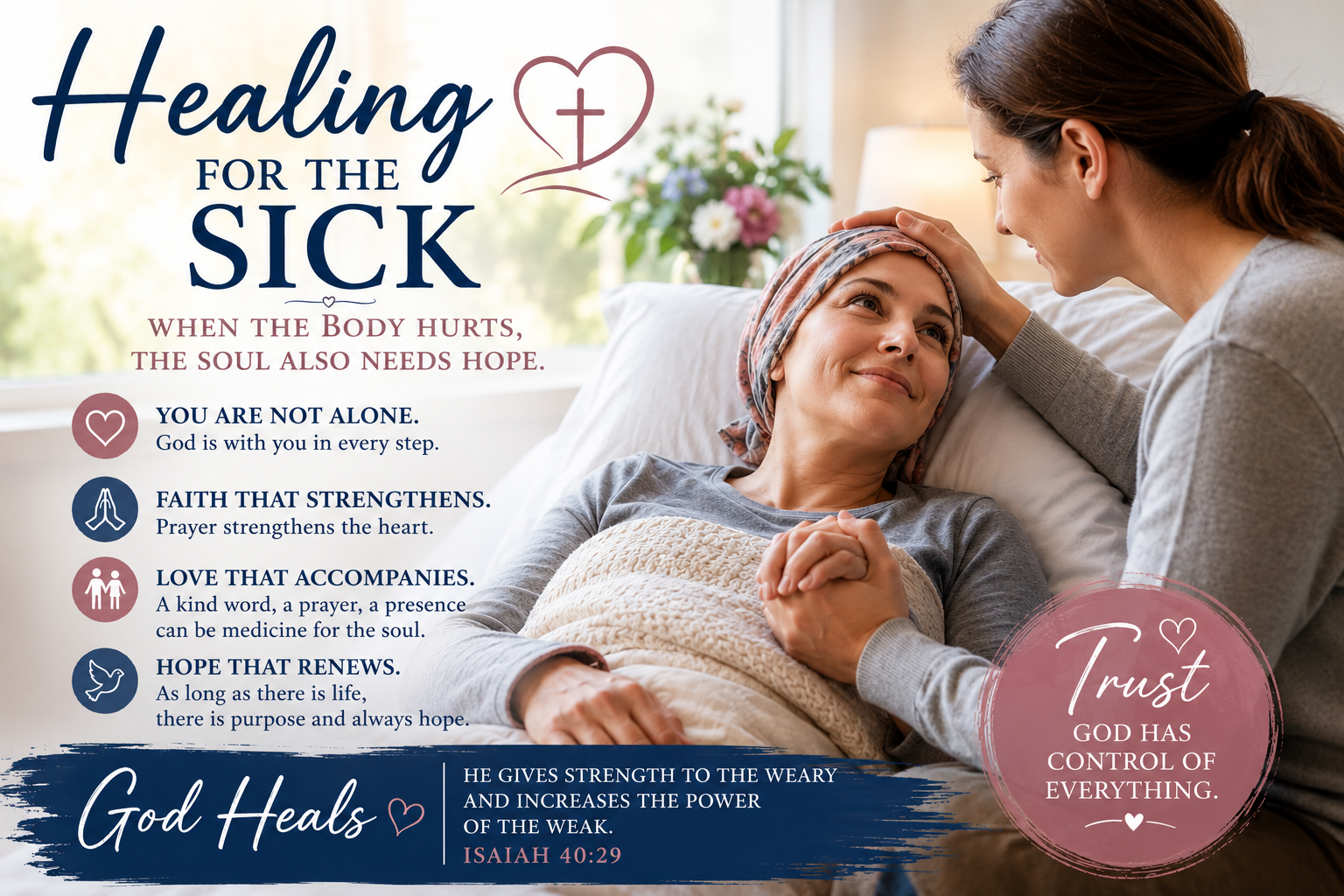
Healing for the Sick

When the Body Hurts, the Soul Also Needs Hope

By Marvin Gandis

Illness is one of those realities no one wants to face, yet sooner or later, it can knock on the door of any family. Sometimes it arrives suddenly, without warning, changing plans from one day to the next. Other times it appears slowly and silently, wearing down the body, the spirit, and inner peace.

When a person becomes sick, the body is not the only thing that suffers. The soul can also hurt. Fear may appear. Uncertainty may grow. Emotional exhaustion may become heavy. There may be concern for the family, anxiety about medical results, sadness over not being able to do what was once normal, and the deep question of why all of this is happening.

That is why speaking about healing for the sick should not be limited only to physical recovery. True healing also touches the mind, the heart, faith, family, hope, and the way a person faces the process.

This message is written with respect, sensitivity, and love. It is not intended to replace medical attention, treatments, or professional guidance. On the contrary, it recognizes that doctors, nurses, therapists, medications, and responsible care are valuable tools. But it also recognizes something very important: human beings do not only need treatment for the body; they also need comfort for the soul.


Illness Does Not Define Your Worth

A sick person may feel weak, limited, dependent, or even like a burden to others. They may look at their current condition and feel they are no longer the same person, that they have lost strength, usefulness, or independence.

But illness does not erase anyone’s dignity.

Your worth does not depend on how many things you can do today. It does not depend on how much energy you have, how many responsibilities you can fulfill, or whether you need help walking, eating, resting, or getting out of bed.

Your worth remains.

There are days when simply getting out of bed is a victory. There are days when breathing calmly is already an act of courage. There are days when smiling, even while the body hurts, reveals a strength many people never see. There are days when praying in silence, enduring a little longer, or continuing to hope is already a deep expression of faith.

Not every victory makes noise. Some of the greatest battles are fought in silence, far from applause, inside a room, in a bed, in a waiting room, during a long night, or in a broken prayer.

To you who are sick: you are no less because you are going through a difficult time. You are not useless because you need support. You are not weak because you cry. You are human. And within your humanity, there is still beauty, purpose, and hope.


When the Body Hurts, the Soul Must Also Be Cared For

Many times, we think healing means only that an illness disappears. And of course, we all desire restored bodies, relieved pain, favorable diagnoses, and complete recoveries.

But there is also a deeper healing, one that begins within.

Some people begin to experience peace even before receiving a final medical answer. Some, in the middle of a difficult treatment, learn to value life more deeply. Others, after a health crisis, discover new priorities, new strength, and a more mature faith.

Healing of the soul does not always mean everything is solved immediately. Sometimes it means being able to rest while waiting. It means having calm, even without all the answers. It means not allowing fear to govern every thought.

  • The body needs care.
  • The mind needs rest.
  • The heart needs comfort.
  • The spirit needs hope.

Because when a person is sick, it is not enough to ask how their body is doing. We must also consider how their spirit is doing, how their faith is doing, how their heart is feeling, and whether they feel accompanied.


Faith Does Not Deny Pain; It Walks With It

In the middle of illness, difficult questions may arise:

  • Why is this happening to me?
  • How long will this last?
  • Will I get better?
  • Does God hear me?
  • Will my family be okay?
  • What will happen if things do not turn out the way I hope?

These questions should not bring guilt. They are human questions. Pain also speaks. Uncertainty also weighs heavily. True faith does not mean denying what we feel; it means learning to walk with hope even when the road is not easy.

  • Having faith does not mean pretending everything is fine.
  • Having faith does not mean smiling when the heart is broken.
  • Having faith does not mean ignoring the diagnosis or rejecting reality.

Having faith means believing that even in the middle of the trial, God is still present. It means trusting when we do not understand everything. It means resting when the soul is tired. It means saying, “Lord, I do not have control over everything, but I place my life in Your hands.”

Faith does not always remove the storm immediately, but it can give strength not to sink within it. It can give peace when the news is not easy. It can remind us that we are not alone, even when no one fully understands what we are living through.


A Word of Hope Can Be Medicine for the Soul

A word can lift or tear down. A visit, a call, a message, a prayer, or a silent presence can mean so much to someone who is sick.

Sometimes the sick person does not need long speeches. Sometimes they need to hear something simple but sincere:

  • “I am with you.”
  • “You are not alone.”
  • “I am praying for you.”
  • “Your life still has purpose.”
  • “We will take this one step at a time.”
  • “You do not have to solve everything today.”
  • “You can rest; you do not have to prove your strength all the time.”

Many times, sick people do not need explanations; they need companionship. They do not need pressure; they need patience. They do not need empty phrases; they need real love. They do not need someone to minimize their pain; they need someone to respect it.

Hope should not be a repeated phrase without sensitivity. Hope should be felt through actions: in a hand being held, in a meal prepared with love, in a timely phone call, in an honest prayer, in a compassionate look, and in a presence that does not disappear when the process becomes long.


Caring for the Sick Is Also a Form of Love

Caring for someone who is sick requires patience, sensitivity, and strength. It is not always easy. Family members and caregivers also get tired, feel fear, and need support.

Sometimes the caregiver suffers in silence. They worry, lose sleep, organize appointments, manage medications, accompany loved ones in hospitals, hear difficult news, encourage others while they themselves are exhausted, and try to be strong even when they are crying inside.

That is why care should be shared whenever possible. No one should have to carry alone the emotional, physical, and spiritual weight of a family illness.

Caring for the sick is not only about helping with practical needs. It also means looking at the person with respect, speaking with tenderness, allowing them to express their emotions, not treating them like a burden, and reminding them that they are still loved.

Love is shown in small details:

  • A glass of water.
  • A silent prayer.
  • A blanket was gently adjusted.
  • A simple meal.
  • A peaceful conversation.
  • A word of encouragement.
  • A hand on the shoulder.
  • A constant presence.

When a family unites around someone who is sick, the burden becomes easier to carry. Illness brings pain, but it can also awaken compassion, reconciliation, gratitude, and unity.


Do Not Confuse Tiredness With Defeat

During illness, there are good days and difficult days. There are moments when faith feels strong and others when the soul feels exhausted. That does not mean you have lost the battle. It means you are human.

  • Getting tired is not giving up.
  • Crying is not failing.
  • Asking for help is not a weakness.
  • Feeling afraid does not mean a lack of faith.

Some processes demand a lot from the body and the heart. That is why it is important to learn to live one day at a time.

You do not have to carry the entire future today. You do not have to answer every question tonight. You do not have to prove strength every minute. Allow yourself to rest. Allow yourself to receive help. Allow yourself to speak. Allow yourself to cry when necessary.

But do not allow hopelessness to have the final word.

Maybe progress is slow, but slow does not mean impossible. Maybe the road is hard, but hard does not mean finished. Maybe today you cannot see everything clearly, but there can still be light ahead.

  • Where there is life, there is purpose.
  • Where there is purpose, there is hope.
  • Where there is hope, there is still a reason to continue.

Peace Is Also Part of Healing

Many people think they will only have peace when everything is resolved. But there is a deeper peace: the peace that arrives even in the middle of uncertainty.

That kind of peace cannot always be explained. It is the calm that holds the heart when the mind is tired. It is the strength that allows someone to sleep even when there is a medical appointment tomorrow. It is the trust that says, “I do not have all the answers, but I am not abandoned.”

Constant worry drains us. Ongoing fear consumes us. Anxiety steals strength. That is why seeking peace is not ignoring reality; it is protecting the heart while going through the battle.

Healing for the sick includes that inner peace. Because the soul also needs to breathe. The heart also needs to rest. The mind also needs a refuge.

Sometimes healing also means to stop fighting internally with everything we cannot control and begin to rest in God, step by step, day by day.


For the One Who Is Sick Today

To you who are facing illness, I want to say something with respect and love:

  • Your life still has value.
  • Your story is not over.
  • Your pain does not define you.
  • Your weakness does not cancel your purpose.
  • Your process does not erase all the good within you.

Maybe today you feel tired. Maybe you have received difficult news. Maybe you have been waiting a long time for improvement. Maybe on the outside you say, “I am fine,” but inside you are fighting many emotions.

You do not have to pretend. You do not have to hide everything. You do not have to be strong in the way others expect. Just keep taking the next possible step.

  • Sometimes the next step will be a medical appointment.
  • Sometimes it will be following the treatment.
  • Sometimes it will be resting.
  • Sometimes it will be asking for help.
  • Sometimes it will be praying.
  • Sometimes it will simply be breathing and saying, “Today, I am still here.”

And that counts too.


For Family and Friends

If you have someone sick near you, do not underestimate the power of your presence. You will not always know what to say. You will not always have answers. But you can offer something very valuable: sincere companionship.

  • Do not minimize their pain.
  • Do not demand joy from them all the time.
  • Do not turn their process into a comparison.
  • Do not use phrases that make them feel guilty for being sad.

Listen. Accompany. Pray. Help in practical ways. Be patient. Be consistent.

Sometimes a sick person remembers more who was present than who had the perfect words.

  • Compassion also heals.
  • Patience also heals.
  • Love also heals.
  • Presence also heals.

Prayer for the Sick

Beloved Lord,

Today we present before You all who are sick, all who feel pain, exhaustion, fear, sadness, or uncertainty.

We ask You to bring comfort to their hearts and strength to their bodies. May Your peace reach every room, hospital, home, and place where someone is suffering in silence.

Guide the doctors, nurses, family members, and caregivers who are helping in the process. Give them wisdom, sensitivity, patience, and strength.

Lord, may no sick person feel forgotten. In the silence, may they feel Your presence. In the pain, may they find rest. In weakness, may they discover new strength.

Bring healing according to Your will. Bring relief where there is suffering, encouragement where there is sadness, clarity where there is confusion, and light where there is fear.

Help every sick person live one day at a time. Help every family remain united. Help every tired heart believe again that there is still hope.

Amen.


Final Reflection

Healing for the sick is not just a beautiful phrase. It is a deep human need. It is the desire to see bodies restored, hearts strengthened, families united, and souls filled with peace.

Illness can touch the body, but it does not have to destroy hope. It can change plans, but it does not have to erase purpose. It can bring tears, but it can also reveal love, faith, patience, and inner strength.

To you who are sick: do not lose faith. Your life is still valuable. Your story is not over. Even if today you feel tired, there is still hope for tomorrow.

To you who care for someone who is sick: your love matters. Your patience matters. Your presence can be medicine for the soul.

And to everyone going through a difficult process, remember this:

  • As long as there is life, there is still purpose.
  • As long as there is faith, there is still strength.
  • As long as there is love, there is still companionship.
  • And as long as there is hope, healing is still possible.

Disclaimer

This content is intended for reflective, spiritual, educational, and motivational purposes only. It is not intended to replace the advice, diagnosis, treatment, or care of a doctor, healthcare professional, therapist, psychologist, counselor, or licensed specialist.

If you or a loved one is facing illness, persistent pain, serious symptoms, anxiety, depression, a medical emergency, or any health condition, please seek professional care immediately.

Faith, prayer, hope, and emotional support can be an important source of strength, but they should accompany —not replace— responsible medical care, recommended treatments, and guidance from qualified professionals.

Every person and every health condition is different. Always consult your doctor or healthcare provider before making decisions related to treatments, medications, health changes, or personal care.