Publicado en Bible Teaching, Biblical Reflection, Christian Living, Christianity, Church and Community, Faith and Spirituality, Spiritual Growth

How Many Times a Year Should We Gather to Please God?

By Marvin Gandis

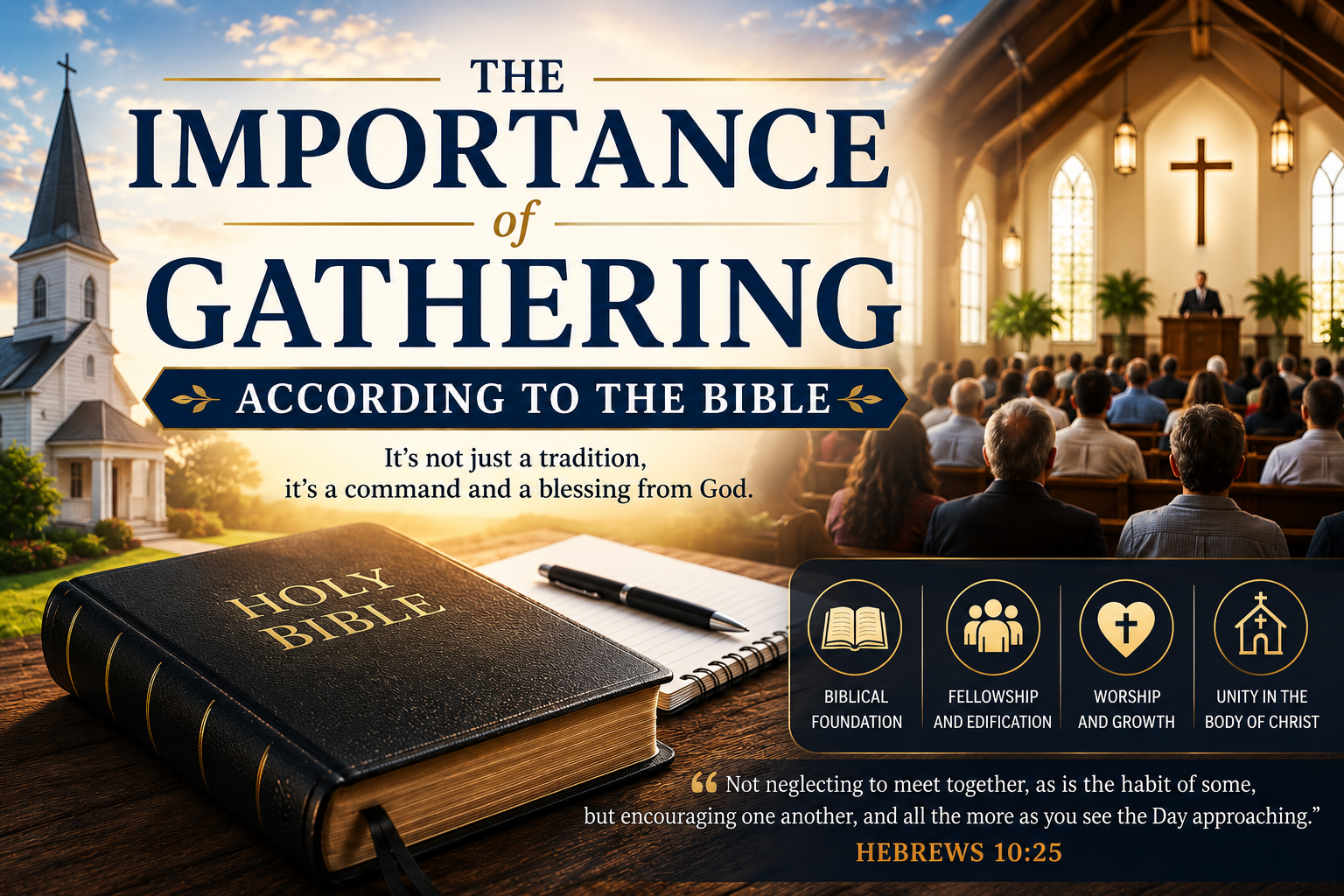
A very important question for every sincere believer is: How many times a year should I gather with other believers to please God?

Some may try to answer with a specific number. Others may say that gathering is not necessary because God is everywhere. However, when we search the Scriptures carefully, we discover that the issue is not only about a number. It is about the heart, obedience, fellowship, perseverance, and spiritual commitment.

God is not looking for empty religious attendance. He is looking for people who worship Him in spirit and truth, who do not abandon fellowship, who grow in faith, and who remain connected to the body of Christ.

In the Old Testament, There Were Appointed Gatherings

Under the Law of Moses, God gave specific instructions to the people of Israel. The men of Israel were commanded to appear before the Lord three times a year.

The Bible says:

“Three times in the year all your males shall appear before the Lord God.”
— Exodus 23:17

We also read:

“Three times a year all your males shall appear before the Lord your God in the place which He chooses: at the Feast of Unleavened Bread, at the Feast of Weeks, and at the Feast of Tabernacles.”
— Deuteronomy 16:16

These gatherings were connected to solemn feasts that were very important for Israel: the Feast of Unleavened Bread or Passover, the Feast of Weeks or Pentecost, and the Feast of Tabernacles.

This shows us that God has always valued His people gathering together to worship, remember His works, give thanks, and renew their spiritual commitment. However, these instructions belonged to the old covenant given to Israel.

In the New Testament, There Is No Exact Number

When we come to the New Testament, we do not find a commandment that says: “The Christian must gather a specific number of times per year.” There is no exact number, such as 10, 20, 40, or 52 times a year.

What we do find is a clear instruction:

“Not forsaking the assembling of ourselves together, as is the manner of some, but exhorting one another, and so much the more as you see the Day approaching.”
— Hebrews 10:25

This verse does not establish an annual number, but it does establish a serious spiritual principle: the believer should not make it a habit to abandon the gathering of the church.

The keyword here is not quantity, but consistency. It is not about attending merely to fulfill a human rule. It is about not living an isolated faith, disconnected from fellowship with other believers.

The Early Church Gathered Frequently

The first Christians understood that faith was not a lonely road. The Bible says:

“And they continued steadfastly in the apostles’ doctrine and fellowship, in the breaking of bread, and in prayers.”
— Acts 2:42

It also says:

“So continuing daily with one accord in the temple, and breaking bread from house to house, they ate their food with gladness and simplicity of heart.”
— Acts 2:46

The early church did not see gathering as a heavy obligation. They saw it as a spiritual necessity. They gathered to learn, pray, share, strengthen one another, and walk together in faith.

This teaches us that the Christian life should not be reduced to an occasional visit to church. Fellowship was a natural part of the disciples’ lives.

The First Day of the Week

We also see in the New Testament that believers gathered on the first day of the week.

The Bible says:

“Now on the first day of the week, when the disciples came together to break bread, Paul spoke to them…”
— Acts 20:7

And Paul wrote:

“On the first day of the week let each one of you lay something aside, storing up as he may prosper…”
— 1 Corinthians 16:2

For this reason, many Christian churches gather weekly, especially on Sundays. However, the main teaching is not simply to mark a day on the calendar. The teaching is to cultivate a life of worship, fellowship, and consistent obedience.

Gathering Is Not Just Going to a Building

It is important to understand that gathering does not simply mean entering a church building, sitting down, and leaving unchanged. Biblical gathering involves participating in the life of the body of Christ.

Paul wrote:

“Now you are the body of Christ, and members individually.”
— 1 Corinthians 12:27

The church is compared to a body. In a body, every member has a function, value, and purpose. A member separated from the body becomes weak. In the same way, a believer who isolates himself spiritually may become cold, discouraged, or distracted.

Gathering means worshiping together, listening to the Word, receiving direction, serving, praying for others, being lovingly corrected, encouraging others, and being encouraged.

God Looks at the Heart

We must also be careful not to fall into external religiosity. A person may gather many times a year and still have a heart far from God.

Jesus said:

“God is Spirit, and those who worship Him must worship in spirit and truth.”
— John 4:24

God is not impressed only by physical presence. God looks at the intention of the heart. Attendance should come from love, gratitude, obedience, and a sincere desire to grow in faith.

The question should not be: “What is the minimum I can do to please God?”
The deeper question should be: “Lord, how can I remain closer to You and to Your people?”

So, How Many Times a Year?

With the Bible in hand, the honest answer is this:

In the New Testament, there is no exact number of times per year that a believer must gather in order to please God.

In the Old Testament, Israel had appointed feasts three times a year. But in the New Testament, the teaching for the believer in Christ is to not forsake gathering, to continue in fellowship, and to live connected to the body of Christ.

A healthy and practical application would be to gather regularly, ideally every week if health, work, distance, and circumstances allow. But not as a religious burden. It should be an expression of love for God and spiritual need.

When There Are Difficult Circumstances

We must also be fair and compassionate. Some people are sick, elderly, without transportation, facing difficult work schedules, or dealing with complicated family situations. God knows every case.

The Bible should not be used to unfairly condemn those who have real limitations. But it should also not be used as an excuse to justify spiritual indifference.

If someone cannot gather physically, they should seek ways to stay connected: prayer, Bible study, phone calls, home meetings, online services, pastoral visits, or fellowship with other believers whenever possible.

The important thing is not to live disconnected from God or from the people of God.

Conclusion

The question should not only be: “How many times a year do I have to gather?”

The more important question is: “Am I remaining faithful, connected, obedient, and willing to grow in God?”

The Bible does not give an exact annual number under the New Testament, but it does give us a clear direction: do not abandon the gathering, continue in fellowship, stir one another up to love and good works, and worship God in spirit and truth.

Gathering does not save a person by itself. Salvation is by grace through faith in Jesus Christ. But a living faith desires fellowship, teaching, correction, worship, and service.

Therefore, to please God, do not look for the minimum. Seek a sincere, consistent, and obedient relationship with Him.

Final Reflection

It is not about fulfilling a number to look good before God.
It is about living a faith that does not isolate itself, grow cold, or drift away.

The believer who loves God also learns to love fellowship with the people of God.

Gathering is not merely a religious habit; it is an opportunity to strengthen the soul, serve with love, and walk in faith together with others.

If you have drifted away from gathering with other believers, do not see this as condemnation, but as an invitation.

Return to seeking God. Return to fellowship. Return to listening to His Word. Return to walking with brothers and sisters who can encourage you, correct you, and strengthen you.

God is not looking for perfect attendance; He is looking for a willing heart.

Draw near to God, remain firm, and do not walk alone.


Disclaimer

This article is a biblical and spiritual reflection based on Scripture passages about gathering, Christian fellowship, and the life of faith. It is not intended to impose a religious burden or replace pastoral guidance, personal Bible study, or the leading of the Holy Spirit. Each believer should examine their life before God with sincerity, while also considering personal circumstances such as health, work, distance, transportation, or family responsibilities. The purpose of this content is to encourage, guide, and strengthen a deeper relationship with God and with the body of Christ.

Publicado en Biblical Reflection, Christian Faith, Christian Living, Devotional, Holiness, Restoration, Spiritual Growth

Return to the Ancient Path: God’s Way Never Goes Out of Style

Por Marvin Gandis

A Call That Still Speaks

We live in a time when many people want a comfortable, modern, quick, and commitment-free Christianity. Many want a faith that does not challenge them, a truth that does not confront them, and a church that entertains more than it transforms.

But God is still calling His people with a clear voice:

“Return To The Ancient Path.”

The ancient path is not a dead religion. It is not an empty tradition. It is not simply looking back with nostalgia. The ancient path is returning to God’s eternal foundation: His Word, His presence, His holiness, His truth, and His purpose.

It is returning to the place where prayer mattered, sin was confronted, obedience was evidence of love, and the church was not a show but a living altar before the Lord.


1. What Does It Mean to Return to the Ancient Path?

To return to the ancient path means to return to God’s original design for our lives.

It means to stop walking according to the pattern of the world and start walking according to the will of the Father.

The ancient path represents:

  • Truth over opinion.
  • Obedience over convenience.
  • Holiness over popularity.
  • Prayer over noise.
  • Humility over pride.
  • God’s presence over entertainment.

This is not about religious appearance. It is about a surrendered heart, a renewed mind, and a life aligned with God.


2. The Problem of Our Generation: Too Much Noise, Too Little Altar

Today we have more information than ever, but less discernment.
More motivational messages, but less repentance.
More religious activity, but less intimacy with God.
More technology, but less prayer.
More spiritual appearance, but less inner transformation.

Many people want God’s blessings but not His authority.
They want promises but not process.
They want open doors but not instructions.
They want victory while still holding on to what enslaves them.

The ancient path reminds us that we cannot serve God our own way and expect heavenly results.

  • God did not call us to adjust His truth to our comfort.
  • He called us to surrender our lives to His truth.

3. The Ancient Path Is a Path of Repentance

One of the least preached but most needed messages today is repentance.

Repentance is not just feeling bad. It is changing direction. It is saying, “Lord, I drifted. I became comfortable. I became cold. I became distracted. But today I return to You.”

True repentance produces visible fruit. It changes how we speak, think, decide, treat others, and manage our lives.

Returning to the ancient path means saying:

  • “Lord, I do not want shallow faith.”
  • “I do not want to live by appearance.”
  • “I do not want to visit you only on Sundays.”
  • “I do not want to seek You only when I have problems.”
  • “I want to walk with You every day.”

That is the heart God restores.


4. The Ancient Path Is a Path of Holiness

Holiness is not human perfection; it is separation unto God.

To be holy does not mean thinking we are better than others. It means understanding that we were bought with a price and that our lives no longer belong to us.

The ancient path calls us to guard what we watch, what we hear, what we say, what we allow, and what we feed in secret.

Because many times the real issue is not what people see in us, but what we tolerate when no one is watching.

God is not looking for perfect Christians. He is looking for sincere, broken, and obedient hearts.

Holiness does not steal our freedom; it frees us from chains disguised as pleasure.


5. The Ancient Path Is a Path of Prayer

A church without prayer may have music, lights, programs, and events, but it loses spiritual power.

  • A family without prayer becomes vulnerable.
  • A leader without prayer becomes dangerous.
  • A believer without prayer becomes weak.
  • A heart without prayer grows cold.

Prayer is not a ritual; it is spiritual breathing.

When we return to the ancient path, we return to the secret place. We return to bowed knees. We return to crying out before God. We return to depending on the Holy Spirit and not only on our strategies.

Many people want apostolic results with a minimal devotional life. But the power of God is not manufactured. It is received in intimacy.


6. The Ancient Path Is a Path of Truth

God’s truth does not change because culture changes.

The world may redefine many things, but it cannot rewrite the Word of God. Truth does not need permission from public opinion to remain true.

Returning to the ancient path means loving the Word, studying it, obeying it, and defending it with humility and courage.

This is not about attacking people. It is about standing firm without negotiating what is eternal.

  • Compassion without truth becomes deception.
  • Truth without love becomes harshness.
  • But truth with love becomes medicine for the soul.

7. The Ancient Path Is Also True Love

Some people think that speaking about holiness, repentance, and truth is unloving. But true love does not allow someone to walk toward destruction without warning them.

  • Love is not applauding everything.
  • Love is not always staying silent.
  • Love is not weakening the message until it loses its power.

Jesus loved deeply, but He also confronted. He forgave, but He also said, “Go and sin no more.” He welcomed the broken, but He never celebrated the chains that were destroying them.

Returning to the ancient path means returning to that kind of love: love that embraces, restores, corrects, and transforms.


8. Signs You Need to Return

You may need to return to the ancient path if:

  • You have lost hunger for the Word.
  • You pray only when you are in crisis.
  • Correction bothers you more than sin.
  • You have a spiritual appearance but little intimacy with God.
  • Your heart has grown cold.
  • You became comfortable attending but stopped serving.
  • You know the truth, but are not living it.
  • You have replaced obedience with excuses.

The good news is that there is still grace. There is still mercy. There is still an open door to return.

God is not waiting to destroy you. He is calling you to restore you.


9. How to Return to the Ancient Path

Returning begins with a sincere decision.

  • First, recognize where you drifted. Do not justify it. Do not cover it. Bring it before God.
  • Second, return to the Word. Do not only search for messages that excite you. Search for the truth that transforms you.
  • Third, rebuild your altar of prayer. Even if you begin with a few minutes, do it sincerely.
  • Fourth, separate yourself from what weakens your spirit. Not everything that is allowed is beneficial.
  • Fifth, seek a healthy spiritual community. Surround yourself with people who draw you closer to God, not people who normalize your spiritual coldness.
  • Sixth, obey what God has already shown you. Sometimes we ask for new instructions when we have not obeyed the first ones.

10. The Promise of Returning

When God’s people return to Him, God restores.

  • He restores the heart.
  • He restores vision.
  • He restores peace.
  • He restores the family.
  • He restores purpose.
  • He restores spiritual fire.

But the return must be real. Not just an emotional moment, but a daily surrender.

The ancient path is not the most popular road, but it is the safest road. It may not always be the easiest, but it always leads to life.


Return Before It Is Too Late

The call is clear: return.

  • Return to the altar.
  • Return to prayer.
  • Return to the Word.
  • Return to obedience.
  • Return to holiness.
  • Return to your first love.
  • Return to the ancient path.

Do not wait until you hit rock bottom to return to God. Do not wait until a crisis wakes you up. Do not wait until you lose everything to value His presence.

Today is a good day to say:

“Lord, here I am. Forgive me. Restore me. Lead me again in Your way.”

The world can offer many roads, but only God’s way produces true life.


Pause today. Pray sincerely. Examine your heart and ask yourself:

Am I walking in God’s path, or only in a comfortable version of my faith?

Share this message with someone who needs to return to purpose, truth, and spiritual fire.


Disclaimer

This article is for educational, reflective, and spiritual purposes only. It is not intended to replace pastoral, psychological, medical, or professional counseling. Every reader is encouraged to seek God, study the Bible personally, and, when necessary, receive guidance from mature spiritual leaders and qualified professionals.