🌐 Prefer to Read This Article in Spanish?
You can also access the complete Spanish version of this article:
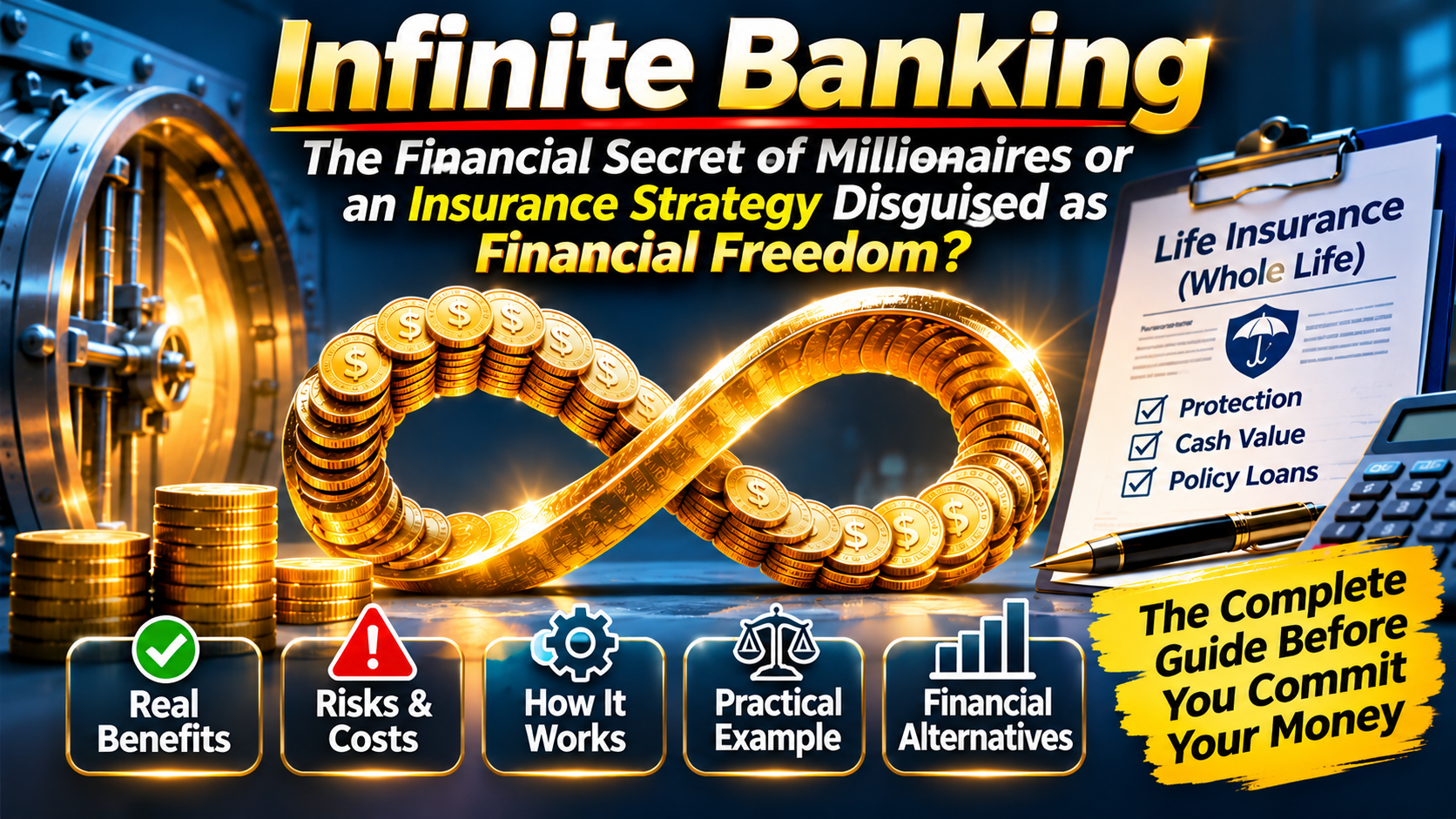
Discover what Infinite Banking really is, how it works, its advantages and disadvantages, and what you need to know before committing your money.
When the Benefits Are Advertised but the System Remains Hidden
Across social media, financial education seminars, and digital platforms, we increasingly hear about a financial strategy known as Infinite Banking.
Its promoters frequently use compelling statements:
- Become your own banker.
- Stop making traditional banks wealthy.
- Use the same money multiple times.
- Build generational wealth.
- Finance purchases without relying on traditional banks.
- Discover the financial secrets of millionaires.
However, when consumers attempt to understand exactly how the system works, they are often encouraged to schedule a private consultation, attend a seminar, or purchase financial training.
Why not explain the product’s mechanics from the beginning?
Whenever a financial opportunity extensively promotes its benefits but dedicates little attention to its costs, mechanisms, and risks, consumers have a responsibility to investigate before making a commitment.
True financial education is not about learning to believe in an opportunity. It is about developing the ability to evaluate it.
What Is Infinite Banking, Really?
The Infinite Banking Concept (IBC) is a financial strategy popularized by R. Nelson Nash through his book Becoming Your Own Banker.
Its foundation involves using a permanent life insurance policy, typically whole life insurance, specifically structured to accumulate cash value and provide access to policy loans.
Therefore, Infinite Banking is:
- Not a banking institution.
- Not a traditional savings account.
- Not a stock market investment.
- Not an unlimited source of money.
- Not a system of free financing.
It is a capital management and financing strategy built around a life insurance contract.
Understanding this distinction significantly changes how the opportunity should be evaluated.
The Financial Product Behind the Concept
Whole life insurance primarily combines two components:
Life insurance protection: Provides a death benefit to designated beneficiaries according to the terms of the policy.
Cash value: Accumulates economic value within the policy that may serve as collateral for borrowing.
Premiums support insurance coverage, administrative expenses, and other contractual costs. Cash value develops according to the policy’s provisions.
Some participating whole life policies may also distribute dividends. However, these dividends are not guaranteed.
Infinite Banking attempts to structure a policy to emphasize cash value accumulation without eliminating the underlying costs of life insurance.
How Does Infinite Banking Work?
Step One: Purchase a Life Insurance Policy
The individual applies for permanent life insurance through an insurance company.
Age, health, desired coverage, and other factors may affect eligibility and costs.
Step Two: Make Regular Contributions
The policyholder begins paying the required premiums and may make additional contributions when permitted.
These payments do not necessarily become immediately available cash value.
Step Three: Accumulate Cash Value
Over time, the insurance policy develops cash value that may serve as financial collateral.
During the early years, the accessible amount may be substantially lower than the total premiums paid.
Step Four: Request a Policy Loan
Once sufficient cash value has accumulated, the policyholder may request a loan.
The insurance company provides the borrowed funds, while the policy’s value serves as collateral.
Step Five: Use and Repay the Money
The borrowed funds may be used for vehicles, personal expenses, business opportunities, or other purposes.
The policyholder may repay the loan and its associated interest according to the contract.
This process can potentially be repeated as borrowing capacity becomes available.
A Practical Example: What Happens to Your Money?
Imagine someone decides to contribute $500 per month to a policy.
| Period | Total Contributions |
|---|---|
| 1 year | $6,000 |
| 3 years | $18,000 |
| 5 years | $30,000 |
| 10 years | $60,000 |
| 20 years | $120,000 |
Suppose that after five years, the policy has accumulated an accessible cash value of $23,000.
The policyholder needs $15,000 to purchase a vehicle and requests a policy loan.
| Financial Component | Amount |
|---|---|
| Total contributions | $30,000 |
| Cash value | $23,000 |
| Policy loan | $15,000 |
| Net policy value after initial debt | $8,000 |
| Hypothetical annual loan interest rate | 6% |
| First-year interest without repayment | $900 |
These figures are hypothetical and do not represent an actual insurance illustration.
Although the policy may continue accumulating cash value according to its contractual provisions, the outstanding loan also generates interest.
Having an asset and receiving borrowed money does not mean that wealth has doubled.
Borrowed money is not newly created wealth. It is a financial obligation.
Do You Really Become Your Own Banker?
The expression is appealing, but it must be understood correctly.
A policyholder may gain additional control over certain financing decisions. However, purchasing a life insurance policy does not legally make someone a banking institution.
The insurance company continues administering the contract, establishing lending conditions, and collecting loan interest.
When promoters claim that you can pay interest to yourself, an important question arises:
Who actually receives the interest?
Contractual loan interest is paid to the insurance company. Policyholders may benefit from cash value growth and potential dividends, but they do not automatically receive the interest they pay.
This distinction deserves as much attention as the promotional promises.
Can You Really Use the Same Money Twice?
Some Infinite Banking advocates suggest that individuals can continue growing their money while simultaneously using it to finance other activities.
Depending on the contract, cash value may continue accumulating while a policy loan remains outstanding.
However, loan interest continues accumulating as well, and outstanding debt reduces the policy’s net value.
Consider this hypothetical example:
- Cash value: $20,000.
- Assumed annual growth: 4%.
- Outstanding loan: $20,000.
- Annual loan interest rate: 6%.
Hypothetical annual growth would equal $800, while loan interest would amount to $1,200.
The resulting difference would be negative $400 before considering other factors.
This example assumes that the contract permits such a loan.
There is no automatic multiplication of money. There is a relationship between assets, liabilities, returns, and costs.
The Real Advantages of Infinite Banking
When properly structured and aligned with a consumer’s financial needs, the strategy may offer legitimate benefits:
- Financial protection for designated beneficiaries.
- Long-term cash value accumulation.
- Access to loans without conventional bank underwriting.
- Flexible repayment arrangements.
- Lower direct exposure to stock market volatility.
- Potential tax advantages.
- Potential usefulness in estate planning.
- An alternative source of financing.
These characteristics may appeal to individuals with stable income, sufficient savings capacity, and long-term financial protection needs.
However, no benefit should be evaluated independently of its cost.
The Disadvantages You Also Need to Understand
Initial Costs
Permanent life insurance may involve commissions, administrative expenses, and insurance costs that affect early cash value accumulation.
Limited Early Liquidity
Recovering the full amount of premiums paid may take considerable time.
Long-Term Financial Commitment
The policyholder must maintain sufficient financial resources to keep the policy in force.
Loan Interest
Accessing capital through a policy loan is not free.
Non-Guaranteed Dividends
Projected dividends may differ significantly from actual results.
Opportunity Cost
Money committed to a policy could otherwise be used for investing, reducing debt, developing a business, or maintaining liquid reserves.
Policy Lapse Risk
Excessive borrowing or an inability to maintain the policy may threaten insurance coverage and create financial or tax consequences.
Insurance Company Risk
Contractual guarantees depend on the insurance company’s ability to meet its obligations. Life insurance cash value is not protected by federal FDIC deposit insurance.
The Truth About the Alleged Tax Benefits
In the United States, qualifying life insurance policies may provide tax-deferred cash value accumulation.
Policy loans from qualifying non-MEC life insurance contracts generally do not create immediate taxable income while the policy remains in force.
However, this does not mean every transaction is tax-free.
Tax liabilities may arise when:
- A policy is surrendered or lapses with outstanding loans.
- Withdrawals exceed the applicable tax basis.
- A policy becomes a Modified Endowment Contract (MEC).
- Certain statutory requirements are not satisfied.
Modified Endowment Contracts may be subject to different tax treatment, including possible additional taxes on certain distributions.
Tax advantages depend on the contract, applicable legislation, and individual circumstances.
Consumers should obtain independent professional tax advice before purchasing life insurance primarily for tax-related purposes.
Why Do Some Promoters Avoid Revealing the System?
The concept of becoming your own banker may sound more appealing than purchasing a permanent life insurance policy.
A presentation centered on financial freedom, independence, and the alleged secrets of wealthy individuals can attract significant consumer interest.
There may also be commercial incentives associated with:
- Insurance policy sales.
- Agent commissions.
- Financial consulting services.
- Educational courses and seminars.
- Lead generation.
This does not mean every promoter is dishonest.
Many insurance professionals provide legitimate services and may recommend appropriate financial products.
Nevertheless, consumers deserve to know what they are purchasing, how much it costs, and who receives compensation for recommending it.
Transparency should not be a reward for attending a seminar. It should be the starting point of financial education.
Infinite Banking Compared With Other Financial Strategies
| Feature | Infinite Banking | High-Yield Savings | Diversified ETF |
|---|---|---|---|
| Life insurance protection | Yes | No | No |
| Initial liquidity | Limited | Generally high | Generally high |
| Initial costs | Potentially high | Generally low | Generally low |
| Direct stock market exposure | Low with whole life | None | Yes |
| Financial commitment | Long-term | Flexible | Flexible |
| Collateralized borrowing | Yes | Depends on institution | Depends on brokerage |
| FDIC protection | No | When eligible | No |
| Complexity | High | Low | Moderate |
There is no single financial instrument that is appropriate for everyone.
Financial decisions should reflect individual needs, objectives, time horizons, and available resources.
Can You Create Your Own Financing System Without Life Insurance?
Yes. Although it would not offer the same insurance protection or contractual features, individuals can create a dedicated fund to finance personal and business opportunities.
The process can begin with five practical actions:
- Establish an emergency fund.
- Make regular contributions to a dedicated capital account.
- Separate personal finances from business finances.
- Use accumulated capital for carefully evaluated opportunities.
- Replenish the money through a disciplined contribution plan.
For example, an individual contributing $500 per month could achieve the following hypothetical results after ten years:
| Assumed Annual Return | Approximate Accumulated Capital |
|---|---|
| 0% | $60,000 |
| 4% | $73,625 |
| 6% | $81,940 |
| 8% | $91,473 |
These illustrations assume end-of-month contributions, monthly compounding, and no withdrawals. They exclude taxes, fees, and inflation. Returns are not guaranteed.
This approach does not replace life insurance coverage, but it demonstrates that greater financial independence can also be pursued through simpler saving and investment strategies.
Twelve Questions to Ask Before Purchasing an Infinite Banking Policy
- Which insurance company backs the product?
- What type of life insurance am I purchasing?
- How much must I contribute each month?
- How much compensation will the insurance agent receive?
- How much cash will be available during the first year?
- When could my surrender value equal my total contributions?
- Which values are guaranteed and which are projected?
- What is the policy loan interest rate?
- Who receives the loan interest?
- What happens if I can no longer pay the premiums?
- What are the potential tax consequences?
- Can I receive an official insurance illustration and review the policy contract before making a decision?
Do not commit your money based solely on testimonials, promotional charts, or verbal promises.
Request written documentation and compare available alternatives.
Who Might Benefit From Infinite Banking?
Infinite Banking may be worth evaluating for individuals who:
- Have stable income and substantial financial surpluses.
- Need permanent life insurance protection.
- Have long-term estate planning objectives.
- Can maintain premiums without compromising essential expenses.
- Understand the financial costs and risks of borrowing.
Conversely, it may be less appropriate for individuals who need immediate income, carry expensive debt, lack emergency savings, or struggle to meet monthly expenses.
A financial strategy should never become a burden that threatens a family’s economic stability.
Warning Signs You Should Never Ignore
Be cautious of any financial presentation that:
- Promises guaranteed wealth.
- Claims that borrowing involves no costs.
- Conceals the identity of the insurance company.
- Presents projected returns as guaranteed.
- Claims every transaction is tax-free.
- Avoids discussing commissions.
- Pressures consumers into signing immediately.
- Dismisses all competing financial strategies.
A legitimate financial strategy should withstand difficult questions, independent comparisons, and detailed examination.
Wealth Begins With Knowledge, Not Secrets
Infinite Banking is not necessarily a scam. Neither is it a miraculous formula for achieving financial freedom.
It is a legitimate strategy based on permanent life insurance that may be useful for certain individuals under specific circumstances.
Problems arise when benefits are exaggerated, costs are minimized, and risks are concealed.
True financial independence begins when we understand how our money works, what it costs to use it, and which alternatives are available.
You do not need access to a secret reserved for millionaires.
You need education, discipline, planning, and the ability to question opportunities that appear too good to be true.
Before asking how much money you can make through a financial strategy, ask how much it will cost, what risks you will assume, and what will happen if things do not go as expected.
Financial knowledge should give you the freedom to make decisions, not create dependence on the person selling you a solution.
Share This Knowledge
If you found this information valuable, share it with friends, family members, and anyone interested in improving their financial education.
One informed decision may prevent years of financial difficulties.
Continue discovering educational resources, financial strategies, and business opportunities at Ir de Compras O.nline
Research Sources
- Nelson Nash Institute — What Is the Infinite Banking Concept?
- National Association of Insurance Commissioners — Life Insurance
- California Department of Insurance — Life Insurance Guide
- Internal Revenue Service — Publication 525
- Federal Deposit Insurance Corporation
- Investor.gov — Financial Education
- Nevada Division of Insurance
Disclaimer
This article is intended exclusively for educational and informational purposes. It does not constitute financial, investment, legal, tax, or insurance advice. All numerical examples are hypothetical and do not represent insurance quotations or guaranteed returns. Policy provisions and tax consequences may vary according to the contract and jurisdiction. Readers should consult qualified, independent professionals before making financial decisions.
